Have you ever wondered if to use phenomenon or phenomena in a sentence? These two words look and sound similar, but they have an important grammatical difference. Understanding when to use each one can help you write more clearly and avoid common English mistakes.
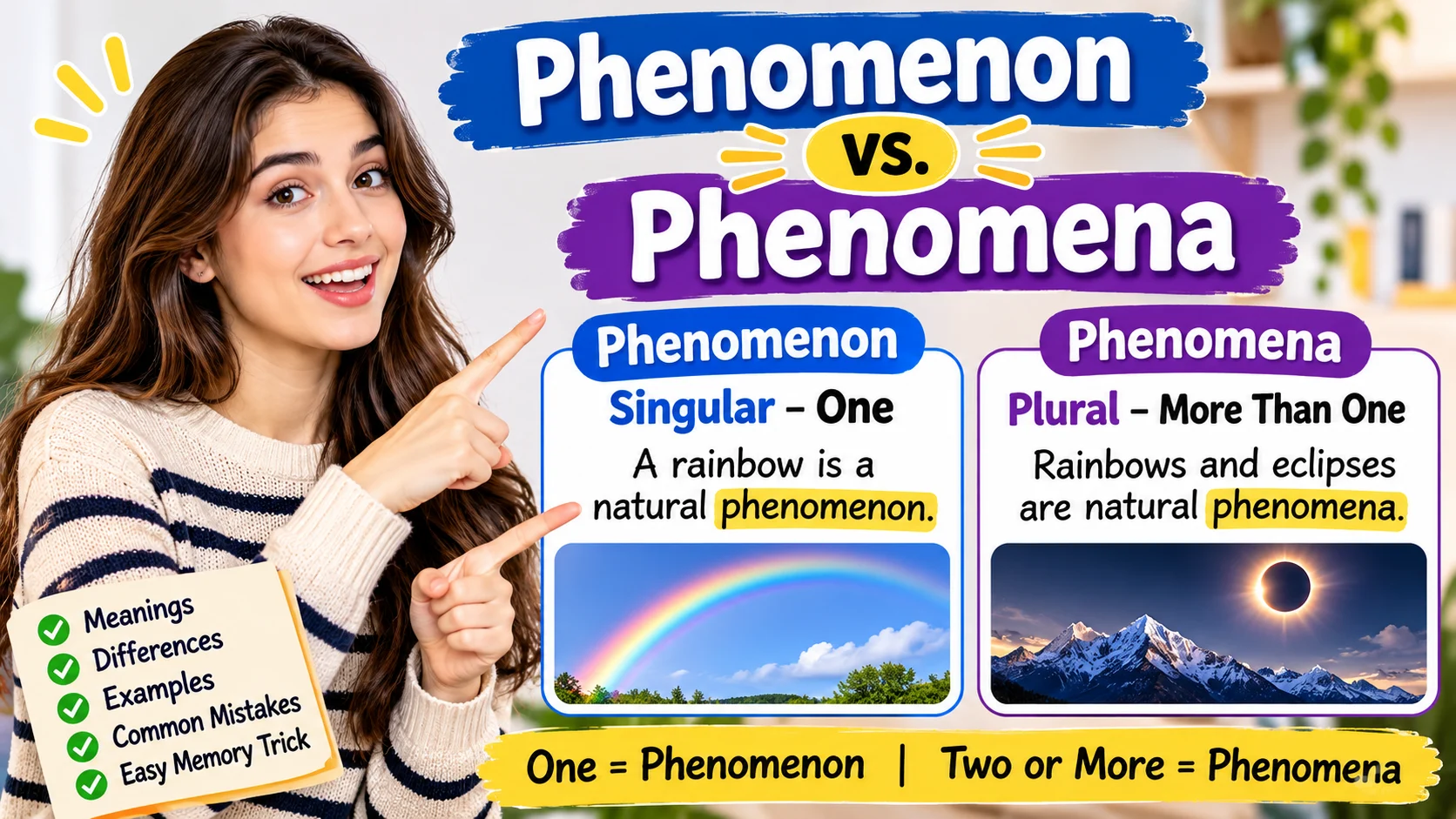
The main difference between phenomenon and phenomena is their number. Phenomenon is the singular form, meaning one observable event, occurrence, or situation. Phenomena is the plural form, referring to two or more events, occurrences, or situations. Both words are commonly used in science, education, everyday conversations, and academic writing. For example, you would say, “A rainbow is a natural phenomenon,” but “Rainbows are natural phenomena.” Although the distinction is simple, many English learners and even fluent speakers sometimes confuse these terms. In this guide, you will learn their meanings, grammatical differences, pronunciation, and correct usage through practical examples.
Quick Answer: Phenomenon vs. Phenomena
Phenomenon is a singular noun used for one observable event, fact, or occurrence. Phenomena is its plural form, used for multiple events or occurrences. For example, “A solar eclipse is a natural phenomenon,” while “Solar eclipses are natural phenomena.”
Why Do People Confuse Phenomenon and Phenomena?
People often confuse these words because they have almost identical meanings and share the same root.
The main source of confusion is their unusual singular and plural forms.
In English, most nouns form their plurals by adding “-s” or “-es.” However, phenomenon follows a different pattern because it comes from Greek.
Here is what makes them different:
- Phenomenon refers to one thing.
- Phenomena refers to more than one thing.
- Phenomenon is singular.
- Phenomena is plural.
For example:
- Correct: This phenomenon is interesting.
- Correct: These phenomena are interesting.
- Incorrect: These phenomenon are interesting.
Remember that the verb and other words in the sentence must also agree with the noun’s number.
1. Phenomenon: Meaning, Definition, and Usage
Phenomenon is a singular noun that describes something observable, noticeable, or experienced.
It can refer to a natural event, scientific occurrence, unusual situation, or remarkable fact.
In simple words, a phenomenon is something that happens or exists and can be observed or experienced.
Examples of Phenomenon
- A rainbow is a beautiful natural phenomenon.
- Scientists are studying this unusual phenomenon.
- The northern lights are a fascinating sight, but a single display can be described as a phenomenon.
- Social media has become a powerful cultural phenomenon.
- The sudden temperature change was an unexpected phenomenon.
How to Use Phenomenon in a Sentence
Use phenomenon when discussing one event, occurrence, or situation.
Common grammatical patterns include:
- A phenomenon
- This phenomenon
- That phenomenon
- An unusual phenomenon
- A natural phenomenon
Example: Climate change is a complex environmental phenomenon.
Here, phenomenon refers to one broad environmental process.
2. Phenomena: Meaning, Definition, and Usage
Phenomena is the plural form of phenomenon. It describes two or more observable events, occurrences, facts, or situations.
You use phenomena when discussing multiple things that can be observed, studied, or experienced.
In simple words, phenomena means more than one phenomenon.
Examples of Phenomena
- Scientists study natural phenomena.
- Weather phenomena can change quickly.
- The researchers examined several unusual phenomena.
- Optical phenomena include rainbows and mirages.
- Social phenomena influence human behavior.
How to Use Phenomena in a Sentence
Use phenomena when referring to multiple events or occurrences.
Common grammatical patterns include:
- These phenomena
- Those phenomena
- Several phenomena
- Many phenomena
- Different phenomena
- Natural phenomena
Example: Earthquakes, volcanic eruptions, and tsunamis are natural phenomena.
Here, phenomena refers to several different natural events.
3. Phenomenon vs. Phenomena: Comparison Table
The following table highlights the main differences between these two words.
| Feature | Phenomenon | Phenomena |
|---|---|---|
| Meaning | One observable event | Multiple observable events |
| Grammatical number | Singular | Plural |
| Word type | Noun | Noun |
| Origin | Greek | Greek |
| Article | A phenomenon | No indefinite article |
| Demonstratives | This / That | These / Those |
| Verb agreement | Is / Was | Are / Were |
| Example | A rare phenomenon | Rare phenomena |
Remember: Phenomenon means one, whereas phenomena means two or more.
4. When Should You Use Phenomenon or Phenomena?
Choosing the correct word depends on if you are discussing one occurrence or multiple occurrences.
Use Phenomenon When Talking About One Thing
Choose phenomenon when referring to a single observable event or situation.
Examples:
- This phenomenon is difficult to explain.
- A solar eclipse is a rare phenomenon.
- The scientist discovered an interesting phenomenon.
- This social phenomenon affects young people.
Use Phenomena When Talking About Multiple Things
Choose phenomena when discussing several observable events or situations.
Examples:
- Natural phenomena are fascinating.
- Scientists investigate different phenomena.
- These phenomena occur throughout the year.
- The study focuses on psychological phenomena.
A Simple Grammar Comparison
- One phenomenon is unusual.
- Two phenomena are unusual.
- This phenomenon occurs naturally.
- These phenomena occur naturally.
The number of events determines which word you should choose.
5. Phenomenon vs. Phenomena: 12 Examples in Sentences
Here are practical examples to help you understand the difference.
Examples Using Phenomenon
1. A rainbow is a natural phenomenon.
The sentence describes one observable natural occurrence.
2. Scientists are investigating this phenomenon.
This refers to one specific event or occurrence.
3. The popularity of online shopping is a modern phenomenon.
It describes one widespread social development.
4. Gravity is a fascinating physical phenomenon.
The word refers to one physical concept or occurrence.
5. The sudden increase in temperature was an unusual phenomenon.
It describes one unexpected event.
6. This phenomenon has attracted worldwide attention.
The sentence discusses one particular occurrence.
Examples Using Phenomena
7. Rainbows and eclipses are natural phenomena.
The sentence describes multiple natural occurrences.
8. Scientists study different weather phenomena.
It refers to several types of weather-related events.
9. These phenomena are difficult to understand.
The word refers to multiple occurrences.
10. Psychological phenomena influence human behavior.
It describes several psychological processes or events.
11. The researchers observed unusual optical phenomena.
The sentence discusses multiple visual occurrences.
12. Many social phenomena change over time.
It refers to several developments in society.
6. Common Mistakes When Using Phenomenon and Phenomena
Even though the difference is straightforward, some grammatical mistakes are common.
Here are the mistakes you should avoid.
Mistake 1: Using Phenomena for One Event
Incorrect: A rainbow is a natural phenomena.
Correct: A rainbow is a natural phenomenon.
Why? A rainbow is being discussed as one occurrence, so the singular noun is required.
Mistake 2: Using Phenomenon for Multiple Events
Incorrect: Earthquakes and floods are natural phenomenon.
Correct: Earthquakes and floods are natural phenomena.
Why? Two or more events require the plural form.
Mistake 3: Using the Wrong Verb
Incorrect: These phenomena is interesting.
Correct: These phenomena are interesting.
Why? Phenomena is plural, so it requires a plural verb.
Mistake 4: Using an Incorrect Article
Incorrect: A phenomena was observed.
Correct: A phenomenon was observed.
Why? The indefinite article “a” must be followed by a singular noun.
Mistake 5: Mixing Singular and Plural Demonstratives
Incorrect: This phenomena is unusual.
Correct: This phenomenon is unusual.
Alternatively:
These phenomena are unusual.
Why? “This” goes with singular nouns, while “these” goes with plural nouns.
7. Memory Trick: How to Remember the Difference
If you frequently forget which word is singular and which is plural, use this simple memory trick.
Phenomenon = One
Phenomena = More than one
You can also remember the ending:
- Phenomenon ends in “-on” and is singular.
- Phenomena ends in “-a” and is plural.
Think of the following examples:
- One phenomenon
- Two phenomena
- Three phenomena
- Several phenomena
Another helpful trick is to remember the word “criterion.”
- One criterion
- Multiple criteria
Both phenomenon/phenomena and criterion/criteria follow Greek-derived singular and plural patterns.
8. Phenomenon vs. Phenomena in American and British English
There is no difference between American and British English when it comes to the meanings or grammatical usage of these words.
Both varieties use:
- Phenomenon for one occurrence.
- Phenomena for multiple occurrences.
The spelling is also identical in American and British English.
| Usage | American English | British English |
|---|---|---|
| Singular | Phenomenon | Phenomenon |
| Plural | Phenomena | Phenomena |
| Meaning | One occurrence | One occurrence |
| Plural meaning | Multiple occurrences | Multiple occurrences |
Example in American English: Climate change is a global phenomenon.
Example in British English: Climate change is a global phenomenon.
Both sentences are grammatically correct.
9. Similar Words: Other Singular and Plural Forms
Phenomenon and phenomena are not the only words with unusual plural forms. English contains several nouns borrowed from Greek and Latin that follow similar patterns.
Here are some useful examples:
| Singular | Plural | Meaning |
|---|---|---|
| Phenomenon | Phenomena | Observable event |
| Criterion | Criteria | Standard or requirement |
| Analysis | Analyses | Detailed examination |
| Thesis | Theses | Research paper or argument |
| Crisis | Crises | Difficult situation |
| Basis | Bases | Foundation or starting point |
| Diagnosis | Diagnoses | Identification of a condition |
| Hypothesis | Hypotheses | Proposed explanation |
Learning these word pairs can improve your grammar and vocabulary.
10. Frequently Asked Questions (FAQs)
1. Is phenomenon singular or plural?
Phenomenon is singular. It refers to one observable event, occurrence, or situation. For example, “A solar eclipse is a natural phenomenon.”
2. Is phenomena singular or plural?
Phenomena is plural. It refers to two or more observable events or occurrences. For example, “Rainbows and eclipses are natural phenomena.”
3. What is the plural of phenomenon?
The plural of phenomenon is phenomena. It is an irregular plural form derived from Greek rather than a regular English plural ending in “-s.”
4. Can I use phenomena in everyday English?
Yes. Phenomena is appropriate in everyday conversations, academic writing, scientific discussions, and general explanations whenever you are referring to multiple occurrences.
5. Is it correct to say “a phenomena”?
No. “A phenomena” is grammatically incorrect because “a” requires a singular noun. The correct expression is “a phenomenon.”
6. Why does phenomenon become phenomena?
The word comes from Greek, where its plural form follows a different grammatical pattern. English has retained this traditional plural form, which is why phenomenon becomes phenomena instead of phenomenons in standard usage.
7. What is the difference between natural phenomenon and natural phenomena?
Natural phenomenon refers to one natural occurrence, such as a rainbow. Natural phenomena refers to multiple natural occurrences, such as rainbows, earthquakes, and volcanic eruptions.
8. Is phenomenons ever correct?
Phenomenons occasionally appears as a nonstandard or specialized plural, but phenomena is the established plural form in standard English. For formal, academic, and everyday writing, use phenomena.
Remember This: Phenomenon vs. Phenomena
Keep these simple rules in mind:
- Phenomenon = Singular: One observable event or occurrence.
- Phenomena = Plural: Two or more observable events or occurrences.
- Use “is” with phenomenon when the sentence requires a singular verb.
- Use “are” with phenomena when the sentence requires a plural verb.
- Use “a phenomenon,” never “a phenomena.”
The easiest way to remember the difference is that one phenomenon becomes multiple phenomena.
Conclusion
Understanding the difference between phenomenon and phenomena is easy once you remember their grammatical numbers. Phenomenon is the singular form used for one observable event, fact, or occurrence, while phenomena is the plural form used for multiple events or occurrences. Both words are useful in everyday communication, scientific discussions, and academic writing.
Whenever you are unsure which word to use, check if you are talking about one thing or several things. Use phenomenon for one and phenomena for more than one. With regular practice and attention to subject-verb agreement, you can use both words confidently and correctly.

I am Martin Joseph, a passionate writer who enjoys creating helpful, thoughtful, and engaging replies. I aim to make conversations easier by sharing practical responses for every situation.