The words tinder and tender look and sound somewhat similar, but they have completely different meanings. One is associated with fire, while the other can describe kindness, gentleness, affection, or something that is easily damaged. Understanding the difference between tinder and tender will help you avoid spelling mistakes and use both words correctly in everyday English.
Although these words differ by just one letter, confusing them can change the meaning of a sentence entirely. For example, dry tinder refers to material that catches fire easily, while a tender heart describes someone who is kind and compassionate. You may also encounter tender in business, cooking, healthcare, and legal contexts. In this guide, you will learn the definitions, pronunciation, grammatical uses, examples, and common mistakes associated with both words.
Quick Answer: What Is the Difference Between Tinder and Tender?
Tinder refers to dry, easily combustible material used to start a fire. Tender describes something soft, gentle, sensitive, or caring. It can also mean a formal offer or bid in business. Although the words look similar, they have different spellings, pronunciations, meanings, and uses.
Why Do People Confuse Tinder and Tender?
People often confuse these words because they share five letters and have similar spellings. Both contain six letters, begin with the letter T, and end with the letter R.
However, their middle letters and meanings are different:
- Tinder: Contains the letter I and relates to starting a fire.
- Tender: Contains the letter E and relates to softness, kindness, sensitivity, or an offer.
Another reason for confusion is that both words can appear in different contexts. While tinder is mainly a noun, tender can function as an adjective, noun, and verb.
What Does Tinder Mean?
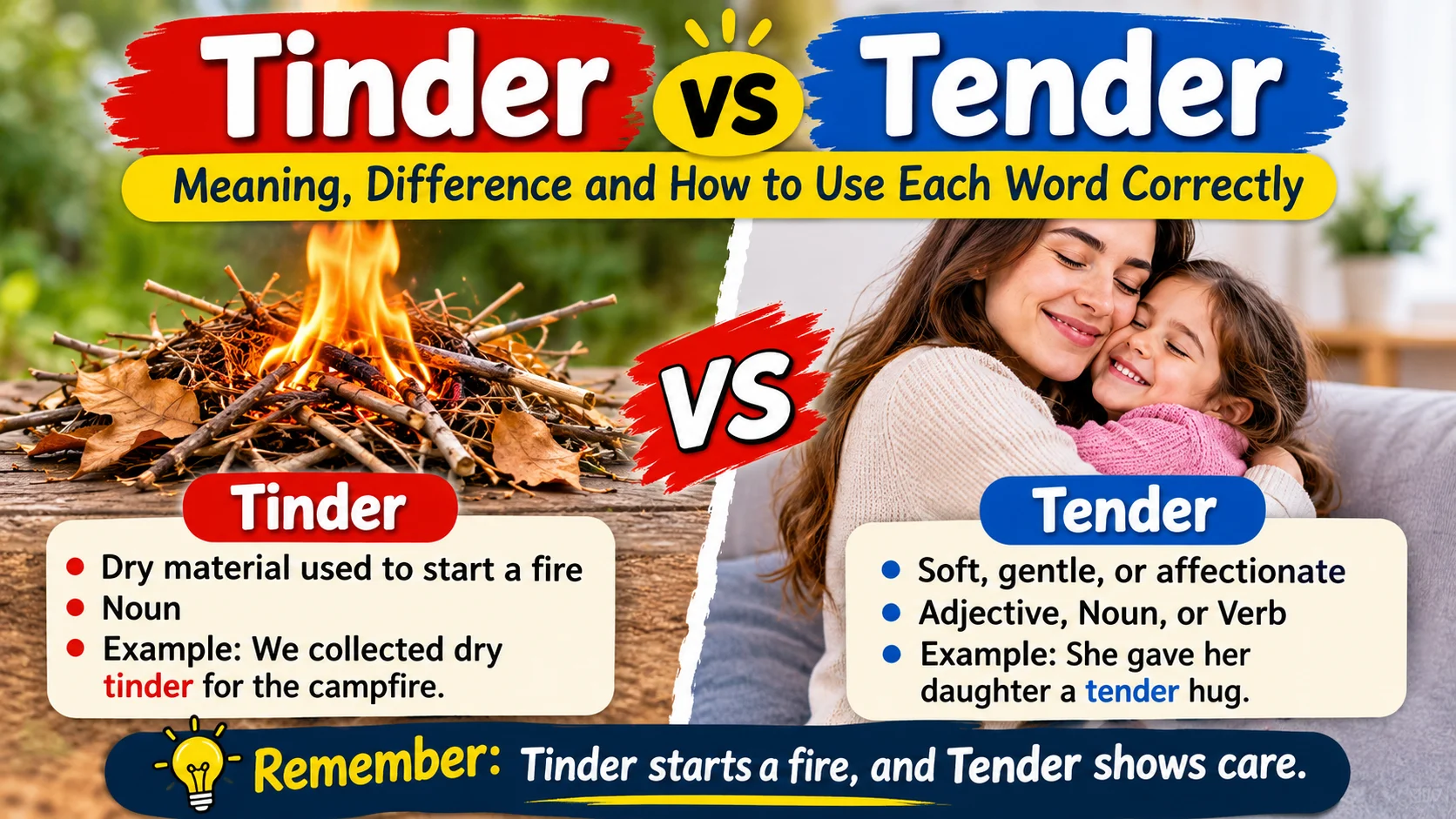
Tinder is a noun that refers to dry, easily ignited material used to start a fire.
It can include dry leaves, small twigs, grass, wood shavings, or other materials that catch fire quickly.
Tinder is especially useful when starting a campfire, lighting a fireplace, or building a traditional fire.
Examples of Tinder
- We collected dry tinder to start the campfire.
- The leaves provided excellent tinder for the fire.
- Always keep your tinder dry when camping.
- He used small pieces of bark as tinder.
Tinder in a Sentence
“The camper gathered some dry tinder before lighting the fire.”
In this sentence, tinder refers to the easily combustible material used to help start the fire.
Is Tinder a Noun or a Verb?
Tinder is primarily used as a noun in modern English. It names the material that helps a fire begin.
It is not commonly used as a verb in everyday conversation.
What Does Tender Mean?
Tender has several meanings depending on the context. It can describe something soft, gentle, sensitive, or affectionate. It can also refer to a formal offer or the act of formally offering something.
As an adjective, tender often describes feelings, physical conditions, food, or someone’s personality.
Examples of Tender
- She has a tender heart.
- The meat became tender after cooking.
- His injured shoulder was still tender.
- The mother gave her baby a tender hug.
Tender in a Sentence
“Her grandmother spoke to the child in a tender voice.”
Here, tender describes a gentle, loving, and caring manner of speaking.
Is Tender a Noun, Verb, or Adjective?
Tender can function in three grammatical roles:
1. Adjective: Describes something gentle, soft, or sensitive.
- Example: The chicken is tender.
2. Noun: Refers to a formal offer or bid.
- Example: The company submitted a tender for the project.
3. Verb: Means to formally offer or present something.
- Example: He decided to tender his resignation.
Tinder vs Tender: Comparison Table
| Feature | Tinder | Tender |
|---|---|---|
| Part of speech | Noun | Noun, verb, adjective |
| Main meaning | Fire-starting material | Soft, gentle, sensitive, or an offer |
| Pronunciation | TIN-der | TEN-der |
| First vowel | I | E |
| Common context | Camping and fire-making | Emotions, cooking, business |
| Example | Dry tinder | Tender feelings |
The easiest way to distinguish them is to remember that tinder helps start a fire, while tender often describes something gentle or soft.
When Should You Use Tinder or Tender?
Choosing the correct word depends on what you want to communicate.
When to Use Tinder
Use tinder when discussing:
- Materials used to start a fire.
- Dry leaves, grass, or small pieces of wood.
- Camping and outdoor activities.
- Fire-making techniques.
- Easily combustible natural materials.
Example: We need some dry tinder before lighting the fireplace.
When to Use Tender
Use tender when discussing:
- Kindness and affection.
- Gentle behavior or emotions.
- Soft or easily damaged objects.
- Sensitive or painful body parts.
- Soft, properly cooked meat.
- Formal business offers or bids.
- Officially presenting a resignation or document.
Example: He gave his daughter a tender smile.
15 Examples of Tinder and Tender in Sentences
Here are practical examples to help you understand how both words work in everyday English.
Examples Using Tinder
- We gathered dry tinder to start a fire.
- The forest floor was covered with leaves that could serve as tinder.
- Keep your tinder away from rain and moisture.
- The camper searched for suitable tinder near the campsite.
- Dry grass can be useful tinder when starting a fire.
- He placed the tinder beneath the small pieces of wood.
- Without dry tinder, starting the fire became difficult.
Examples Using Tender
- She has a tender heart and always helps others.
- The chicken was tender and delicious.
- His injured knee felt tender to the touch.
- The father gave his son a tender hug.
- The company submitted a tender for the construction project.
- She spoke in a soft and tender voice.
- The manager decided to tender his resignation.
- Their relationship was filled with tender moments.
These examples demonstrate that tinder belongs mainly to the context of fire, whereas tender has several meanings across everyday life and professional communication.
Common Mistakes When Using Tinder and Tender
Even though these words are easy to distinguish once you understand them, learners sometimes use one instead of the other.
Here are common mistakes to avoid.
Mistake 1: Using tender instead of tinder when talking about fire
Incorrect: We collected dry tender to start the fire.
Correct: We collected dry tinder to start the fire.
Mistake 2: Using tinder instead of tender when describing affection
Incorrect: She gave her baby a tinder hug.
Correct: She gave her baby a tender hug.
Mistake 3: Confusing tender meat with tinder
Incorrect: The steak was very tinder.
Correct: The steak was very tender.
Mistake 4: Assuming both words have the same pronunciation
Although their pronunciation patterns are similar, the vowel sounds are different:
- Tinder: /ˈtɪn.dər/
- Tender: /ˈten.dər/
Mistake 5: Assuming tender only describes emotions
Tender can also describe food, physical sensitivity, business offers, and formal actions.
Understanding the context is the best way to select the correct word.
Memory Trick: How to Remember Tinder vs Tender
A simple memory trick can help you remember the difference.
- Tinder = I = Ignite: The word contains I, and tinder helps ignite a fire.
- Tender = E = Emotion: The word contains E, and tender can describe gentle emotions and affection.
You can also remember these two short sentences:
- “Tinder starts a fire.”
- “Tender shows care.”
These associations make it easier to remember the correct spelling and meaning.
American vs British English: Tinder and Tender
There is no significant spelling difference between tinder and tender in American and British English.
Both words are spelled the same way in the two varieties of English, and their core meanings remain consistent.
| Word | American English | British English |
|---|---|---|
| Tinder | Tinder | Tinder |
| Tender | Tender | Tender |
The pronunciation of the final R in tender and tinder may vary depending on the speaker’s accent.
However, neither word changes its spelling simply because someone is writing in American or British English.
Similar Words to Tinder and Tender
Learning related words can help expand your vocabulary and improve your understanding of English.
Words Similar to Tinder
These words are associated with fire-starting materials:
- Kindling: Small, dry sticks or pieces of wood used to help start a fire.
- Firewood: Wood used as fuel for a fire.
- Combustible: Capable of catching fire and burning.
- Flammable: Easily set on fire.
- Fuel: A substance that produces energy when burned.
Words Similar to Tender
These words are related to softness, kindness, or sensitivity:
- Gentle: Kind, calm, and considerate.
- Soft: Not hard or rough.
- Delicate: Easily damaged or requiring careful treatment.
- Affectionate: Showing love or fondness.
- Compassionate: Showing sympathy and concern for others.
- Sensitive: Easily affected physically or emotionally.
Remember that these similar words are not always interchangeable. Their meanings and grammatical uses depend on the sentence.
Final Verdict: Tinder or Tender?
Both tinder and tender are correct English words, but they have completely different meanings.
Use tinder when referring to dry material used to start a fire. Use tender when describing something gentle, soft, affectionate, sensitive, or a formal business offer.
The most important distinction is their context: tinder is associated with fire, while tender is commonly associated with softness, care, and formal offers.
Frequently Asked Questions
1. What is the main difference between tinder and tender?
Tinder is dry material used to start a fire, while tender describes something soft, gentle, affectionate, or sensitive. Tender can also refer to a formal business offer or bid.
2. Is tinder a real English word?
Yes. Tinder is a standard English noun that refers to dry, easily combustible material used to start a fire. Dry grass, leaves, and wood shavings are common examples.
3. What does tender mean in simple words?
Tender means soft, gentle, kind, or sensitive. For example, a tender hug is a gentle and affectionate hug, while tender meat is soft and easy to chew.
4. Are tinder and tender pronounced the same?
No. Their pronunciations are slightly different. Tinder is pronounced TIN-der, while tender is pronounced TEN-der. The first vowel sound distinguishes them.
5. Can tender be used as a noun?
Yes. Tender can be a noun referring to a formal offer or bid, especially in business and construction. For example, several companies submitted tenders for the project.
6. What is the opposite of tender?
The opposite depends on the meaning. When tender means gentle or kind, possible opposites include harsh, rough, or cruel. When it describes soft food, tough is a common opposite.
7. Is tinder related to fire?
Yes. Tinder is directly associated with fire-making. It refers to dry materials that catch fire easily and help ignite larger pieces of fuel.
8. What is the easiest way to remember tinder and tender?
Remember that tinder starts a fire, while tender describes softness or kindness. Associating the I in tinder with ignite and the E in tender with emotion can help you remember both words.
Remember This
- Tinder: Dry material used to start a fire.
- Tender: Soft, gentle, affectionate, or sensitive.
- Tender (noun): A formal offer or bid.
- Tender (verb): To formally offer or present something.
Never use these words interchangeably because their meanings are different.
Conclusion
Understanding the difference between tinder and tender is simple once you learn their meanings and contexts. Although they look similar, tinder refers to fire-starting material, whereas tender describes softness, kindness, sensitivity, or a formal offer.
To avoid confusion, remember the phrase “tinder starts a fire, and tender shows care.” Practice using both words in everyday sentences, and you will become more confident in choosing the correct spelling and meaning.

I am Martin Joseph, a passionate writer who enjoys creating helpful, thoughtful, and engaging replies. I aim to make conversations easier by sharing practical responses for every situation.