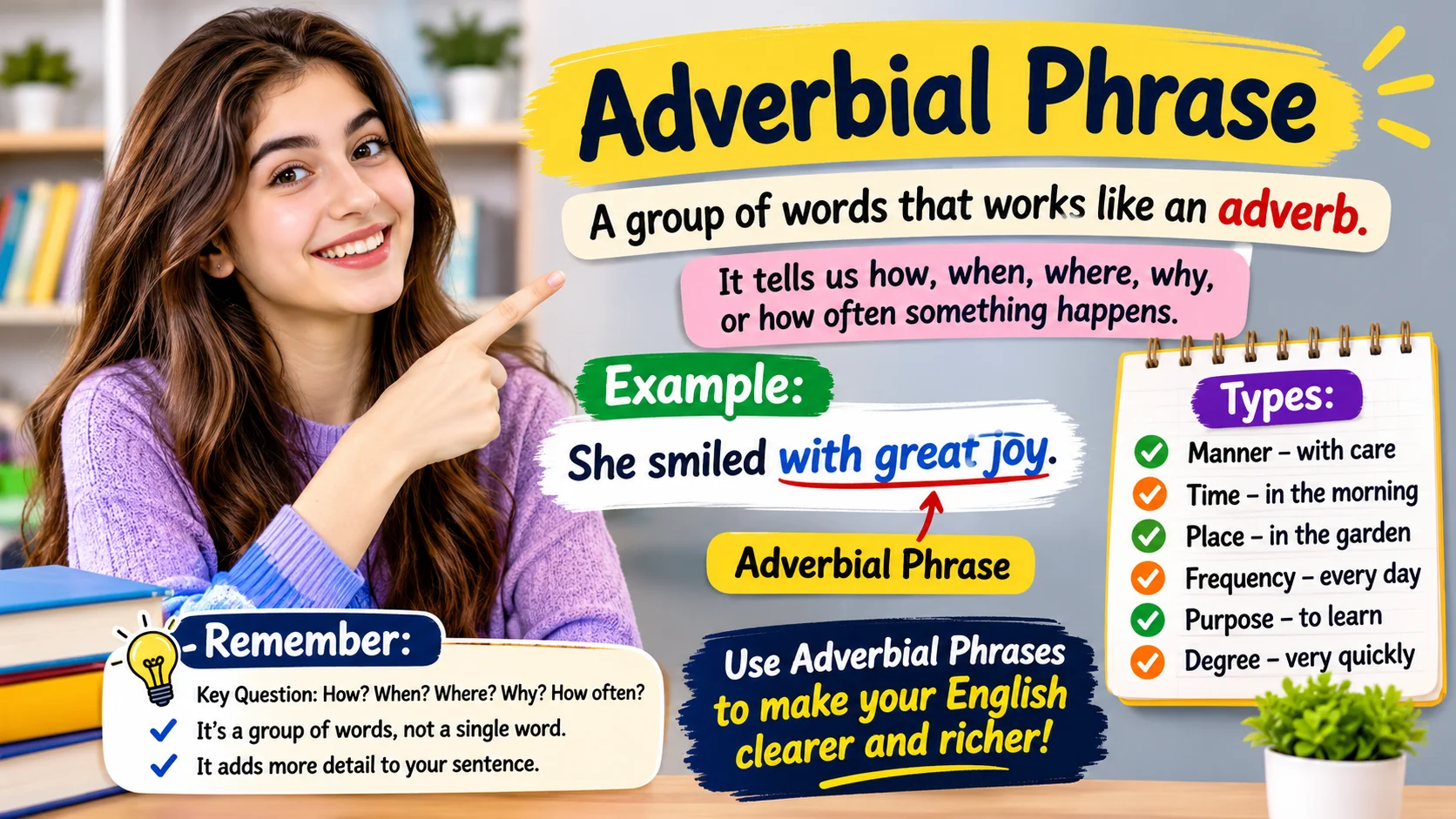
An adverbial phrase is a group of words that works like an adverb in a sentence. It gives extra information about a verb, adjective, or another adverb by explaining how, when, where, why, or to what extent something happens. For example, in the sentence “She spoke with great confidence,” the phrase “with great confidence” tells us how she spoke. It is an adverbial phrase.
Understanding adverbial phrases is important for building clear, detailed, and grammatically correct sentences. They help writers add information about actions, describe circumstances, and make communication more meaningful. Students often confuse adverbial phrases with adverb clauses because both provide similar information. However, they have different grammatical structures. In this guide, you will learn the meaning of an adverbial phrase, its types, how to identify it, common mistakes to avoid, and practical examples that make the concept easy to understand.
Quick Answer: What Is an Adverbial Phrase?
An adverbial phrase is a group of words that functions as an adverb in a sentence. It modifies a verb, adjective, or another adverb by explaining how, when, where, why, or how often something happens. For example, “in the morning” is an adverbial phrase in “I exercise in the morning.”
Why Do People Confuse Adverbial Phrases?
People often confuse adverbial phrases with other grammatical structures because they perform similar functions.
For example:
- Adverbs: Describe actions or qualities using a single word.
- Adverbial phrases: Use a group of words to provide additional information.
- Adverbial clauses: Use a group of words containing a subject and a verb to provide additional information.
Consider these examples:
- Adverb: She sings beautifully.
- Adverbial phrase: She sings with great passion.
- Adverbial clause: She sings because she loves music.
All three examples explain something about the action, but their grammatical structures are different.
First Word: Adverb
An adverb is a word that modifies a verb, adjective, or another adverb. It usually explains how, when, where, or to what extent something happens.
Examples of Adverbs
- She runs quickly.
- He arrived yesterday.
- They live nearby.
- The movie was extremely interesting.
- She speaks softly.
In these examples, the highlighted words provide additional information about the actions or descriptions.
What Are the Main Types of Adverbs?
Some common types include:
- Adverbs of manner: Explain how something happens.
- Adverbs of time: Explain when something happens.
- Adverbs of place: Explain where something happens.
- Adverbs of frequency: Explain how often something happens.
- Adverbs of degree: Explain the extent or intensity of something.
Second Word: Adverbial Phrase
An adverbial phrase is a group of two or more words that performs the function of an adverb.
Unlike a single-word adverb, it provides information through a combination of words.
Examples of Adverbial Phrases
- He completed the work in a hurry.
- We will meet after lunch.
- The children played in the garden.
- She answered the question with confidence.
- They left before sunrise.
The phrases provide information about how, when, or where the actions happen.
What Are the Main Types of Adverbial Phrases?
Adverbial phrases can be classified according to the information they provide.
1. Adverbial Phrases of Manner
These explain how an action happens.
Examples:
- She spoke in a gentle voice.
- He completed the task with care.
- They worked at a fast pace.
2. Adverbial Phrases of Time
These explain when an action happens.
Examples:
- We arrived in the evening.
- She studies after dinner.
- They will return next week.
3. Adverbial Phrases of Place
These explain where an action happens.
Examples:
- The children played in the park.
- She waited near the entrance.
- He works at the office.
4. Adverbial Phrases of Frequency
These explain how often something happens.
Examples:
- He visits us every weekend.
- She practices on a regular basis.
- They meet twice a month.
5. Adverbial Phrases of Purpose or Reason
These explain why an action happens or what it is intended to achieve.
Examples:
- She went to the library to study.
- He saved money for a new car.
- They left early because of the storm.
6. Adverbial Phrases of Degree
These express the extent or intensity of an action or description.
Examples:
- She was tired to a great extent.
- He agreed almost completely.
- The water was cold beyond expectation.
Adverb vs Adverbial Phrase vs Adverbial Clause: Comparison Table
These three grammatical terms have related functions, but their structures are different.
| Feature | Adverb | Adverbial Phrase | Adverbial Clause |
|---|---|---|---|
| Structure | One word | Group of words | Subject and verb |
| Function | Modifies | Modifies | Modifies |
| Example | Quickly | With great speed | Because he was late |
| Sentence | She ran quickly. | She ran with great speed. | She ran because she was late. |
Remember: An adverbial phrase does not contain its own subject-verb combination functioning as a clause.
When Should You Use an Adverbial Phrase?
Use an adverbial phrase when you want to provide additional information about an action, description, or another adverb.
Here are the main situations:
1. To Explain How Something Happens
Use an adverbial phrase of manner to describe the way someone performs an action.
Example:
– He answered the question without hesitation.
2. To Explain When Something Happens
Use an adverbial phrase of time to identify the timing of an action.
Example:
– We will start the meeting in ten minutes.
3. To Explain Where Something Happens
Use an adverbial phrase of place to describe the location of an action.
Example:
– The dog is sleeping under the table.
4. To Explain Why Something Happens
Use an adverbial phrase to provide a reason or purpose.
Example:
– She went outside to get some fresh air.
5. To Add More Detail to a Sentence
Adverbial phrases make sentences more informative.
Example:
- Basic: The boy spoke.
- Detailed: The boy spoke in a quiet and respectful manner.
20+ Examples of Adverbial Phrases in Sentences
The following examples demonstrate how adverbial phrases work in everyday English.
| No. | Sentence | Adverbial Phrase | Function |
|---|---|---|---|
| 1 | She sings with great passion. | With great passion | Manner |
| 2 | We arrived in the morning. | In the morning | Time |
| 3 | He waited near the door. | Near the door | Place |
| 4 | They visit us every Sunday. | Every Sunday | Frequency |
| 5 | She spoke in a low voice. | In a low voice | Manner |
| 6 | I will call you after lunch. | After lunch | Time |
| 7 | The cat slept under the bed. | Under the bed | Place |
| 8 | He worked with great patience. | With great patience | Manner |
| 9 | We exercise twice a week. | Twice a week | Frequency |
| 10 | She went out to buy groceries. | To buy groceries | Purpose |
| 11 | The children played in the backyard. | In the backyard | Place |
| 12 | He completed the project ahead of schedule. | Ahead of schedule | Time |
| 13 | They walked at a slow pace. | At a slow pace | Manner |
| 14 | She visits her parents every month. | Every month | Frequency |
| 15 | We stayed at the hotel for two nights. | At the hotel / For two nights | Place / Duration |
| 16 | He answered without any difficulty. | Without any difficulty | Manner |
| 17 | The train arrived before sunset. | Before sunset | Time |
| 18 | She sat beside her mother. | Beside her mother | Place |
| 19 | He saved money for his education. | For his education | Purpose |
| 20 | They worked throughout the night. | Throughout the night | Time |
| 21 | The students listened with full attention. | With full attention | Manner |
| 22 | We met at the end of the street. | At the end of the street | Place |
These examples show that adverbial phrases can appear in different positions within sentences.
Common Mistakes When Using Adverbial Phrases
Learning the definition is only the first step. You should also understand the mistakes that learners commonly make.
1. Confusing Adverbial Phrases with Adverbial Clauses
An adverbial phrase does not have its own subject and finite verb, while an adverbial clause does.
Incorrect identification:
- Phrase: Because he was tired.
- Clause: Because he was tired.
Both are actually clauses because they contain a subject and a verb. A correct phrase would be “because of his tiredness.”
2. Assuming Every Prepositional Phrase Is Adverbial
Not every prepositional phrase functions as an adverb.
Compare:
- The book on the table is mine. (Adjectival phrase)
- She placed the book on the table. (Adverbial phrase)
In the first sentence, the phrase describes the book. In the second, it tells us where she placed it.
3. Using Unnecessary Words
Avoid adding too many words that make a sentence difficult to understand.
Wordy: He walked in a manner that was very slow.
Better: He walked at a slow pace.
4. Placing Phrases in Confusing Positions
Incorrect placement can make a sentence unclear.
Unclear: She almost drove her children to school every day.
Clearer: She drove her children to school almost every day.
The second sentence makes the intended frequency clearer.
5. Confusing Adverbs with Adverbial Phrases
Remember that an adverb is generally one word, while an adverbial phrase consists of multiple words.
- Quickly: Adverb.
- At a rapid speed: Adverbial phrase.
Memory Trick: How to Remember an Adverbial Phrase
An easy way to remember an adverbial phrase is to think of the five common questions:
- How? She spoke with confidence.
- When? We met after school.
- Where? He waited near the gate.
- Why? She went out to buy food.
- How often? They practice every weekend.
If a group of words answers one of these questions about an action, it may be functioning as an adverbial phrase.
Another useful trick is to remember:
Adverb = One word
Adverbial phrase = A group of words
Adverbial clause = A group of words with a subject and verb
Adverbial Phrases in American vs British English
Adverbial phrases are used in both American and British English. Their grammatical functions remain the same, although some vocabulary and expressions may differ.
| Meaning | American English | British English |
|---|---|---|
| On vacation | On vacation | On holiday |
| At a particular time | On the weekend | At the weekend |
| In a specific location | In the hospital | In hospital |
| At a certain distance | A block away | A street away |
These expressions can function adverbially depending on how they are used in a sentence.
For example:
- American: We are going on vacation next week.
- British: We are going on holiday next week.
Both sentences use an adverbial phrase of time and circumstance.
Similar Grammatical Terms You Should Know
Understanding related grammatical terms can make it easier to recognize adverbial phrases.
1. Adverb
A word that modifies a verb, adjective, or another adverb.
Example: She works carefully.
2. Adverbial Clause
A dependent clause that functions as an adverb.
Example: She left because she was tired.
3. Prepositional Phrase
A group of words beginning with a preposition and ending with its object.
Example: Under the chair.
A prepositional phrase can function as an adverb or adjective.
4. Adjective Phrase
A group of words that describes a noun or pronoun.
Example: The girl with long hair is my sister.
5. Infinitive Phrase
A group of words containing an infinitive and its modifiers or complements.
Example: She went outside to get some fresh air.
An infinitive phrase can function adverbially when it expresses purpose.
Final Verdict: What Is an Adverbial Phrase?
An adverbial phrase is a group of words that performs the job of an adverb. It adds information about how, when, where, why, or how often an action happens.
For example, in “He completed the assignment with great care,” the phrase “with great care” explains how he completed the assignment.
The most important thing to remember is that an adverbial phrase adds useful details to a sentence without forming an independent clause. Learning to identify and use these phrases will help you write clearer and more meaningful English sentences.
Frequently Asked Questions (FAQs)
1. What is an adverbial phrase in simple words?
An adverbial phrase is a group of words that works like an adverb. It provides extra information about an action, such as how, when, where, or why something happens. For example, “after school” is an adverbial phrase in “We play football after school.”
2. What are five examples of adverbial phrases?
Here are five common examples:
- In the morning.
- With great care.
- Near the entrance.
- After the meeting.
- Every weekend.
Each phrase can provide additional information about an action in a sentence.
3. What are the main types of adverbial phrases?
The common types include:
- Adverbial phrases of manner.
- Adverbial phrases of time.
- Adverbial phrases of place.
- Adverbial phrases of frequency.
- Adverbial phrases of purpose or reason.
- Adverbial phrases of degree.
They explain different circumstances surrounding an action or description.
4. What is the difference between an adverb and an adverbial phrase?
An adverb is usually a single word, whereas an adverbial phrase is a group of words that performs the same grammatical function.
Example:
- Adverb: She walked slowly.
- Adverbial phrase: She walked at a slow pace.
Both explain how she walked.
5. Can an adverbial phrase come at the beginning of a sentence?
Yes. An adverbial phrase can appear at the beginning, middle, or end of a sentence, depending on its purpose and the sentence structure.
Examples:
- In the morning, we go jogging.
- We usually, after lunch, take a short break.
- She studies in the evening.
A comma is commonly used after an introductory adverbial phrase, especially when it is longer.
6. What is the difference between an adverbial phrase and an adverbial clause?
An adverbial phrase does not contain its own subject and finite verb, while an adverbial clause contains both.
Examples:
- Phrase: Because of the rain, we stayed home.
- Clause: Because it was raining, we stayed home.
Both explain why we stayed home, but their structures differ.
7. How do you identify an adverbial phrase in a sentence?
Find the action or description and ask questions such as how, when, where, why, or how often. Then identify the group of words that provides the answer.
Example:
“She completed her homework before dinner.”
The phrase “before dinner” tells us when she completed her homework, so it functions as an adverbial phrase.
Remember This
- An adverbial phrase is a group of words that works like an adverb.
- It provides information about how, when, where, why, or how often something happens.
- It can appear at different positions in a sentence.
- It does not contain its own subject and finite verb.
- It helps make sentences clearer, richer, and more informative.
Conclusion
An adverbial phrase is an important part of English grammar because it helps explain the circumstances surrounding an action or description. It can tell readers how something happens, when it takes place, where it occurs, or why someone does something. Recognizing these phrases makes it easier to understand sentence structure and communicate ideas effectively.
The best way to master adverbial phrases is through regular reading, writing, and practice. Start by identifying phrases in everyday sentences, ask what information they provide, and try creating your own examples. With practice, you will become more confident in using them naturally and correctly.

I am Martin Joseph, a passionate writer who enjoys creating helpful, thoughtful, and engaging replies. I aim to make conversations easier by sharing practical responses for every situation.