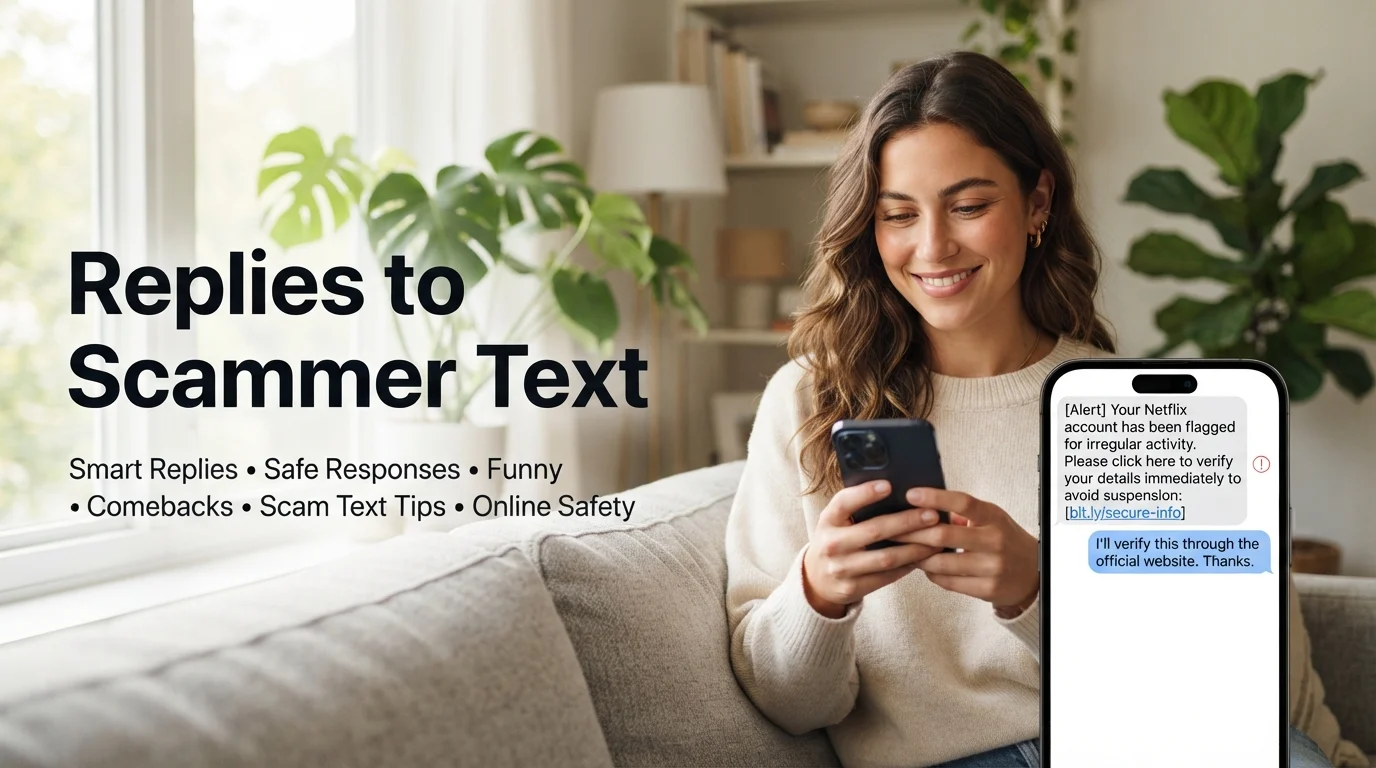
Getting a suspicious text message can be confusing, annoying, or even unsettling. Whether someone is pretending to be a delivery company, bank, employer, friend, or random stranger, knowing the right replies to scammer text messages can help you stay calm and avoid making the situation worse.
The safest response is often no response at all. Scammers frequently send messages to see who will engage, click a link, share personal information, or confirm that a phone number is active. If you decide to respond, keep your message brief, avoid revealing information, and never click suspicious links or send money. The examples below cover funny, polite, direct, and safety-first ways to handle scam texts.
1. “I Don’t Respond to Suspicious Messages”
Best for: Clearly suspicious texts from unknown numbers.
Alternative: “I don’t respond to messages I can’t verify.”
Examples:
“I don’t respond to suspicious messages. Take care.”
“I can’t verify who you are, so I won’t continue this conversation.”
A simple response can establish a boundary without revealing anything about yourself.
2. “Please Identify Yourself”
Best for: Messages claiming to be from someone you might know.
Alternative: “Who is this, and how do I know you?”
Examples:
“Please identify yourself before we continue.”
“Who are you and why are you contacting me?”
Avoid confirming your name, address, workplace, or other personal details while asking.
3. “I’ll Verify This Independently”
Best for: Fake bank, delivery, government, or business messages.
Alternative: “I’ll contact the company directly.”
Examples:
“I’ll verify this through the company’s official website.”
“I won’t use the link in this message. I’ll contact them directly.”
This is one of the safest responses because legitimate organizations can usually be contacted through independently verified channels.
4. “Wrong Number”
Best for: Random messages pretending to have contacted you accidentally.
Alternative: “You have the wrong person.”
Examples:
“Sorry, wrong number.”
“You’ve reached the wrong person. Please check the number.”
Keep it short. There is no need to explain who you are.
5. “Please Stop Contacting Me”
Best for: Persistent scam messages.
Alternative: “Do not contact this number again.”
Examples:
“Please stop contacting me.”
“Do not send any further messages to this number.”
Afterward, consider blocking and reporting the number rather than continuing the conversation.
6. “I Don’t Click Links From Unknown Numbers”
Best for: Texts containing suspicious URLs.
Alternative: “I never open links from unverified senders.”
Examples:
“I don’t click links from unknown numbers.”
“I’ll access the official website directly instead.”
This response reinforces a useful cybersecurity habit without sharing personal information.
7. “Nice Try, But I’m Not Interested”
Best for: Obvious fake offers or suspicious promotions.
Alternative: “No thanks. I’m not interested.”
Examples:
“Nice try, but I’ll pass.”
“I’m not interested in unsolicited offers.”
A confident but non-aggressive answer is enough. You do not need to prove that you recognized the scam.
8. “I’ll Contact the Company Myself”
Best for: Fake customer-service or account-alert messages.
Alternative: “I’ll use the official customer-service number.”
Examples:
“I’ll contact the company directly to verify this.”
“I’ll check my account through the official app.”
Never use a phone number provided in a suspicious text to verify the message.
9. “This Message Looks Suspicious”
Best for: Messages with obvious scam indicators.
Alternative: “This doesn’t look legitimate.”
Examples:
“This message looks suspicious, so I won’t respond further.”
“The request doesn’t appear legitimate.”
You can identify the warning signs without arguing with the sender.
10. “I Won’t Share Personal Information”
Best for: Requests for passwords, addresses, codes, or identification details.
Alternative: “I never share sensitive information through unsolicited texts.”
Examples:
“I won’t provide personal information through text.”
“I don’t share account details with unknown contacts.”
This is especially useful when a scammer tries to create urgency.
11. “I’ll Report This Message”
Best for: Persistent, fraudulent, or threatening scam messages.
Alternative: “This number will be reported.”
Examples:
“I’m reporting this message as suspicious.”
“I’ll report this number rather than continue the conversation.”
Reporting can help your mobile provider or relevant platform identify abusive activity.
12. “You’re Not Getting Any Information From Me”
Best for: Scammers asking probing personal questions.
Alternative: “I don’t provide those details.”
Examples:
“I don’t share that information with unknown contacts.”
“You won’t get personal information from me.”
Avoid giving even small details that could help a scammer build a profile about you.
13. “Please Use an Official Contact Method”
Best for: Someone claiming to represent a company.
Alternative: “I’ll only communicate through verified channels.”
Examples:
“Please contact me through your official support channel.”
“I only handle account matters through verified communication.”
This makes it clear that you will not follow an unfamiliar communication route.
14. “I’m Not Going to Continue This Conversation”
Best for: A scammer who keeps changing their story.
Alternative: “I’m ending this conversation.”
Examples:
“I’m not comfortable continuing this conversation.”
“I’m ending this conversation now.”
Once you send a boundary-setting message, stop engaging.
15. “This Number Has Been Reported”
Best for: Repeated scam attempts.
Alternative: “I’m reporting this number.”
Examples:
“This number is being reported for suspicious activity.”
“I’m reporting this message to my carrier.”
Use this only if you actually intend to report the message.
16. A Lighthearted “Good Try”
Best for: Harmless-looking scam attempts when you want a playful response.
Alternative: “Good attempt!”
Examples:
“Good try, but I’m going to pass.”
“Nice attempt. I’m not falling for it.”
Humor can feel satisfying, but remember that ignoring and blocking is usually safer.
17. “I Know This Is a Scam”
Best for: Extremely obvious fraudulent messages.
Alternative: “This appears to be a scam.”
Examples:
“I recognize this as a scam message.”
“This looks like a fraudulent request.”
There is no advantage in debating the scammer after making your position clear.
18. “I Don’t Discuss Financial Matters by Text”
Best for: Fake investment, payment, refund, or banking scams.
Alternative: “I verify financial requests independently.”
Examples:
“I don’t handle financial requests through unsolicited texts.”
“I’ll verify any payment request independently.”
Never send banking credentials, payment information, verification codes, or cryptocurrency to an unknown contact.
19. “I Don’t Recognize This Request”
Best for: Unexpected invoices, deliveries, subscriptions, or account notices.
Alternative: “I have no record of this.”
Examples:
“I don’t recognize this request, so I won’t take action.”
“I have no record of this transaction.”
This response avoids confirming whether the scammer’s assumptions about you are correct.
20. “I’ll Check My Account Directly”
Best for: Fake account-security alerts.
Alternative: “I’ll verify this through the official app.”
Examples:
“I’ll check my account directly rather than use this link.”
“I’ll verify the alert through the official app.”
This is much safer than clicking a link supplied in the message.
21. “Remove My Number From Your List”
Best for: Repeated promotional or suspicious messages.
Alternative: “Do not contact this number again.”
Examples:
“Please remove this number from your contact list.”
“I do not want further messages from this number.”
If the messages continue, block and report the sender.
22. “I’m Not Interested”
Best for: Fake job opportunities, prizes, investments, or offers.
Alternative: “No thank you.”
Examples:
“I’m not interested in this offer.”
“No thanks. I won’t be participating.”
You don’t need to explain your decision or answer follow-up questions.
23. “I Verify Unexpected Requests”
Best for: Messages designed to create urgency.
Alternative: “I don’t act on unexpected requests.”
Examples:
“I always verify unexpected requests first.”
“I won’t take action until I confirm this independently.”
This is particularly useful for impersonation scams.
24. “I Won’t Share a Verification Code”
Best for: Requests for one-time passwords or security codes.
Alternative: “Security codes are private.”
Examples:
“I never share verification codes with anyone.”
“I won’t provide a security code through text.”
A verification code can sometimes be the final piece a scammer needs to access an account. Never share one simply because someone asks.
25. “I’ll Deal With This Through Official Support”
Best for: Fake technical support or customer-service scams.
Alternative: “I’ll contact official support myself.”
Examples:
“I’ll resolve this through official support.”
“I won’t use an unofficial support number.”
This keeps the interaction on a verified channel.
26. “Please Don’t Contact Me Again”
Best for: Direct and polite boundary-setting.
Alternative: “Further messages are not welcome.”
Examples:
“Please don’t contact me again.”
“I don’t wish to receive further messages.”
After sending it, avoid getting pulled into another conversation.
27. “I’m Blocking This Number”
Best for: Persistent scam attempts.
Alternative: “I’m blocking and reporting this number.”
Examples:
“I’m blocking this number now.”
“I’ll block this contact and report the message.”
Blocking is often more useful than trying to get the last word.
28. A Funny “Wrong Person”
Best for: Lighthearted situations where you want a humorous response.
Alternative: “Definitely not your target audience.”
Examples:
“Wrong person—good luck elsewhere.”
“You’ve reached someone who doesn’t take mystery offers.”
Keep humor harmless and avoid revealing information about yourself.
29. No Reply at All
Best for: Almost every unsolicited scam text.
Alternative: Block and report.
Examples:
No response—block the number.
No response—report the suspicious message.
Sometimes the best reply to a scammer text is no reply. Engagement can tell scammers that your number is active.
30. “I’m Reporting and Blocking This Number”
Best for: Clear scam attempts that you want to shut down immediately.
Alternative: “I won’t respond further.”
Examples:
“I’m reporting and blocking this number now.”
“This message is suspicious. I’m reporting it and ending contact.”
This combines a firm boundary with the safest next step: ending communication.
What Should You Do After Receiving a Scam Text?
Knowing replies to scammer text messages is useful, but your actions after receiving the message matter even more.
First, avoid clicking links, downloading attachments, calling unfamiliar numbers, or providing personal information. If the message claims to come from a bank, delivery company, employer, government agency, or another organization, verify it using a website, phone number, or app you already trust.
Next, consider blocking and reporting the sender. Keep screenshots if you believe the message could be useful for a fraud report. If you already clicked a suspicious link, provided information, or sent money, take action quickly by securing relevant accounts and contacting the appropriate financial institution or service.
What Not to Say to a Scammer
Even when you recognize a scam, avoid giving the sender information that can be useful later.
Don’t confirm your full name, address, workplace, date of birth, account details, passwords, PINs, one-time codes, or financial information. Avoid explaining why you know the message is fake, because that can encourage the scammer to change tactics.
You also don’t need to threaten, insult, or challenge the sender. The goal isn’t to win the conversation—it’s to protect yourself.
Quick Safety Rules for Suspicious Text Messages
Keep these simple rules in mind:
- Don’t click unexpected links.
- Don’t download unknown attachments.
- Don’t share passwords or verification codes.
- Don’t send money to unknown contacts.
- Don’t confirm personal information.
- Don’t trust urgency as proof of legitimacy.
- Verify organizations independently.
- Block persistent scam numbers.
- Report suspicious messages when appropriate.
- If you’ve already responded, don’t panic—secure your accounts and take appropriate action.
Frequently Asked Questions
1. What is the best reply to a scammer text?
Usually, the safest choice is not to reply. If you need to respond, keep it brief, such as “I don’t respond to unsolicited messages,” then block and report the number.
2. Should I mess with a scammer?
It’s understandable to want a funny comeback, but prolonged conversations aren’t recommended. Engaging can confirm that your number is active and may expose you to additional attempts.
3. Should I click a link to see if a scam text is real?
No. Don’t use the link in a suspicious message to verify it. Instead, visit the organization’s official website or use its verified app or contact information.
4. What should I do if I already replied to a scammer?
Don’t panic. Stop communicating, avoid sharing additional information, block the number, and report the message when appropriate. If you provided passwords, financial information, or security codes, take immediate steps to secure the affected accounts.
5. Can replying to a scam text be dangerous?
It can increase the risk of further contact and social-engineering attempts. A response may tell scammers that the number is active, so ignoring, blocking, and reporting suspicious messages is generally safer.
Conclusion
The smartest replies to scammer text messages are usually short, calm, and information-free. You don’t need a clever comeback to prove that you recognized a scam. In many situations, the best strategy is simply to avoid responding, block the number, and report the message.
If you do choose to reply, use a simple boundary such as “I don’t respond to unsolicited messages” or “I’ll verify this through an official channel.” Most importantly, never click suspicious links or share passwords, verification codes, financial information, or other sensitive details. Staying calm and cautious is the best comeback of all.

I am Martin Joseph, a passionate writer who enjoys creating helpful, thoughtful, and engaging replies. I aim to make conversations easier by sharing practical responses for every situation.