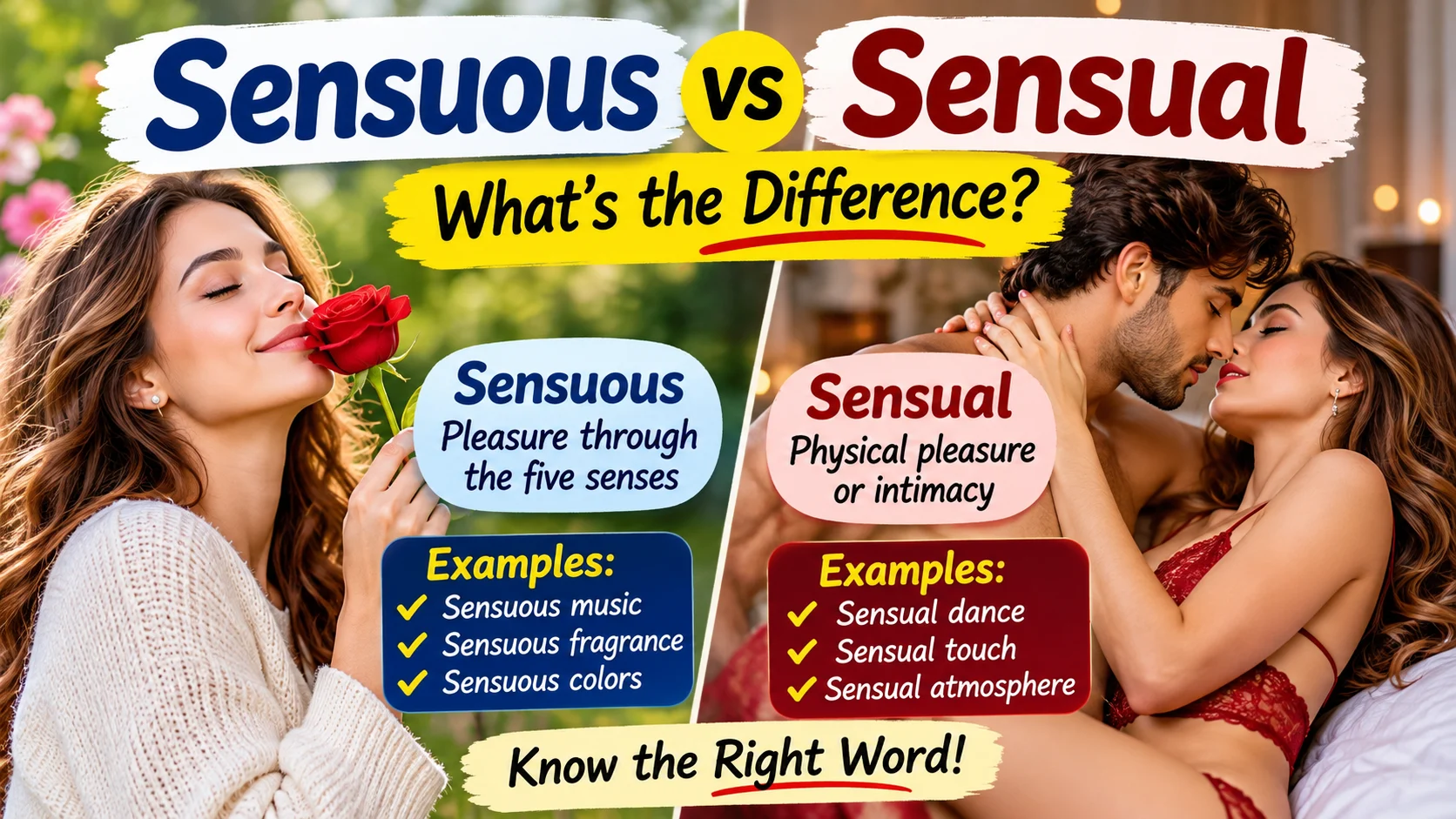
The words sensuous and sensual look and sound similar, but they have slightly different meanings. Both relate to the senses and physical experiences, yet they are not always interchangeable. Understanding the difference between sensuous and sensual can help you choose the right word when describing beauty, pleasure, art, food, music, or romantic experiences.
Although both words can describe enjoyable physical sensations, sensuous usually emphasizes pleasure through the five senses, such as sight, hearing, taste, smell, and touch. Sensual, on the other hand, more commonly suggests physical pleasure, intimacy, or sexual attraction. For example, a beautiful painting may be described as sensuous because of its colors and textures, while a sensual dance may suggest romantic or physical attraction. Knowing these differences makes your writing clearer and helps you avoid misunderstandings in everyday conversations.
Quick Answer: Sensuous vs Sensual
Sensuous describes something that appeals pleasantly to the five senses, including sight, sound, taste, smell, and touch. Sensual describes physical pleasure or enjoyment, often with romantic or sexual associations. Both words can refer to sensory experiences, but sensual is more strongly connected to physical intimacy, while sensuous emphasizes sensory beauty and enjoyment.
Why Do People Confuse Sensuous and Sensual?
People often confuse these words because they share the same Latin root, sensus, meaning feeling or perception.
Both words relate to physical sensations and experiences. They can also describe similar things, including music, art, food, perfume, and personal experiences.
However, their usual associations are different:
- Sensuous: Focuses on pleasure experienced through the five senses.
- Sensual: Focuses on physical enjoyment, bodily pleasure, and sometimes sexual attraction.
For example:
- The sensuous colors of the painting created a peaceful atmosphere.
- The couple shared a sensual moment together.
The first sentence emphasizes visual beauty, while the second suggests physical or romantic intimacy.
First Word: What Does Sensuous Mean?
Sensuous is an adjective that describes something that appeals to the senses and creates a pleasurable sensory experience.
It is commonly used for things that are beautiful, rich, soft, fragrant, musical, or enjoyable to experience physically.
Sensuous experiences can involve:
- Sight: Beautiful colors, landscapes, and artwork.
- Hearing: Gentle music, soothing sounds, and pleasant melodies.
- Taste: Delicious food, rich flavors, and sweet desserts.
- Smell: Fresh flowers, fragrant candles, and pleasant perfumes.
- Touch: Soft fabrics, smooth surfaces, and comfortable textures.
Examples of Sensuous in Sentences
- The garden was filled with sensuous colors and beautiful flowers.
- She enjoyed the sensuous sound of classical music.
- The artist used sensuous textures to make the painting more interesting.
- The restaurant offered a sensuous dining experience.
- The perfume had a rich and sensuous fragrance.
When Should You Use Sensuous?
Use sensuous when you want to describe something that provides pleasure through the senses without necessarily suggesting sexual attraction.
Common expressions include:
- Sensuous beauty
- Sensuous experience
- Sensuous music
- Sensuous colors
- Sensuous textures
- Sensuous fragrance
- Sensuous pleasure
Second Word: What Does Sensual Mean?
Sensual is an adjective that describes something related to physical pleasure, bodily enjoyment, or the senses. It often carries romantic or sexual associations.
The word can describe physical experiences, attractive appearances, intimate moments, and activities that create bodily pleasure.
For example, a sensual massage may suggest relaxing physical pleasure, while a sensual dance may communicate romance, intimacy, or sexual attraction.
Examples of Sensual in Sentences
- They shared a sensual kiss under the moonlight.
- The movie included a sensual romantic scene.
- She wore a sensual perfume for the evening.
- The couple enjoyed a sensual dance together.
- The advertisement used sensual imagery to create an intimate atmosphere.
When Should You Use Sensual?
Use sensual when describing physical pleasure, romantic feelings, bodily enjoyment, or sexual attraction.
Common expressions include:
- Sensual pleasure
- Sensual experience
- Sensual touch
- Sensual dance
- Sensual attraction
- Sensual massage
- Sensual atmosphere
Remember that sensual does not always mean sexual. It can also describe ordinary physical enjoyment, such as appreciating delicious food or relaxing in a warm bath.
Sensuous vs Sensual: Comparison Table
| Feature | Sensuous | Sensual |
|---|---|---|
| Part of speech | Adjective | Adjective |
| Main meaning | Pleasing to the senses | Related to physical pleasure |
| Main focus | Five senses | Bodily sensations |
| Common association | Beauty and sensory enjoyment | Intimacy and physical pleasure |
| Sexual meaning | Usually not implied | Often implied |
| Common uses | Art, music, food, nature | Romance, touch, dance |
| Example | Sensuous music | Sensual dance |
The main difference: Sensuous emphasizes sensory beauty, while sensual more often emphasizes physical pleasure and intimacy.
When to Use Sensuous vs Sensual
Choosing the correct word depends on what you want to communicate.
Use Sensuous for Sensory Beauty
Choose sensuous when describing something that appeals to the senses in an enjoyable or beautiful way.
Examples:
- The sensuous fragrance of fresh roses filled the room.
- The painting featured sensuous colors and delicate textures.
- We enjoyed a sensuous evening listening to soft music.
Use Sensual for Physical or Romantic Pleasure
Choose sensual when describing experiences connected to physical enjoyment, intimacy, or attraction.
Examples:
- Their sensual dance attracted everyone’s attention.
- The romantic setting created a sensual atmosphere.
- The couple shared a sensual evening together.
Can Both Words Describe the Same Thing?
Yes. Sometimes both words can describe the same object or experience, but the meaning changes slightly.
For example:
- Sensuous music: Music that is beautiful and pleasurable to hear.
- Sensual music: Music that creates a feeling of physical pleasure or romantic intimacy.
The difference depends on the emphasis and context.
12 Examples of Sensuous vs Sensual in Sentences
Here are practical examples to help you understand how these words work in everyday English.
| Sensuous | Sensual |
|---|---|
| 1. The sensuous fragrance of jasmine filled the garden. | The sensual perfume created a romantic mood. |
| 2. She admired the sensuous beauty of the painting. | The couple shared a sensual kiss. |
| 3. The sensuous melody relaxed everyone. | The sensual dance expressed romantic attraction. |
| 4. The restaurant offered a sensuous dining experience. | They enjoyed a sensual evening together. |
| 5. The fabric had a soft, sensuous texture. | The massage provided sensual pleasure. |
| 6. The sensuous colors made the artwork beautiful. | The film featured a sensual romantic scene. |
More Examples in Everyday Contexts
7. Art and design
- Sensuous: The sculpture had smooth, sensuous curves.
- Sensual: The sculpture’s presentation created a sensual atmosphere.
8. Food and drinks
- Sensuous: The chocolate offered a rich, sensuous taste.
- Sensual: The meal became part of an intimate, sensual evening.
9. Nature
- Sensuous: The garden provided a sensuous experience of colors and fragrances.
- Sensual: The romantic setting created a sensual atmosphere.
10. Fashion
- Sensuous: The dress had a beautiful, sensuous texture.
- Sensual: She chose a sensual outfit for the romantic evening.
11. Music
- Sensuous: The sensuous melody was soothing and beautiful.
- Sensual: The sensual rhythm made the dance feel intimate.
12. Personal experiences
- Sensuous: Walking through the forest was a sensuous experience.
- Sensual: They enjoyed a sensual moment together.
Common Mistakes When Using Sensuous and Sensual
Even fluent English speakers sometimes use these words incorrectly. Here are some mistakes worth avoiding.
1. Assuming Both Words Mean Exactly the Same Thing
Although they overlap, they have different common associations.
Incorrect assumption: Sensuous always means sexual.
Correct understanding: Sensuous generally describes pleasurable sensory experiences.
2. Using Sensual When You Mean Visual Beauty
If you are describing a beautiful painting without romantic or physical associations, sensuous is often the better choice.
- Better: The painting has sensuous colors.
- Different emphasis: The painting has sensual colors.
3. Thinking Sensual Always Means Sexual
Sensual can describe physical enjoyment without necessarily referring to sex.
For example:
– She enjoyed the sensual pleasure of a warm bath.
This sentence can simply describe physical comfort and relaxation.
4. Ignoring Context
The same noun can work with both adjectives, depending on the intended meaning.
For example:
- Sensuous fragrance: A fragrance that delights the sense of smell.
- Sensual fragrance: A fragrance associated with physical attraction or intimacy.
Always consider the message you want to communicate.
Memory Trick: How to Remember Sensuous vs Sensual
A simple memory trick can help you remember the difference.
Sensuous = Senses
Think of the five senses: seeing, hearing, tasting, smelling, and touching.
Sensual = Physical Pleasure
Think of bodily enjoyment, romantic attraction, and intimacy.
Remember these two examples:
- A sensuous painting appeals to your eyes.
- A sensual kiss expresses physical intimacy.
This simple distinction makes it easier to choose the correct word.
American vs British English: Sensuous and Sensual
There is no major spelling difference between American and British English for these words.
Both varieties use:
- Sensuous
- Sensual
Their meanings and general usage are also similar in both varieties of English.
For example:
| American English | British English |
|---|---|
| A sensuous fragrance | A sensuous fragrance |
| A sensual dance | A sensual dance |
| A sensuous experience | A sensuous experience |
| Sensual pleasure | Sensual pleasure |
The distinction is about meaning and context, not regional spelling.
Similar Words Related to Sensuous and Sensual
Several other English words have meanings related to the senses, physical enjoyment, or attraction.
| Word | Meaning | Example |
|---|---|---|
| Sensory | Related to the senses | Sensory experiences can be enjoyable. |
| Sensitive | Easily affected by physical or emotional experiences | She has sensitive skin. |
| Physical | Related to the body | Physical comfort is important. |
| Erotic | Related to sexual desire or excitement | The novel contains erotic themes. |
| Romantic | Related to love and affection | They planned a romantic dinner. |
| Pleasurable | Giving enjoyment or satisfaction | It was a pleasurable experience. |
| Tactile | Related to the sense of touch | The fabric has a pleasant tactile quality. |
These words are related, but they are not always interchangeable.
For example, sensory is a broad term for the senses, while erotic has a much more specifically sexual meaning.
Final Verdict: Sensuous vs Sensual
The difference between sensuous and sensual is mainly about emphasis.
- Sensuous describes beauty, pleasure, and enjoyment through the five senses.
- Sensual describes physical pleasure, bodily enjoyment, and often romantic or sexual attraction.
Use sensuous when discussing beautiful music, delicious food, pleasant fragrances, or attractive textures.
Use sensual when discussing physical intimacy, romantic experiences, or bodily pleasure.
Both words are correct English adjectives, but choosing the right one helps you express your intended meaning more clearly.
Frequently Asked Questions (FAQs)
1. What is the main difference between sensuous and sensual?
Sensuous describes something that appeals pleasantly to the five senses, such as beautiful music, delicious food, or fragrant flowers. Sensual describes physical pleasure and bodily enjoyment, often with romantic or sexual associations. The two words overlap, but their usual emphasis is different.
2. Does sensuous mean sexual?
No. Sensuous does not normally mean sexual. It describes something that provides pleasure through sight, hearing, taste, smell, or touch. For example, a sensuous painting may have beautiful colors and textures without suggesting anything romantic or sexual.
3. Does sensual always mean sexual?
No. Although sensual often has romantic or sexual associations, it can also describe ordinary physical pleasure. For example, enjoying a warm bath, soft fabric, or delicious food can be described as a sensual experience.
4. Can sensuous and sensual be used interchangeably?
Sometimes, but not always. Both words can describe experiences involving the senses. However, sensuous emphasizes sensory beauty, while sensual more commonly suggests physical enjoyment or intimacy. Replacing one with the other can change the meaning or tone of a sentence.
5. Is sensuous a positive word?
Yes. Sensuous is generally positive and describes something that provides enjoyable sensory experiences. It is often used for art, music, nature, fragrances, food, and textures.
6. What is an example of a sensuous experience?
Listening to beautiful music, enjoying the fragrance of fresh flowers, tasting delicious food, or feeling soft fabric can all be sensuous experiences. These activities provide pleasure through one or more of the five senses.
7. What is another word for sensual?
Depending on the context, similar words include physical, intimate, erotic, pleasurable, and tactile. However, these words have different meanings. For example, intimate often suggests closeness, while erotic specifically relates to sexual desire.
Remember This
- Sensuous = Pleasure through the five senses.
- Sensual = Physical pleasure, often involving intimacy or attraction.
- Sensuous is commonly used for beauty, music, food, and art.
- Sensual is commonly used for romance, touch, and physical enjoyment.
- Both words can overlap, so context matters.
Conclusion
Understanding the difference between sensuous and sensual is easier when you remember what each word emphasizes. Sensuous focuses on the pleasure of experiencing the world through your five senses, while sensual focuses more on physical enjoyment, bodily sensations, and sometimes romantic or sexual attraction. Although the meanings overlap, they communicate slightly different ideas.
The next time you describe a beautiful painting, delicious meal, romantic moment, or pleasant fragrance, think about the meaning you want to express. Choose sensuous for sensory beauty and sensual for physical pleasure or intimacy. Using these words correctly will make your English more precise, natural, and expressive.

I am Amelia Jane, an author at ReplyLop, passionate about creating helpful, thoughtful, and engaging replies that make conversations easier, clearer, and more meaningful for everyone.