Understanding subordinating conjunctions is an important part of learning English grammar. These words help connect ideas, explain relationships between events, and make sentences more meaningful. if you are a student, an ESL learner, or someone looking to improve everyday writing, knowing how subordinating conjunctions work can help you communicate more clearly.
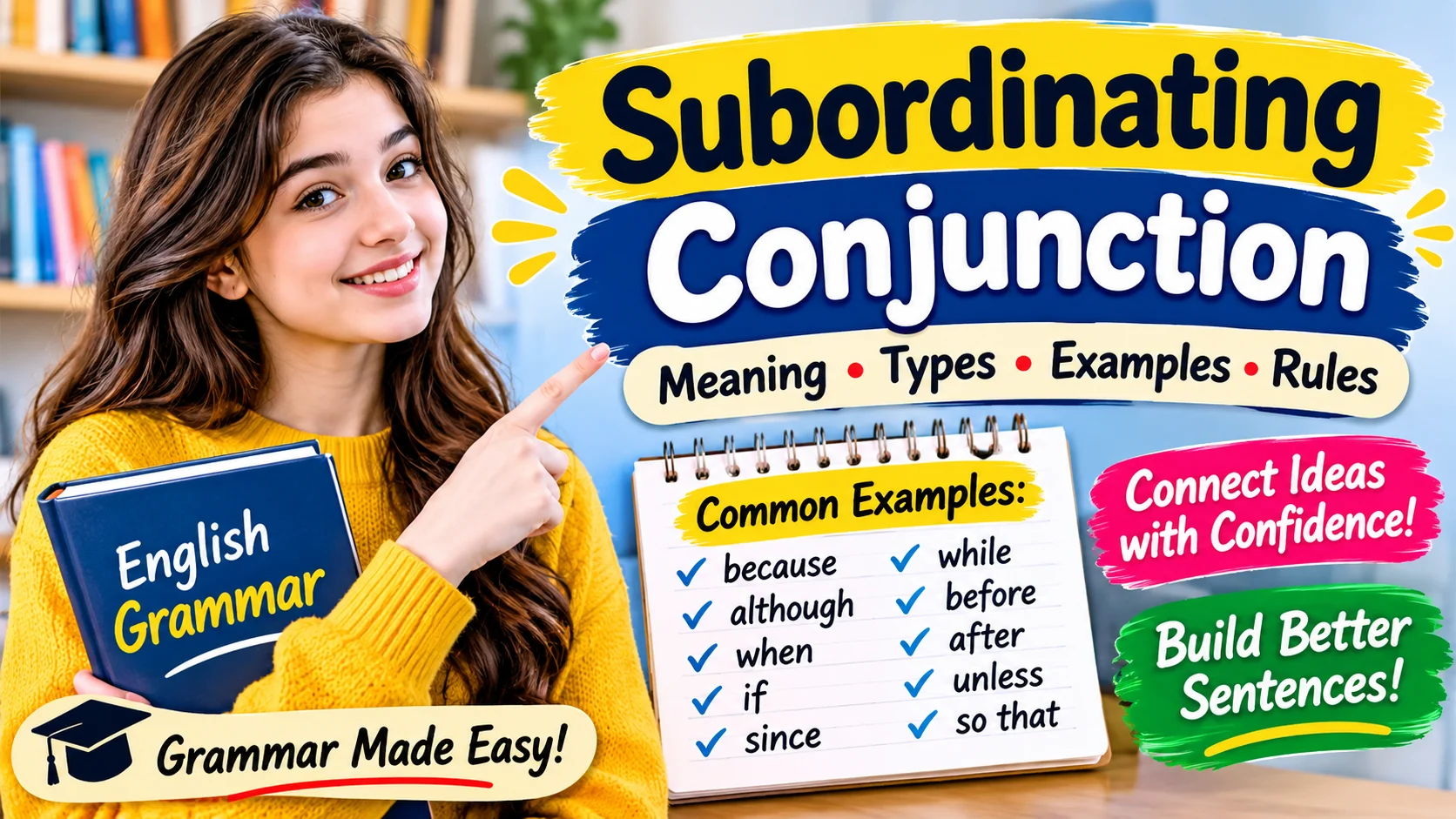
A subordinating conjunction connects a dependent clause to an independent clause. Common examples include because, although, since, if, when, while, and unless. These words show relationships such as time, reason, condition, contrast, and purpose. For example, in the sentence “I stayed home because it was raining,” the word because connects the reason to the main idea. Learning how to recognize and use these conjunctions will help you build grammatically correct sentences and express more complex thoughts naturally.
Quick Answer: What Is a Subordinating Conjunction?
A subordinating conjunction is a word or phrase that connects a dependent clause to an independent clause. It shows how two ideas are related, such as time, reason, condition, contrast, or purpose. Common subordinating conjunctions include because, although, if, when, since, and while.
Why Do People Confuse Subordinating Conjunctions?
Subordinating conjunctions are sometimes confused with coordinating conjunctions and other connecting words because they all join words, phrases, or clauses.
However, they perform different grammatical functions.
The main reason for confusion is that some words can have different grammatical roles depending on how they are used.
For example:
- Because: I stayed inside because it was cold.
- And: She cooked dinner, and I washed the dishes.
- Although: Although he was tired, he continued working.
The important difference is that a subordinating conjunction introduces a dependent clause, which cannot normally stand alone as a complete sentence.
First Word: What Is a Subordinating Conjunction?
A subordinating conjunction is a connecting word that introduces a dependent clause and links it to an independent clause.
It helps explain why something happens, when an event takes place, under what condition something occurs, or how two ideas contrast.
Examples of Subordinating Conjunctions
Here are some commonly used subordinating conjunctions:
- Because
- Although
- Though
- Since
- If
- Unless
- When
- Whenever
- While
- Before
- After
- Until
- Once
- As
- Whereas
- Even though
- So that
- In order that
- Provided that
- As soon as
How Does a Subordinating Conjunction Work?
A subordinating conjunction introduces a dependent clause.
Consider this example:
I went to bed early because I was tired.
The sentence has two clauses:
- Independent clause: I went to bed early.
- Dependent clause: Because I was tired.
The independent clause expresses a complete thought. The dependent clause gives a reason but cannot stand alone as a complete sentence in this context.
The word because connects these two ideas and explains their relationship.
Second Word: What Is a Dependent Clause?
A dependent clause is a group of words that contains a subject and a verb but does not express a complete thought on its own.
It needs an independent clause to complete its meaning.
For example:
Although she was nervous, she gave a great presentation.
Here:
- Dependent clause: Although she was nervous.
- Independent clause: She gave a great presentation.
The dependent clause creates an expectation, but the independent clause completes the thought.
What Is an Independent Clause?
An independent clause contains a subject and a verb and expresses a complete thought. It can stand alone as a sentence.
Examples:
- She loves reading.
- They went shopping.
- I finished my homework.
- He plays football.
When an independent clause is connected to a dependent clause, the result is a more informative and meaningful sentence.
Subordinating Conjunction vs Other Conjunctions: Comparison Table
Subordinating conjunctions are different from coordinating and correlative conjunctions. Understanding these differences makes English sentence construction easier.
| Type | Function | Examples |
|---|---|---|
| Subordinating conjunction | Connects a dependent clause to an independent clause | Because, although, if |
| Coordinating conjunction | Connects equally important words, phrases, or independent clauses | And, but, or |
| Correlative conjunction | Uses paired words to connect related elements | Either…or, neither…nor |
| Conjunctive adverb | Connects ideas and shows a logical relationship | However, therefore, consequently |
Examples of Each Type
1. Subordinating conjunction:
I stayed home because I was sick.
2. Coordinating conjunction:
I was sick, but I went to work.
3. Correlative conjunction:
Either you can call me or you can send a message.
4. Conjunctive adverb:
It was raining; therefore, we stayed inside.
When to Use Subordinating Conjunctions
Subordinating conjunctions are useful when you want to show a specific relationship between two ideas.
Different subordinating conjunctions communicate different meanings.
1. To Show Reason or Cause
Use because, since, and as to explain why something happens.
Examples:
- I stayed home because I was feeling sick.
- Since it was getting late, we decided to leave.
- As she had no money, she walked home.
2. To Show Time
Use when, while, before, after, until, and once to explain when something happens.
Examples:
- Call me when you arrive.
- She listened to music while studying.
- Wash your hands before you eat.
- We went outside after the rain stopped.
3. To Show Condition
Use if, unless, provided that, and as long as to describe conditions.
Examples:
- You can join us if you finish your work.
- I will not go unless you come with me.
- You can borrow my book provided that you return it.
4. To Show Contrast
Use although, though, even though, and whereas to express contrasting ideas.
Examples:
- Although he was tired, he kept working.
- Even though it was expensive, she bought it.
- I prefer tea, whereas my brother likes coffee.
5. To Show Purpose
Use so that and in order that to explain the purpose of an action.
Examples:
- She studies hard so that she can pass the exam.
- He spoke slowly so that everyone could understand him.
- They saved money in order that they could buy a house.
6. To Show Comparison
Use than and as in certain comparative constructions.
Examples:
- She is taller than I am.
- He works as hard as his brother does.
15 Examples of Subordinating Conjunctions in Sentences
The following examples show how subordinating conjunctions work in everyday English.
- Because: I went to bed early because I had an important meeting.
- Although: Although it was raining, we went for a walk.
- If: You can borrow my laptop if you need it.
- When: I will call you when I reach home.
- While: She was reading while her brother was watching television.
- Since: Since you are here, we can start the meeting.
- Unless: You will not improve unless you practice regularly.
- Before: Finish your homework before you go outside.
- After: We watched a movie after we finished dinner.
- Until: Wait here until I return.
- Even though: Even though he was nervous, he spoke confidently.
- Whenever: Whenever I visit my grandmother, she makes my favorite food.
- Whereas: My sister enjoys cooking, whereas I prefer baking.
- So that: I set an alarm so that I would wake up early.
- As soon as: I will message you as soon as I arrive.
These examples demonstrate how subordinating conjunctions make sentences more detailed by connecting related thoughts.
Common Mistakes When Using Subordinating Conjunctions
Even experienced English learners sometimes make mistakes when using subordinating conjunctions.
Here are some common errors and how to correct them.
1. Writing a Dependent Clause as a Complete Sentence
Incorrect: Because I was feeling tired.
Correct: I went to bed early because I was feeling tired.
A dependent clause needs an independent clause to complete its meaning.
2. Forgetting the Comma
Incorrect: Although it was cold we went outside.
Correct: Although it was cold, we went outside.
When a dependent clause comes before the independent clause, place a comma after it.
3. Using Two Subordinating Conjunctions Unnecessarily
Incorrect: Because I was tired, so I went to bed.
Correct: Because I was tired, I went to bed.
In standard sentence construction, avoid using because and so together to connect the same cause-and-effect relationship.
4. Confusing Coordinating and Subordinating Conjunctions
Incorrect explanation: And is a subordinating conjunction.
Correct explanation: And is a coordinating conjunction.
Remember that coordinating conjunctions connect elements of equal grammatical importance, while subordinating conjunctions introduce dependent clauses.
5. Confusing Although and But
Incorrect: Although she was tired, but she continued working.
Correct: Although she was tired, she continued working.
You can also write:
She was tired, but she continued working.
Both structures are correct when used separately.
Easy Memory Trick to Remember Subordinating Conjunctions
A simple way to remember subordinating conjunctions is to think of the word DEPENDENT.
A subordinating conjunction introduces a dependent clause that needs another clause to complete its meaning.
You can also remember the five major relationships:
- Time: When, before, after, while
- Reason: Because, since, as
- Condition: If, unless, provided that
- Contrast: Although, though, whereas
- Purpose: So that, in order that
Try identifying the conjunction in a sentence and asking what relationship it expresses.
For example:
“I stayed home because it was raining.”
Ask yourself: Why did I stay home?
Answer: Because it was raining.
This makes it easier to recognize the purpose of the conjunction.
American vs British English: Are Subordinating Conjunctions Different?
Subordinating conjunctions are generally used in the same way in American and British English.
Words such as because, although, while, if, before, and after have the same basic grammatical functions in both varieties.
There may be small differences in writing preferences and punctuation, but the basic rules remain consistent.
For example:
American English: I stayed home because it was raining.
British English: I stayed home because it was raining.
Both sentences are grammatically correct.
The important point is that subordinating conjunctions do not have separate American and British grammatical systems.
Similar Words and Related Grammar Terms
Several grammar terms are closely related to subordinating conjunctions. Understanding them will help you recognize different sentence structures.
1. Coordinating Conjunction
A coordinating conjunction connects words, phrases, or independent clauses of equal grammatical importance.
Examples: And, but, or, nor, for, yet, so.
2. Correlative Conjunction
Correlative conjunctions are pairs of words that work together to connect related sentence elements.
Examples:
- Either…or
- Neither…nor
- Both…and
- Not only…but also
3. Dependent Clause
A dependent clause contains a subject and a verb but cannot normally stand alone as a complete sentence.
Example: Although she was busy.
4. Independent Clause
An independent clause expresses a complete thought and can stand alone as a sentence.
Example: She finished her work.
5. Complex Sentence
A complex sentence contains one independent clause and at least one dependent clause.
Example: I went to school although I was feeling sick.
6. Conjunctive Adverb
A conjunctive adverb connects ideas by showing relationships such as contrast, result, or addition.
Examples: However, therefore, furthermore, consequently.
Final Verdict: What Is a Subordinating Conjunction?
A subordinating conjunction is a word or phrase that introduces a dependent clause and connects it to an independent clause.
It helps explain relationships involving time, reason, condition, contrast, and purpose.
Common examples include because, although, since, if, when, while, and unless.
The easiest way to recognize one is to look for a word that introduces a dependent clause and makes its relationship with the main clause clear.
Frequently Asked Questions (FAQs)
1. What are the 7 subordinating conjunctions?
There are many subordinating conjunctions in English, but seven common examples are:
- Because
- Although
- Since
- If
- When
- While
- Unless
They introduce dependent clauses and express relationships such as reason, time, condition, and contrast.
2. What are the 10 most common subordinating conjunctions?
Ten commonly used subordinating conjunctions are because, although, since, if, when, while, unless, before, after, and until.
These words help connect dependent clauses to independent clauses in everyday communication.
3. How do you identify a subordinating conjunction?
Look for a word that introduces a dependent clause and connects it to an independent clause.
For example:
“I stayed inside because it was raining.”
The word because introduces the dependent clause and explains the reason for staying inside.
4. What is the difference between coordinating and subordinating conjunctions?
A coordinating conjunction connects elements of equal grammatical importance, while a subordinating conjunction connects a dependent clause to an independent clause.
For example:
- Coordinating: I was tired, but I continued working.
- Subordinating: Although I was tired, I continued working.
5. Can a sentence start with a subordinating conjunction?
Yes. A sentence can begin with a subordinating conjunction when the dependent clause comes before the independent clause.
Example:
“Although it was raining, we went shopping.”
A comma usually separates the introductory dependent clause from the independent clause.
6. Is because a subordinating conjunction?
Yes. Because is a subordinating conjunction that introduces a dependent clause expressing reason or cause.
Example:
“She stayed home because she was sick.”
The clause beginning with because explains why she stayed home.
7. What are the five types of subordinating conjunctions?
Five useful categories are:
- Time: When, before, after.
- Reason: Because, since, as.
- Condition: If, unless, provided that.
- Contrast: Although, though, whereas.
- Purpose: So that, in order that.
These categories help explain the relationship between clauses.
8. Do subordinating conjunctions always need a comma?
No. Comma placement depends on the position of the dependent clause.
- Dependent clause first: Because I was tired, I went home.
- Dependent clause second: I went home because I was tired.
A comma is generally used when the introductory dependent clause comes before the independent clause. It is usually unnecessary when the dependent clause follows the main clause.
Remember This
- A subordinating conjunction introduces a dependent clause.
- It connects a dependent clause to an independent clause.
- It expresses time, reason, condition, contrast, or purpose.
- Common examples include because, although, if, when, and unless.
- An introductory dependent clause is generally followed by a comma.
- A dependent clause cannot normally stand alone as a complete sentence.
Conclusion
Subordinating conjunctions are essential parts of English grammar because they help connect ideas and create meaningful, detailed sentences. Words such as because, although, when, if, and while explain relationships between actions, events, and situations. Understanding their functions makes it easier to recognize dependent clauses and construct complex sentences correctly.
The best way to master subordinating conjunctions is through regular reading, writing, and practice. Pay attention to how these words connect ideas in everyday conversations and written English. With a little practice, you will be able to use them naturally and improve your overall communication skills.

I am Martin Joseph, a passionate writer who enjoys creating helpful, thoughtful, and engaging replies. I aim to make conversations easier by sharing practical responses for every situation.