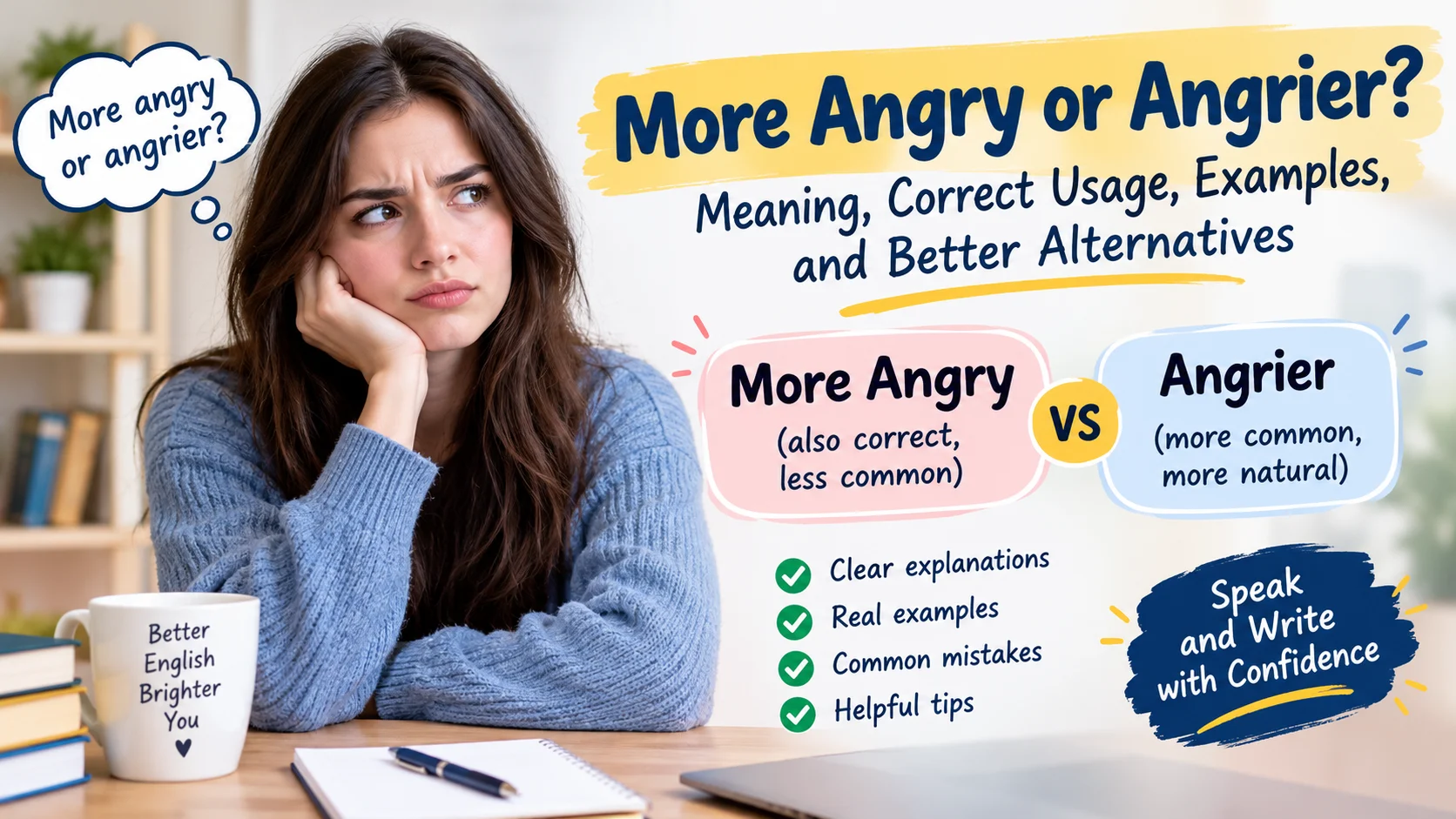
Have you ever wondered if “more angry” or “angrier” is the correct expression? Both phrases can be used in English to compare levels of anger, but they differ in style and naturalness. Understanding when to use each form will help you speak and write more confidently.
The word angry describes a feeling of annoyance, frustration, or displeasure. When you want to compare how angry two people are, or describe how someone’s anger increases, you can use a comparative form. “Angrier” is generally the more natural and common choice, while “more angry” is also grammatically acceptable in many contexts. The best option depends on the sentence, the intended emphasis, and the rhythm of your writing. In this guide, you will learn the difference between “more angry” and “angrier,” explore practical examples, discover common mistakes, and find alternative expressions that make your English sound more natural.
Quick Answer: More Angry or Angrier?
Both “more angry” and “angrier” are grammatically acceptable comparative forms of “angry.” However, “angrier” is generally more common and natural in everyday English. Use it when comparing two levels of anger, such as “She became angrier.” “More angry” can also be used for emphasis or when it fits the sentence better.
Why Do People Confuse “More Angry” and “Angrier”?
People often confuse these expressions because English has two common ways to form comparative adjectives.
The first method adds -er to an adjective:
- Small → Smaller
- Fast → Faster
- Angry → Angrier
The second method places more before an adjective:
- Beautiful → More beautiful
- Interesting → More interesting
- Careful → More careful
Because both methods express comparison, learners may wonder if “more angry” is incorrect.
The answer is no. Both forms can be correct, but “angrier” is usually preferred in ordinary conversation.
Another source of confusion is the spelling of “angry.” When adding the comparative ending, the y changes to i, producing “angrier,” not “angryer.”
First Word: Understanding “More”
The word more indicates a greater amount, degree, or quantity.
When placed before an adjective, it can create a comparative expression.
Examples:
- She is more confident than before.
- This book is more interesting than the previous one.
- He seems more angry today than he did yesterday.
In the last example, “more” emphasizes a higher degree of anger.
Although “more angry” is acceptable, many speakers would naturally say, “He seems angrier today than he did yesterday.”
Remember: More can be used to form comparisons, but it is not necessary for every adjective.
Second Word: Understanding “Angry”
Angry is an adjective that describes someone who feels anger, frustration, or strong displeasure.
Examples:
- My brother is angry about the decision.
- The customer became angry after waiting for an hour.
- She sounded angry during the conversation.
The comparative form of “angry” is commonly written as angrier.
Examples:
- He is angrier than his brother.
- She became angrier when nobody listened.
- The teacher looked angrier after hearing the explanation.
The spelling follows a familiar English pattern: adjectives ending in a consonant followed by y often change y to i before adding -er.
For example:
- Happy → Happier
- Busy → Busier
- Easy → Easier
- Angry → Angrier
More Angry vs. Angrier: Comparison Table
| Feature | More Angry | Angrier |
|---|---|---|
| Meaning | A greater degree of anger | A greater degree of anger |
| Grammar | Generally acceptable | Correct |
| Everyday usage | Less common in many contexts | Generally more common |
| Formation | More + angry | Angry + comparative ending |
| Example | He looks more angry today. | He looks angrier today. |
| Best advice | Use when it suits the sentence or emphasis | Usually the natural first choice |
Both expressions can communicate the same basic meaning. In most ordinary sentences, “angrier” is the simpler and more natural choice.
When Should You Use Each Expression?
1. When to Use “Angrier”
Use “angrier” when you want a straightforward comparison between two people, situations, or moments.
Examples:
- My father became angrier after hearing the news.
- She was angrier than I expected.
- The customer grew angrier as the delay continued.
This form is particularly natural in everyday conversation and general writing.
2. When to Use “More Angry”
Use “more angry” when it fits your sentence’s emphasis, structure, or rhythm.
Examples:
- He seemed more angry than disappointed.
- She was more angry about the dishonesty than about the mistake itself.
- I felt more angry after learning the full story.
The phrase can work especially well when the writer wants to contrast anger with another emotion or highlight a particular aspect of a situation.
However, “angrier” would also work in many of these sentences.
3. When You Want to Sound Natural
If you are unsure which expression to choose, start with “angrier.”
For example:
Less natural in many everyday contexts: “My friend is more angry today.”
More natural: “My friend is angrier today.”
The first sentence is not automatically wrong, but the second is generally the more direct choice.
12 Examples of “More Angry” and “Angrier”
The following examples show how both forms work in everyday English.
Example 1: Comparing Two People
Angrier: James is angrier than Michael.
More angry: James is more angry than Michael.
Both sentences compare the anger levels of two people.
Example 2: Describing a Change in Emotion
Angrier: She became angrier when he ignored her question.
More angry: She became more angry when he ignored her question.
Both describe increasing anger, although “angrier” is generally more natural.
Example 3: Talking About Work
Angrier: My manager seemed angrier after the meeting.
More angry: My manager seemed more angry after the meeting.
Both forms communicate the manager’s emotional state.
Example 4: Discussing an Argument
Angrier: He grew angrier as the argument continued.
More angry: He grew more angry as the argument continued.
The sentences describe anger increasing over time.
Example 5: Comparing Different Emotions
Angrier: She was angrier than she was disappointed.
More angry: She was more angry than disappointed.
The second version is particularly natural because it contrasts two emotions directly.
Example 6: Talking About a Customer
Angrier: The customer became angrier after waiting for another hour.
More angry: The customer became more angry after waiting for another hour.
Both sentences describe frustration developing into stronger anger.
Example 7: Discussing a Mistake
Angrier: My teacher looked angrier when I admitted my mistake.
More angry: My teacher looked more angry when I admitted my mistake.
The comparative adjective shows that the teacher’s anger increased.
Example 8: Describing a Reaction
Angrier: Her reaction became angrier after she heard the explanation.
More angry: Her reaction became more angry after she heard the explanation.
The first sentence is generally more natural, although “reaction” may be better described as more hostile or more intense, depending on the context.
Example 9: Talking About a Family Member
Angrier: My sister was angrier with me than with our brother.
More angry: My sister was more angry with me than with our brother.
Both sentences compare the sister’s feelings toward two people.
Example 10: Describing Yesterday and Today
Angrier: He seems angrier today than he did yesterday.
More angry: He seems more angry today than he did yesterday.
Both versions compare the person’s current mood with a previous mood.
Example 11: Comparing Reactions to News
Angrier: Dad became angrier when he heard the second part of the story.
More angry: Dad became more angry when he heard the second part of the story.
Both are understandable, but “angrier” is usually the more natural choice.
Example 12: Expressing Frustration
Angrier: I get angrier when people refuse to listen.
More angry: I get more angry when people refuse to listen.
Both sentences describe a recurring emotional response.
Common Mistakes When Using “More Angry”
English learners sometimes make small mistakes when comparing levels of anger. Here are the most important ones to avoid.
Mistake 1: Writing “Angryer”
Incorrect: She became angryer after the argument.
Correct: She became angrier after the argument.
Why? The y changes to i before adding -er.
Mistake 2: Assuming “More Angry” Is Always Wrong
Incorrect rule: You must never say “more angry.”
Better understanding: Both “more angry” and “angrier” are acceptable comparative forms.
For example, “He seems more angry than upset” is understandable and natural in many contexts.
Mistake 3: Using “Most Angry” for Every Comparison
“Most angry” can express the highest degree of anger among three or more people or things, but “angriest” is often the more natural choice.
Example:
Less natural in many contexts: She was the most angry person in the room.
More natural: She was the angriest person in the room.
Both forms can be grammatical, depending on the context.
Mistake 4: Using “More Angrier”
Incorrect: He became more angrier after the discussion.
Correct: He became angrier after the discussion.
Why? “More angrier” combines two comparative markers. In standard English, use one comparative form rather than both together.
Mistake 5: Confusing “Angry” With “Angrily”
Incorrect: She spoke angry to her brother.
Correct: She spoke angrily to her brother.
“Angry” is an adjective, while “angrily” is an adverb that describes how someone performs an action.
Memory Trick: How to Remember “Angrier”
Use this simple memory trick:
Angry + comparative = Angrier
Think of the familiar pattern:
- Happy → Happier
- Hungry → Hungrier
- Angry → Angrier
When an adjective ends in a consonant followed by y, the y often changes to i before adding -er.
To remember the difference between the two expressions, use this rule:
When in doubt, choose “angrier.”
It is generally shorter, more direct, and more natural in everyday English.
American vs. British English: Is There a Difference?
There is no major grammatical difference between American and British English when it comes to “more angry” and “angrier.”
Both forms are understood in both varieties.
Examples in American English:
- He looks angrier today.
- She seems more angry about the decision than disappointed.
Examples in British English:
- He looks angrier today.
- She seems more angry about the decision than disappointed.
The choice is mainly a matter of sentence structure, emphasis, and personal style rather than a strict difference between American and British English.
For everyday speech and writing in either variety, “angrier” is generally a safe and natural choice.
Similar Words and Related Expressions
Several words can describe anger, but they do not all mean exactly the same thing.
| Word or Expression | Meaning | Example |
|---|---|---|
| Angry | Feeling anger | He is angry about the delay. |
| Angrier | More angry than someone or something else | She is angrier than her brother. |
| Angriest | Having the highest degree of anger in a group | He was the angriest person there. |
| Furious | Extremely angry | She was furious about the lie. |
| Irritated | Slightly angry or annoyed | He felt irritated by the noise. |
| Annoyed | Bothered or mildly angry | I was annoyed by the interruption. |
| Upset | Unhappy, distressed, or troubled | She was upset about the argument. |
| Frustrated | Annoyed because something is difficult or unsuccessful | He felt frustrated by the delay. |
| More upset | Experiencing a greater degree of distress | She seemed more upset after the call. |
| More frustrated | Experiencing greater frustration | I became more frustrated with the process. |
Choose the word that best describes the emotion you want to express. Someone who is irritated may not be furious, and a person who is upset may be sad rather than angry.
Final Verdict: Which Expression Should You Choose?
Both “more angry” and “angrier” are grammatically acceptable, but “angrier” is generally the more common and natural choice in everyday English.
Use “angrier” for straightforward comparisons:
- She is angrier than before.
- He became angrier after the argument.
Use “more angry” when it fits the emphasis or structure of your sentence:
- She was more angry than disappointed.
- He seemed more angry about the delay than the actual mistake.
If you are writing an essay, sending a message, or speaking English in everyday situations, you can usually choose “angrier” without hesitation.
Frequently Asked Questions
1. Is “more angry” grammatically correct?
Yes. “More angry” is a grammatically acceptable comparative expression. However, “angrier” is generally more common and natural in everyday English.
Example: “He looks angrier today” is a natural way to describe an increase in anger.
2. Is “angrier” or “more angry” better?
“Angrier” is usually the better choice for simple comparisons because it is concise and widely used.
For example, “She became angrier after the conversation” sounds natural. “More angry” can also work when you want a particular emphasis or contrast.
3. Why does “angry” become “angrier”?
English commonly changes the final y to i when an adjective ending in a consonant plus y takes the comparative ending -er.
Examples include:
- Angry → Angrier
- Happy → Happier
- Easy → Easier
4. Can I say “more angrier”?
No. In standard English, “more angrier” is considered incorrect because it combines two comparative markers.
Say “angrier” or, where appropriate, “more angry.”
Correct: He became angrier after the argument.
Also correct: He became more angry after the argument.
5. What is the superlative form of “angry”?
The usual superlative form is angriest.
Use it when comparing three or more people or things and identifying the one with the highest degree of anger.
Example: “She was the angriest person in the room.”
“Most angry” is also possible in certain contexts, but “angriest” is generally more natural.
6. What is the opposite of “angry”?
Possible opposites include calm, peaceful, relaxed, and content, depending on the context.
Example: “He was angry before the meeting, but he felt calm afterward.”
7. Can I use “angrier” in formal writing?
Yes. “Angrier” is appropriate in formal and informal English.
For example: “The public became angrier as concerns about the decision increased.”
You do not need to replace “angrier” with “more angry” to make your writing formal.
8. Is “more angry than upset” correct?
Yes. “More angry than upset” is a natural way to compare two emotional states.
Example: “I was more angry than upset when I discovered the mistake.”
The expression emphasizes that anger was the stronger emotion.
Remember This
- Angry: The basic adjective describing anger.
- Angrier: The usual comparative form.
- More angry: An acceptable alternative in many contexts.
- Angriest: The usual superlative form.
- More angrier: Incorrect in standard English because it uses two comparative markers.
For most everyday situations, choose “angrier.” Use “more angry” when it better expresses your intended meaning or emphasis.
Conclusion
Understanding the difference between “more angry” and “angrier” makes English comparisons easier. Both expressions can be correct, but “angrier” is generally more natural and common in everyday speech and writing. Remember the spelling rule: angry becomes angrier by changing the final y to i before adding -er.
The next time you describe someone’s feelings, try using “angrier” in a sentence such as “He became angrier after the discussion.” If you want to emphasize a contrast, “more angry than disappointed” may work better. With a little practice, you will know which expression fits your sentence and communicate your ideas more clearly.

I am Amelia Jane, an author at ReplyLop, passionate about creating helpful, thoughtful, and engaging replies that make conversations easier, clearer, and more meaningful for everyone.