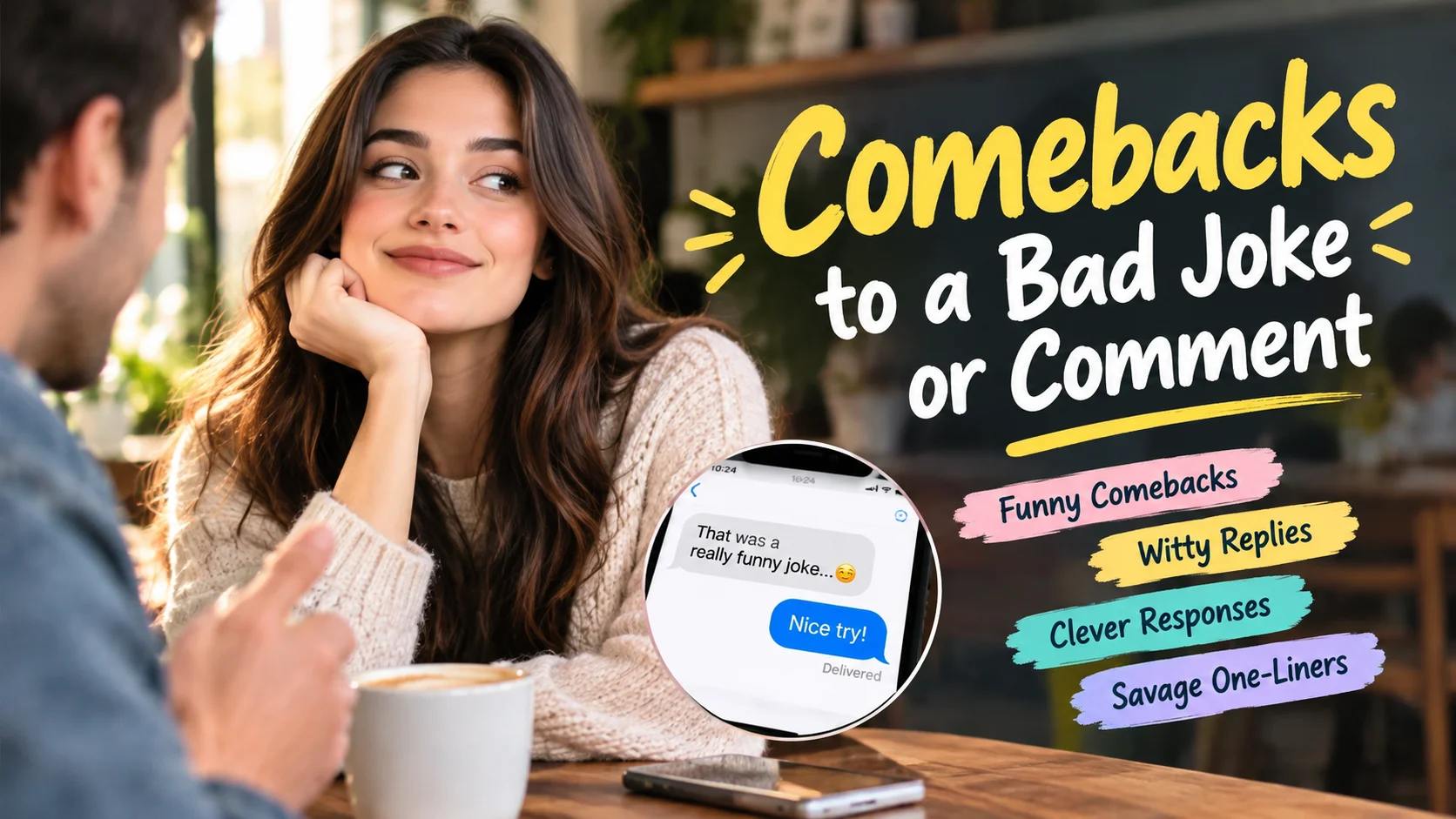
Sometimes people make jokes that simply are not funny. Other times, a comment crosses the line and leaves you wondering how to respond without making the situation even worse. Having a few clever comebacks to a bad joke or comment can help you stay confident, composed, and in control of the conversation.
The best response does not always have to be harsh or insulting. A witty reply, playful comeback, sarcastic answer, or calm one-liner can communicate that the comment was unnecessary while keeping your dignity intact. The key is choosing a response that matches the situation, your relationship with the person, and how far the comment went.
1. “Was That Supposed to Be Funny?”
Best for: A joke that completely misses the mark.
Alternative: “I’m trying to find the funny part.”
Examples:
“Was that supposed to be funny?”
“I think the joke needs a little more work.”
Sometimes the simplest reaction is the most effective. Asking whether the person intended to be funny puts the awkwardness back where it belongs without requiring a long argument.
2. “Nice Try”
Best for: Someone making a weak attempt at teasing you.
Alternative: “Good effort.”
Examples:
“Nice try, but I’m not offended.”
“Good effort. Maybe next time.”
This comeback is short, confident, and slightly playful. It works especially well when you do not want to give the comment too much attention.
3. “You Can Do Better Than That”
Best for: Someone who normally has a better sense of humor.
Alternative: “I expected better from you.”
Examples:
“You can definitely do better than that.”
“I know you have better jokes than this.”
This response keeps things relatively friendly while letting the person know their comment was disappointing.
4. “I’ll Pretend I Didn’t Hear That”
Best for: An awkward or unnecessary comment.
Alternative: “Let’s just pretend that never happened.”
Examples:
“I’ll pretend I didn’t hear that.”
“Okay, we’re going to erase that moment.”
A humorous response can make an uncomfortable situation feel lighter while signaling that the comment was not appreciated.
5. “That Joke Needs a Rewrite”
Best for: A terrible joke that sounds forced.
Alternative: “Maybe try that one again.”
Examples:
“That joke definitely needs a rewrite.”
“Let’s work on the punchline.”
This is a clever way to criticize the joke rather than directly attacking the person.
6. “I’m Not Sure What You Were Going For”
Best for: Confusing or poorly delivered comments.
Alternative: “What exactly was the joke?”
Examples:
“I’m not sure what you were going for there.”
“Was that supposed to make sense?”
Asking for clarification can make a bad joke lose its power quickly. Sometimes the person realizes how awkward the comment sounds when they have to explain it.
7. “That Was Painful”
Best for: An exceptionally bad joke among friends.
Alternative: “That was difficult to listen to.”
Examples:
“Wow, that joke was painful.”
“I think we all felt that one.”
This comeback works best in casual situations where playful teasing is already part of the relationship.
8. “Let’s Move On”
Best for: Comments that are uncomfortable or inappropriate.
Alternative: “Anyway, moving on…”
Examples:
“Let’s move on from that comment.”
“Anyway, let’s talk about something else.”
Not every bad comment deserves a clever insult. Sometimes confidently changing the subject is the strongest response.
9. “Interesting Choice of Words”
Best for: A comment that sounds rude or questionable.
Alternative: “That was an interesting thing to say.”
Examples:
“Interesting choice of words.”
“That’s certainly one way to put it.”
This comeback is subtle and often more powerful than an aggressive response because it makes the speaker reconsider what they said.
10. “Did You Practice That?”
Best for: A rehearsed or predictable insult.
Alternative: “How long did you wait to say that?”
Examples:
“Did you practice that one beforehand?”
“Was that comeback prepared?”
This playful response works when someone delivers an insult as though they have just produced the greatest comeback ever.
11. “I’ll Give You Points for Confidence”
Best for: Someone confidently delivering a terrible joke.
Alternative: “The confidence was impressive.”
Examples:
“I’ll give you points for confidence.”
“That was bold, considering the joke.”
You acknowledge their confidence without pretending their joke was actually funny.
12. “That Didn’t Land”
Best for: A joke that gets absolutely no reaction.
Alternative: “That one fell flat.”
Examples:
“Yeah, that really didn’t land.”
“I think that joke missed its destination.”
This is one of the easiest funny responses to use because it directly describes what happened without becoming overly personal.
13. “You Lost Me at the Beginning”
Best for: Long jokes that make no sense.
Alternative: “I stopped understanding three sentences ago.”
Examples:
“You lost me at the beginning.”
“I was confused before we even reached the punchline.”
A little humor can make this response feel more playful than insulting.
14. “I’m Going to Give That a Zero”
Best for: Friendly situations where you want a humorous roast.
Alternative: “That gets a solid two out of ten.”
Examples:
“I’m giving that joke a zero.”
“Two out of ten for effort.”
Pretending to be a comedy judge gives you a funny way to respond without becoming genuinely hostile.
15. “That’s Your Best One?”
Best for: Someone who is trying hard to impress the group.
Alternative: “That’s what you came up with?”
Examples:
“That’s your best one?”
“That was the joke you decided to go with?”
This comeback is effective because it challenges the quality of the joke while keeping your response brief.
16. “I Think the Joke Was on You”
Best for: Someone whose joke accidentally makes them look silly.
Alternative: “Plot twist: you roasted yourself.”
Examples:
“I think the joke was actually on you.”
“Congratulations, you accidentally roasted yourself.”
This works particularly well when someone tries to make fun of you but ends up making an embarrassing point about themselves.
17. “Thanks for the Entertainment”
Best for: A silly or ridiculous comment.
Alternative: “Well, that was entertaining.”
Examples:
“Thanks for the entertainment.”
“I needed a laugh today, so thanks.”
This response turns the situation around by refusing to take the comment seriously.
18. “That’s Certainly an Opinion”
Best for: A rude opinion disguised as humor.
Alternative: “You’re entitled to your opinion.”
Examples:
“That’s certainly an opinion.”
“Interesting opinion. I’ll leave it there.”
This is a calm comeback that works especially well when you want to avoid an unnecessary argument.
19. “Were You Trying to Roast Me?”
Best for: Someone attempting a weak insult.
Alternative: “Was that supposed to be a roast?”
Examples:
“Were you trying to roast me?”
“That was more of a light toast than a roast.”
The second version adds humor and is especially useful among friends.
20. “You’ll Get Them Next Time”
Best for: A friend whose joke failed spectacularly.
Alternative: “Better luck with the next one.”
Examples:
“You’ll get them next time.”
“Keep practicing. Your breakthrough is coming.”
This is a playful way to respond without turning a bad joke into a serious conflict.
21. “I’m Not Taking the Bait”
Best for: Someone deliberately trying to provoke you.
Alternative: “Nice attempt, but I’m not falling for it.”
Examples:
“I’m not taking the bait.”
“Nice try, but I’m not giving you the reaction you want.”
When someone is clearly trying to get a reaction, staying calm can be more effective than delivering a harsher insult.
22. “That Was Unnecessary”
Best for: A comment that crosses a personal boundary.
Alternative: “You could have kept that to yourself.”
Examples:
“That was unnecessary.”
“I don’t think that comment was needed.”
Not every situation calls for humor. When a joke becomes disrespectful, a direct response can communicate your boundary clearly.
23. “Let’s Keep It Respectful”
Best for: Rude comments in professional or public settings.
Alternative: “Let’s keep the conversation respectful.”
Examples:
“Let’s keep it respectful.”
“I’m happy to talk, but let’s keep the comments respectful.”
This is a mature comeback when sarcasm could make the situation worse.
24. “That Says More About You”
Best for: Personal insults disguised as jokes.
Alternative: “That comment tells me more about you than me.”
Examples:
“That says more about you than it does about me.”
“I’m comfortable with myself, so I’ll leave that comment with you.”
This response redirects attention away from the insult and shows emotional confidence.
25. “I’m Choosing Not to Respond to That”
Best for: Comments that are too offensive to joke about.
Alternative: “I’m not giving that comment any attention.”
Examples:
“I’m choosing not to respond to that.”
“I don’t think that deserves a response.”
Sometimes silence is the ultimate comeback. You do not owe everyone a witty answer.
26. “Okay… Anyway”
Best for: Minor awkward comments when you want to move forward.
Alternative: “Anyway, back to the actual conversation.”
Examples:
“Okay… anyway, what were you saying?”
“Right. Anyway, let’s continue.”
This is especially useful when you want to show that the comment did not bother you enough to derail the conversation.
27. “You Really Said That Out Loud”
Best for: Surprisingly inappropriate or ridiculous remarks.
Alternative: “You actually thought that was worth saying?”
Examples:
“You really said that out loud?”
“I’m impressed you decided to say that publicly.”
This comeback draws attention to the speaker’s decision without requiring you to insult them directly.
28. “I’ll Give You One More Chance”
Best for: Playful banter with close friends.
Alternative: “Take two.”
Examples:
“I’ll give you one more chance. Try again.”
“Take two. That one didn’t work.”
Keep this one for friendly conversations where both people understand the teasing is harmless.
29. “That’s Not Going to Bother Me”
Best for: Someone clearly trying to hurt your feelings.
Alternative: “You’re going to have to try harder than that.”
Examples:
“That’s not going to bother me.”
“If you were trying to upset me, it didn’t work.”
A confident response shows that you control your reaction rather than allowing someone else’s comment to control your mood.
30. “I Think We’re Done Here”
Best for: A conversation that has become disrespectful.
Alternative: “I’m not continuing this conversation.”
Examples:
“I think we’re done here.”
“I’m walking away from this conversation.”
When a joke becomes harassment, repeated disrespect, or personal attacks, ending the conversation is often better than trying to win with a clever comeback.
How to Choose the Right Comeback
The best comeback depends on the context. A playful joke between close friends deserves a different response from an insulting comment at work or a disrespectful remark from a stranger.
Before responding, consider three things: how offensive the comment was, who said it, and what outcome you want. If you simply want to keep things light, use humor. If someone crossed a boundary, be direct. If they are intentionally provoking you, refusing to engage may be your strongest move.
Remember that being quick-witted does not mean being cruel. The most effective comeback often makes your point while allowing you to remain calm and confident.
Frequently Asked Questions
1. What is a good comeback to a bad joke?
A simple response such as “Was that supposed to be funny?” or “Nice try” can work well. Choose a playful or direct response depending on the situation.
2. How do you respond to a rude comment without being rude?
Stay calm and use a confident statement such as “That was unnecessary” or “Let’s keep it respectful.” You can also change the subject rather than escalating the situation.
3. What is a funny response to an unfunny joke?
Try “That joke really didn’t land,” “I’m giving that a two out of ten,” or “I think you’ll get them next time.”
4. Should I ignore a bad comment?
Ignoring a comment can be the best choice when someone is clearly trying to provoke you. You do not need to respond to every joke, insult, or opinion.
5. How can I make my comebacks sound natural?
Keep your response short and match your normal speaking style. A natural one-liner delivered calmly usually sounds more confident than an overly complicated insult.
Conclusion
Having a few clever comebacks to a bad joke or comment can make awkward conversations much easier to handle. Whether you choose a funny comeback, sarcastic response, witty one-liner, or calm boundary-setting statement, the goal is not simply to win the exchange. It is to respond in a way that fits the moment and protects your confidence.
When the comment is harmless, have fun with it. When it is rude, speak up. And when someone is deliberately trying to provoke you, remember that walking away can be more powerful than any comeback. Choose your words wisely, stay composed, and let your response reflect the kind of person you want to be.

I’m Victor Daniel, a passionate writer at ReplyLop. I enjoy creating helpful, friendly, funny, and thoughtful replies that make conversations easier, clearer, and more engaging.