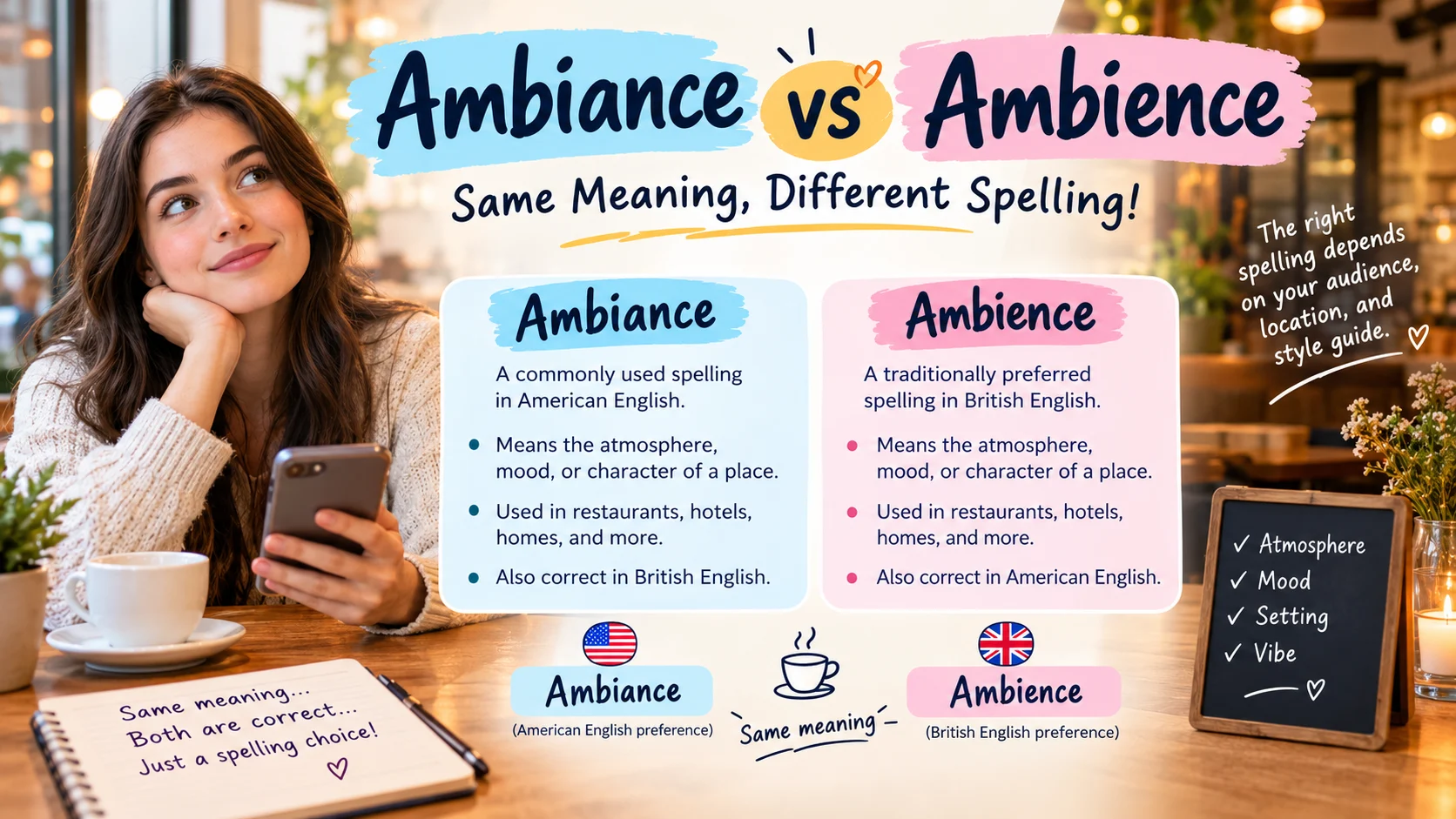
Have you ever wondered if to write ambiance or ambience? Both spellings are correct, and both describe the atmosphere, mood, or feeling of a place. if you are describing a cozy café, a romantic restaurant, a peaceful garden, or a lively party, you can use either word without changing the basic meaning.
The main difference between ambiance and ambience is their spelling and regional preference. Ambiance is more commonly associated with American English, while ambience is traditionally preferred in British English. However, both forms are understood in English-speaking countries, and neither is grammatically incorrect. Choosing the right spelling depends mainly on your audience, location, and writing style. In this guide, you will learn what each word means, how to use it in sentences, which spelling to choose, and how to avoid common mistakes. You will also discover practical examples that make the difference easy to remember.
Quick Answer: Ambiance vs Ambience
Ambiance and ambience mean exactly the same thing: the atmosphere, mood, or character of a place. Ambiance is commonly preferred in American English, while ambience is traditionally preferred in British English. Both spellings are correct, and you can use either when describing the feeling created by lighting, sounds, decorations, or other surroundings.
Why Do People Confuse Ambiance and Ambience?
People often confuse these words because they have the same meaning, pronunciation in many varieties of English, and grammatical function.
Both words are nouns. They describe the overall feeling or atmosphere of an environment rather than a specific object.
For example:
- The restaurant has a romantic ambiance.
- The restaurant has a romantic ambience.
Both sentences are correct. The only difference is the spelling.
The confusion also comes from regional spelling conventions. American English often favors ambiance, whereas British English traditionally favors ambience. However, these preferences are not absolute, and both spellings appear in different English-speaking regions.
First Word: What Does Ambiance Mean?
Ambiance is a noun that means the atmosphere, mood, or overall feeling of a place.
It describes how a setting feels to the people experiencing it. Several elements can contribute to a place’s ambiance, including:
- Lighting: Soft lights can create a relaxing ambiance.
- Music: Gentle music can produce a peaceful ambiance.
- Decorations: Elegant furniture can give a room a luxurious ambiance.
- Colors: Warm colors can make a space feel welcoming.
- People: Friendly guests can create a lively ambiance.
- Sounds: Quiet surroundings can create a calm ambiance.
Examples of Ambiance in Sentences
- The hotel is famous for its luxurious ambiance.
- Soft lighting gives the restaurant a romantic ambiance.
- I love the cozy ambiance of this little coffee shop.
- The music created a cheerful ambiance at the party.
- The office has a professional ambiance that helps employees focus.
In each example, ambiance describes the overall feeling of a place.
Second Word: What Does Ambience Mean?
Ambience is also a noun meaning the atmosphere, mood, or character of a place.
It describes the same qualities as ambiance, including the effects of lighting, sound, design, and surroundings.
For example:
- The garden has a peaceful ambience.
- The hotel offers a warm and welcoming ambience.
- The restaurant’s ambience makes it perfect for a date.
All three sentences use ambience correctly.
The spelling is traditionally associated with British English, although it is also used in American English and other varieties of English.
Examples of Ambience in Sentences
- The café has a relaxed ambience.
- The soft music adds to the peaceful ambience.
- We enjoyed the elegant ambience of the wedding venue.
- The candles created a romantic ambience in the bedroom.
- The library’s quiet ambience makes it an excellent place to study.
Notice that these sentences would retain their meaning if you replaced ambience with ambiance.
Ambiance vs Ambience: Comparison Table
| Feature | Ambiance | Ambience |
|---|---|---|
| Meaning | Atmosphere or mood | Atmosphere or mood |
| Part of speech | Noun | Noun |
| American English | Commonly preferred | Also used |
| British English | Also used | Traditionally preferred |
| Pronunciation | Usually the same | Usually the same |
| Describes | A place’s overall feeling | A place’s overall feeling |
| Correct spelling? | Yes | Yes |
| Example | The ambiance is relaxing. | The ambience is relaxing. |
Key takeaway: Neither spelling is more correct than the other. The choice is primarily a matter of regional preference and consistency.
When Should You Use Ambiance or Ambience?
Choosing between these spellings is straightforward once you consider your audience.
1. Use Ambiance for American English
If you are writing for an American audience, ambiance is a natural choice.
Examples:
- The restaurant’s ambiance is perfect for a romantic dinner.
- We redesigned the living room to create a welcoming ambiance.
This spelling is particularly familiar in American restaurant descriptions, lifestyle writing, and everyday conversation.
2. Use Ambience for British English
If your audience primarily uses British English, ambience is a suitable choice.
Examples:
- The hotel offers a relaxing ambience.
- The café’s traditional ambience attracts many visitors.
This spelling fits naturally into British English writing, although ambiance is also understood.
3. Use Either Word in General Writing
When writing for an international audience, either spelling is acceptable.
For example:
- The resort has a beautiful ambiance.
- The resort has a beautiful ambience.
Both sentences communicate the same idea.
Choose one spelling and use it consistently throughout your article or document.
4. Follow Your Organization’s Style Guide
Businesses, publishers, schools, and publications may have preferred spelling conventions.
If a style guide specifies ambience, use that form throughout the document. If it prefers ambiance, follow that preference instead.
Consistency matters more than choosing one spelling as universally correct.
12 Examples of Ambiance vs Ambience in Everyday English
The following examples show how both spellings work in different situations.
Example 1: Describing a Restaurant
- The restaurant has a romantic ambiance.
- The restaurant has a romantic ambience.
Both sentences describe the restaurant’s overall atmosphere.
Example 2: Talking About a Coffee Shop
- I love the cozy ambiance of this coffee shop.
- I love the cozy ambience of this coffee shop.
Both versions describe a comfortable, welcoming environment.
Example 3: Describing a Hotel
- The hotel creates a luxurious ambiance for its guests.
- The hotel creates a luxurious ambience for its guests.
Either spelling works in a hotel description.
Example 4: Describing a Wedding
- The candles gave the wedding a magical ambiance.
- The candles gave the wedding a magical ambience.
Both sentences describe the mood created by the decorations.
Example 5: Talking About a Bedroom
- Soft lighting creates a peaceful ambiance in the bedroom.
- Soft lighting creates a peaceful ambience in the bedroom.
Both versions suggest a calm and relaxing environment.
Example 6: Describing an Office
- The modern furniture gives the office a professional ambiance.
- The modern furniture gives the office a professional ambience.
Both sentences describe the impression created by the office environment.
Example 7: Describing a Party
- The DJ created a lively ambiance at the party.
- The DJ created a lively ambience at the party.
Both sentences communicate an energetic, enjoyable atmosphere.
Example 8: Describing a Garden
- The garden has a peaceful ambiance in the early morning.
- The garden has a peaceful ambience in the early morning.
Both forms describe the garden’s calming atmosphere.
Example 9: Talking About a Library
- The library’s quiet ambiance helps me concentrate.
- The library’s quiet ambience helps me concentrate.
Both versions describe an environment suitable for studying.
Example 10: Describing a Spa
- The spa’s relaxing ambiance helps visitors unwind.
- The spa’s relaxing ambience helps visitors unwind.
Both spellings are correct in this context.
Example 11: Writing a Restaurant Review
- The food was delicious, and the ambiance was wonderful.
- The food was delicious, and the ambience was wonderful.
Both sentences are suitable for a review.
Example 12: Describing a Shopping Mall
- The mall’s festive ambiance made holiday shopping enjoyable.
- The mall’s festive ambience made holiday shopping enjoyable.
Both versions describe the atmosphere created by seasonal decorations and activities.
Common Mistakes When Using Ambiance and Ambience
Although both spellings are correct, some mistakes can make your writing less clear.
Mistake 1: Thinking One Spelling Is Incorrect
Incorrect assumption: Ambience is always wrong in American English.
Correction: Both ambiance and ambience are correct. Regional preferences may influence which form sounds more natural.
Mistake 2: Thinking the Words Have Different Meanings
Incorrect assumption: Ambiance describes a romantic atmosphere, while ambience describes a peaceful one.
Correction: The words have the same meaning. The atmosphere being described depends on the context and accompanying adjectives.
Mistake 3: Changing Spellings Without a Reason
Using ambiance in one paragraph and ambience in another may look inconsistent.
Better approach: Choose one spelling based on your audience or style guide, then use it throughout your writing.
Mistake 4: Confusing Ambiance With Ambitious
Ambiance means atmosphere, while ambitious describes someone who strongly wants to achieve something.
Examples:
- The restaurant has a pleasant ambiance.
- She is an ambitious student.
These words have different meanings and should not be confused.
Mistake 5: Using Ambiance to Describe Only Decorations
Decorations can influence a place’s ambiance, but ambiance refers to the overall atmosphere.
For example, the ambiance of a restaurant may depend on its lighting, music, furniture, service, and the behavior of its guests.
Memory Trick: How to Remember Ambiance vs Ambience
Use this simple trick to remember which spelling to choose.
Ambiance = American preference
Both words begin with ambi-, but ambiance ends in -ance. You can associate that spelling with the American preference.
Ambience = British preference
The ending -ence can remind you of the traditional British spelling.
Remember that this is only a memory aid, not a strict rule. Both forms are accepted in both varieties of English.
Another easy trick is to remember the meaning instead of the spelling:
Ambiance or ambience = the feeling of a place.
If you are describing if a restaurant feels cozy, romantic, elegant, or lively, either word can work.
Ambiance vs Ambience in American and British English
The main difference between these words is their traditional regional preference.
American English
In American English, ambiance is commonly preferred.
Examples:
- The restaurant has a warm ambiance.
- The hotel is known for its luxurious ambiance.
You may also encounter ambience in American publications and everyday writing.
British English
In British English, ambience is traditionally preferred.
Examples:
- The restaurant has a welcoming ambience.
- The hotel offers a peaceful ambience.
However, ambiance is also used in British English.
Which Spelling Should ESL Learners Use?
If you are learning English as a second language, you can safely learn both forms.
Choose ambiance when following American English conventions and ambience when following traditional British English conventions.
If you are preparing for an examination, completing an assignment, or writing for a particular publication, follow the spelling conventions recommended by your teacher or style guide.
The important thing is to understand the meaning and use the word naturally.
Similar Words to Ambiance and Ambience
Several English words have meanings related to ambiance and ambience. However, they are not always interchangeable.
| Word | Meaning | Example |
|---|---|---|
| Atmosphere | The overall feeling or character of a place or situation | The restaurant has a friendly atmosphere. |
| Mood | A particular emotional feeling | The soft music created a romantic mood. |
| Environment | The surrounding conditions in which someone or something exists | The office provides a comfortable working environment. |
| Setting | The place or surroundings where something happens | The garden was a beautiful setting for the wedding. |
| Vibe | The general feeling or impression of a person or place; informal | This café has a relaxed vibe. |
| Character | The distinctive qualities of a place or thing | The old building has plenty of character. |
| Aura | A distinctive atmosphere or impression associated with someone or something | The room had an aura of elegance. |
Ambiance vs Atmosphere
Atmosphere is one of the closest synonyms for ambiance and ambience.
For example:
- The café has a cozy ambiance.
- The café has a cozy atmosphere.
Both sentences describe how the café feels.
Ambiance vs Mood
Mood often focuses more directly on an emotional feeling, while ambiance describes the overall atmosphere that can help create that feeling.
For example:
- The lighting creates a relaxing ambiance.
- The relaxing music puts me in a good mood.
Ambiance vs Vibe
Vibe is more informal and common in casual conversation.
For example:
- This restaurant has a sophisticated ambiance.
- This restaurant has a great vibe.
Both sentences describe the restaurant positively, but the tone differs.
Final Verdict: Ambiance or Ambience?
The correct choice is both.
Ambiance and ambience are two accepted spellings of the same noun. They describe the atmosphere, mood, or overall feeling of a place.
Use ambiance if you prefer the spelling commonly associated with American English. Choose ambience if you follow traditional British English spelling conventions.
Neither spelling is inherently more correct, and both are widely understood. When writing for a specific audience, follow its preferred conventions and maintain consistency throughout your text.
Frequently Asked Questions
1. Is ambiance or ambience correct?
Both ambiance and ambience are correct English spellings. They have the same meaning and refer to the atmosphere, mood, or character of a place. The choice generally depends on regional preference or a publication’s style guide.
2. What is the difference between ambiance and ambience?
There is no difference in meaning. Ambiance is commonly associated with American English, while ambience is traditionally preferred in British English. Both words can describe the atmosphere of a restaurant, hotel, home, garden, or other setting.
3. Is ambiance American or British English?
Ambiance is commonly preferred in American English. However, it is not exclusive to the United States and is also used in British English. Both spellings are accepted internationally.
4. Is ambience British or American English?
Ambience is traditionally preferred in British English, but it is also used in American English. It is a correct spelling in both varieties.
5. How do you pronounce ambiance and ambience?
Both words are commonly pronounced the same way, although pronunciation can vary slightly by accent. A typical pronunciation is AM-bee-uhns, with the stress on the first syllable.
6. Can I use ambiance and ambience interchangeably?
Yes. You can generally use them interchangeably because they have the same meaning. However, it is best to choose one spelling and use it consistently within the same document.
7. What is another word for ambiance or ambience?
Common alternatives include atmosphere, mood, environment, setting, and vibe. The best choice depends on the context and the level of formality you want.
8. Which spelling should I use in formal writing?
Both spellings are suitable for formal writing. Choose ambiance for a style that follows common American English preferences or ambience for one that follows traditional British English preferences. If your organization has a style guide, follow its recommendation.
Remember This
- Ambiance: A correct spelling commonly preferred in American English.
- Ambience: A correct spelling traditionally preferred in British English.
- Meaning: Both words describe the atmosphere, mood, or character of a place.
- Grammar: Both words are nouns.
- Best practice: Choose the spelling that suits your audience and use it consistently.
Conclusion
The difference between ambiance and ambience is mainly a matter of spelling preference, not meaning. Both words describe the atmosphere or overall feeling of a place, if it is a cozy café, an elegant hotel, a romantic restaurant, or a peaceful garden. Neither spelling is incorrect, and both are understood by English speakers around the world.
If you write primarily for an American audience, ambiance is a natural choice. If you follow British English conventions, ambience is traditionally preferred. Most importantly, understand what the word means, use it in the right context, and remain consistent in your writing. Once you remember these simple points, choosing between ambiance and ambience becomes easy.

I am Amelia Jane, an author at ReplyLop, passionate about creating helpful, thoughtful, and engaging replies that make conversations easier, clearer, and more meaningful for everyone.