Have you ever wondered if to use “compared to” or “as compared to” in a sentence? Both phrases are grammatically acceptable in English, and both help readers understand similarities or differences between two people, things, ideas, or situations. However, they can sound slightly different depending on the context and sentence structure.
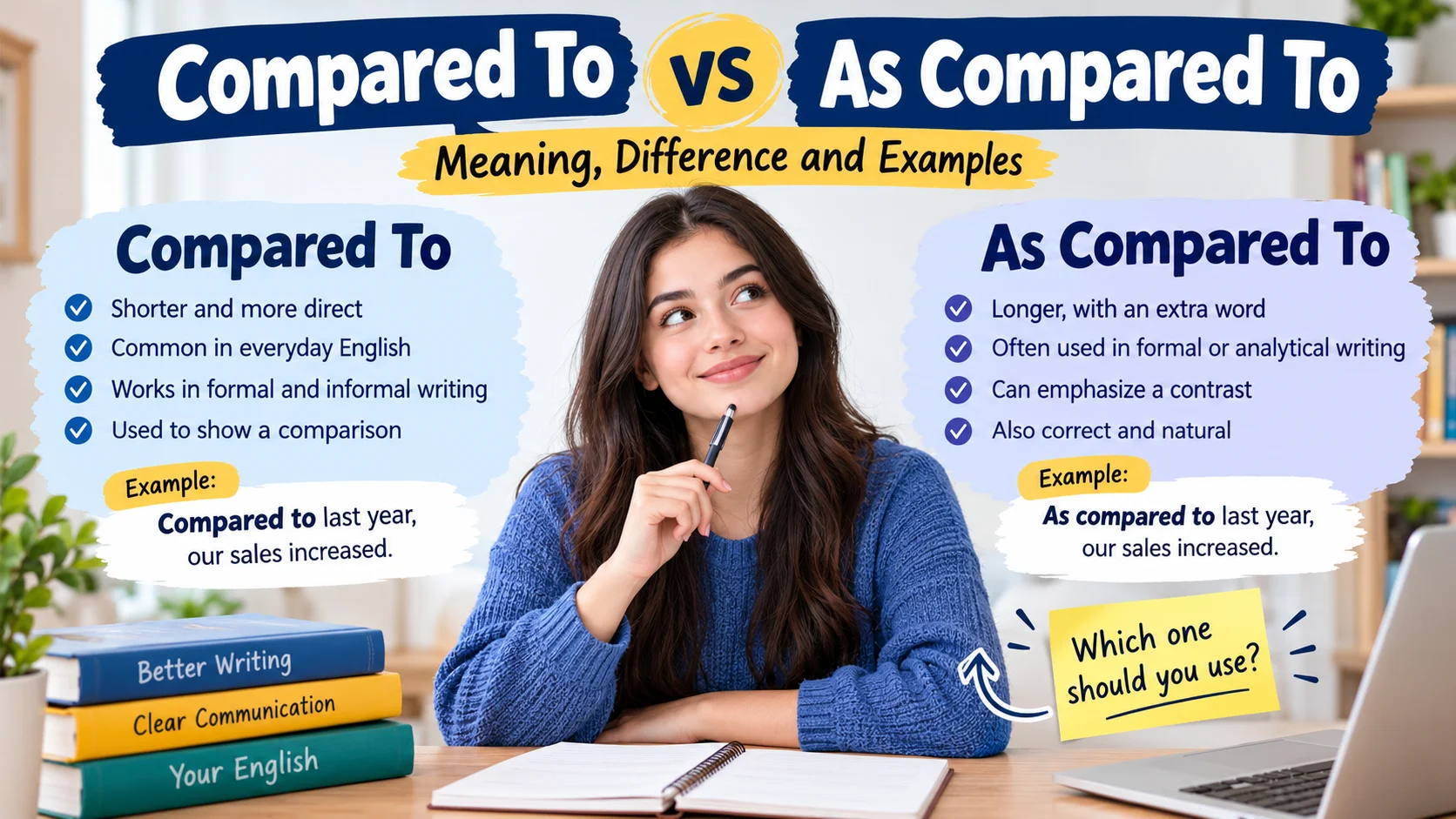
The main difference is that “compared to” is shorter, more direct, and more common in everyday English, while “as compared to” often emphasizes a contrast or comparison, particularly in formal or analytical writing. In many sentences, you can use either phrase without significantly changing the meaning. The best choice depends on what you want to emphasize and how naturally the sentence reads.
In this guide, you will learn the meanings of both expressions, discover when to use each one, and explore practical examples. if you are a student, an English learner, or someone who wants to improve everyday writing, these simple explanations will help you choose the right phrase with confidence.
Quick Answer: Compared To vs As Compared To
“Compared to” and “as compared to” are both correct English expressions used to show similarities or differences. “Compared to” is generally more concise and natural in everyday communication. “As compared to” can emphasize a contrast and is often found in formal, academic, or analytical writing. Choose the phrase that makes your sentence clearest.
Why Do People Confuse These Phrases?
People often confuse these expressions because they share the word “compared” and frequently communicate the same basic idea.
For example:
- Compared to last year, sales have increased.
- As compared to last year, sales have increased.
Both sentences communicate that sales are higher than they were last year.
The confusion arises because English has several expressions for making comparisons, including “compared with,” “in comparison with,” and “as opposed to.” Although these expressions are related, they do not always fit every sentence in exactly the same way.
Another reason for the confusion is that some writers assume “as compared to” is automatically more correct or professional. That is not true. Both expressions are acceptable, and adding “as” does not automatically make a sentence more formal or accurate.
The key is to understand the context and choose the expression that communicates your meaning naturally.
First Word: What Does “Compared To” Mean?
“Compared to” is a phrase used to examine the similarities or differences between two or more things.
It is widely used in everyday conversations, academic writing, business communication, and general descriptions.
Meaning of Compared To
The expression can introduce a comparison between people, objects, situations, quantities, or ideas.
For example:
- Compared to my old phone, this one is much faster.
- Compared to last month, our expenses are lower.
- Her new apartment is spacious compared to her previous one.
In each example, the phrase helps readers understand how one thing relates to another.
When Is “Compared To” Appropriate?
Use “compared to” when you want to make a clear comparison without adding unnecessary words.
It works especially well in:
- Everyday conversations
- Emails and messages
- Essays and assignments
- Product reviews
- Reports and presentations
- Discussions about prices, performance, or results
Example: Compared to other laptops in this price range, this model offers excellent battery life.
This sentence is concise, understandable, and natural.
Is “Compared To” Formal or Informal?
“Compared to” works in both formal and informal English.
You can use it in a casual conversation with a friend or in a professional report. Its suitability depends on the sentence, not simply on the level of formality.
For example:
- Informal: Compared to yesterday, today feels much warmer.
- Formal: Compared to the previous quarter, revenue increased by 12%.
Both sentences use the phrase appropriately.
Second Word: What Does “As Compared To” Mean?
“As compared to” is another expression used to introduce a comparison. It often highlights a difference between two things or draws attention to a particular contrast.
The phrase is common in formal discussions, reports, academic writing, and analytical explanations. However, it is also grammatically acceptable in ordinary communication.
Meaning of As Compared To
The expression generally means “when compared with” or “in comparison with.”
For example:
- As compared to last year, this year’s performance has improved.
- The city has a larger population as compared to the nearby town.
- As compared to traditional methods, this approach requires less time.
Each sentence compares one situation with another.
When Is “As Compared To” Appropriate?
Use “as compared to” when you want to frame a comparison explicitly, particularly in a sentence that discusses results, trends, quantities, or differences.
It may be suitable for:
- Analytical reports
- Academic discussions
- Business presentations
- Statistical explanations
- Formal descriptions
- Written comparisons between alternatives
Example: As compared to the previous study, the latest research included a larger sample.
The phrase introduces a comparison between two studies.
However, remember that “as compared to” is not automatically better than “compared to.” In many cases, the shorter expression communicates exactly the same information.
Compared To vs As Compared To: Comparison Table
| Feature | Compared To | As Compared To |
|---|---|---|
| Basic meaning | Shows a comparison | Shows a comparison |
| Grammatical status | Correct | Correct |
| Length | Shorter | Longer |
| Everyday English | Very natural | Acceptable, but sometimes wordier |
| Formal writing | Appropriate | Appropriate |
| Academic writing | Commonly suitable | Also suitable |
| Emphasis | Direct comparison | Can give the comparison more explicit framing |
| Conciseness | Generally more concise | Uses an additional word |
| Example | Compared to last year, profits rose. | As compared to last year, profits rose. |
| Best general advice | A good default choice | Use when it fits your sentence and style |
The main takeaway: Both expressions are correct, but “compared to” is usually the simpler choice when the two phrases communicate the same meaning.
When Should You Use Each Phrase?
Choosing between these expressions becomes easier when you consider the type of sentence you are writing.
1. Use “Compared To” for Everyday Communication
When speaking naturally or writing a simple sentence, “compared to” is often the most straightforward option.
Examples:
- Compared to my brother, I am taller.
- This restaurant is affordable compared to the one we visited yesterday.
- Compared to winter, spring feels pleasant.
These sentences are direct and easy to understand.
2. Use “As Compared To” When It Fits an Analytical Sentence
In reports or discussions that emphasize differences between situations, “as compared to” can work well.
Examples:
- As compared to the previous year, operating costs declined.
- The new model consumes less energy as compared to the older version.
The phrases introduce comparisons, although both sentences could be rewritten more concisely using “compared to.”
3. Use “Compared To” When You Want Concise Writing
Concise writing removes unnecessary words while preserving meaning.
For example:
Wordy: As compared to the old system, the new system is faster.
Concise: Compared to the old system, the new system is faster.
Both sentences are understandable, but the second is shorter.
4. Use Either Phrase When Both Sound Natural
You do not need to follow a strict rule that assigns one phrase to formal writing and the other to informal writing.
For example:
- Compared to the previous report, this report contains more details.
- As compared to the previous report, this report contains more details.
Both are acceptable. Your preferred writing style can determine which one you choose.
15 Examples of Compared To vs As Compared To
These examples demonstrate how both expressions work in everyday and formal contexts.
Example 1: Comparing Prices
Compared to: Compared to the local store, the online shop offers lower prices.
As compared to: As compared to the local store, the online shop offers lower prices.
Both sentences compare the prices offered by two sellers.
Example 2: Comparing Weather
Compared to: Compared to yesterday, today is much colder.
As compared to: As compared to yesterday, today is much colder.
Both expressions introduce a comparison between two days.
Example 3: Comparing Students
Compared to: Compared to his classmates, Daniel reads quickly.
As compared to: As compared to his classmates, Daniel reads quickly.
Both sentences describe Daniel’s reading speed relative to his classmates.
Example 4: Comparing Technology
Compared to: Compared to my old laptop, this computer starts faster.
As compared to: As compared to my old laptop, this computer starts faster.
Both sentences compare the performance of two computers.
Example 5: Comparing Expenses
Compared to: Compared to last month, our expenses have decreased.
As compared to: As compared to last month, our expenses have decreased.
Both expressions introduce a comparison between monthly expenses.
Example 6: Comparing Cities
Compared to: Compared to the capital, this town is quieter.
As compared to: As compared to the capital, this town is quieter.
Both sentences describe a difference in the atmosphere of two places.
Example 7: Comparing Work Performance
Compared to: Compared to last quarter, our team completed more projects.
As compared to: As compared to last quarter, our team completed more projects.
Both sentences compare the team’s results across two periods.
Example 8: Comparing Books
Compared to: Compared to the first book, the sequel has a more interesting ending.
As compared to: As compared to the first book, the sequel has a more interesting ending.
Both phrases introduce a comparison between two books.
Example 9: Comparing Exercise Routines
Compared to: Compared to walking, running generally requires more effort.
As compared to: As compared to walking, running generally requires more effort.
Both sentences compare the physical demands of two activities.
Example 10: Comparing Transportation
Compared to: Compared to driving, taking the train can be more relaxing.
As compared to: As compared to driving, taking the train can be more relaxing.
Both sentences compare two methods of transportation.
Example 11: Comparing Business Results
Compared to: Compared to the previous year, revenue increased by 15%.
As compared to: As compared to the previous year, revenue increased by 15%.
Both sentences report a change in revenue relative to the previous year.
Example 12: Comparing Learning Methods
Compared to: Compared to memorization, practical exercises can improve understanding.
As compared to: As compared to memorization, practical exercises can improve understanding.
Both sentences compare two approaches to learning.
Example 13: Comparing Mobile Phones
Compared to: Compared to my previous phone, this model takes clearer pictures.
As compared to: As compared to my previous phone, this model takes clearer pictures.
Both sentences compare camera performance.
Example 14: Comparing Populations
Compared to: Compared to the rural area, the city has a larger population.
As compared to: As compared to the rural area, the city has a larger population.
Both phrases introduce a comparison between two locations.
Example 15: Comparing Two Approaches
Compared to: Compared to the traditional approach, this method is easier to implement.
As compared to: As compared to the traditional approach, this method is easier to implement.
Both sentences explain how one method differs from another.
Writing tip: You do not need to repeat “as” every time you make a comparison. Choose the expression that sounds most natural and fits the tone of your writing.
Common Mistakes to Avoid
Although both phrases are correct, writers sometimes make mistakes when using them.
Mistake 1: Assuming “As Compared To” Is Always More Formal
Some people believe that adding “as” makes a sentence sound more professional.
Incorrect assumption: “Compared to” is only suitable for casual conversations.
Better understanding: Both expressions can appear in formal and informal contexts.
Example: Compared to the previous quarter, sales increased significantly.
This sentence is perfectly suitable for a business report.
Mistake 2: Using Extra Words Unnecessarily
Sometimes, writers use “as compared to” repeatedly when a shorter expression would be clearer.
Wordy: As compared to the previous version, the updated version is more reliable.
Concise: Compared to the previous version, the updated version is more reliable.
The second sentence communicates the same information with fewer words.
Mistake 3: Comparing Things That Are Not Comparable
A comparison should clearly identify the things being compared.
Unclear: Compared to my sister, the weather is better.
This sentence compares two unrelated subjects.
Clearer: Compared to my sister’s hometown, my hometown has better weather.
Now the sentence compares the weather in two locations.
Mistake 4: Creating an Unclear Comparison
Make sure the reader understands which subject is being compared with another.
Unclear: Compared to last year, the company says profits increased.
This sentence may be interpreted in different ways because the introductory comparison does not clearly connect to the main statement.
Clearer: The company says profits increased compared to last year.
The revised sentence makes the intended relationship easier to understand.
Mistake 5: Thinking “Compared To” and “Compared With” Are Always Different
“Compared to” and “compared with” frequently overlap in modern English.
Some traditional style guides distinguish between comparing things to highlight similarities and comparing things to examine differences. However, actual usage is more flexible, and both expressions can introduce similarities or differences.
For example:
- Compared to last year, the company performed better.
- Compared with last year, the company performed better.
Both sentences are acceptable.
Memory Trick: How to Remember the Difference
Use this simple trick to remember which expression to choose.
Compared to = concise comparison.
As compared to = comparison with an additional word.
Remember that the second phrase is longer, but not necessarily more formal, more accurate, or more professional.
When you are unsure, start with “compared to.” If “as compared to” fits your sentence and writing style, you can use it instead.
Here is an easy example:
- Compared to tea, coffee has a stronger flavor.
- As compared to tea, coffee has a stronger flavor.
Both sentences express the same general idea.
The first is simply more concise.
American vs British English
There is no major grammatical difference between American and British English in the use of “compared to” and “as compared to.”
Both expressions are understood and used in both varieties of English.
American English
American English commonly uses “compared to” in everyday writing, professional communication, and general explanations.
Example: Compared to last year, our expenses are lower.
The expression is direct and natural.
British English
British English also uses “compared to” and “as compared to.”
Example: Compared to last year, our expenses are lower.
The same sentence works naturally in British English.
Which Expression Should You Choose?
For both American and British audiences, “compared to” is an excellent default choice.
In academic writing, business reports, and formal documents, follow any style guide provided by your school, employer, publisher, or organization.
The important point is that neither expression is exclusively American or British.
Similar Words and Expressions
English has several expressions that can help you compare people, objects, situations, and ideas.
Understanding their differences will make your writing more flexible.
1. Compared With
“Compared with” is commonly used to examine similarities or differences.
Example: Compared with last year’s results, this year’s results are stronger.
It can often replace “compared to” without changing the meaning.
2. In Comparison With
“In comparison with” is a slightly longer expression that explicitly introduces a comparison.
Example: In comparison with the old design, the new design is easier to use.
It works well in formal and explanatory writing.
3. In Contrast To
“In contrast to” emphasizes a difference rather than simply introducing a comparison.
Example: In contrast to his outgoing brother, Mark is quiet.
Use this expression when the difference between two subjects is important.
4. Relative To
“Relative to” describes something in relation to another thing or a reference point.
Example: Housing costs are high relative to average salaries.
This expression is especially useful in economic, statistical, and analytical discussions.
5. As Opposed To
“As opposed to” emphasizes a distinction between alternatives.
Example: I prefer reading printed books as opposed to reading on a screen.
It is useful when distinguishing one option from another.
6. Unlike
“Unlike” introduces a direct difference between two subjects.
Example: Unlike her older brother, Mia enjoys waking up early.
It is usually shorter than “as compared to.”
7. In Relation To
“In relation to” explains how something connects to or relates to another subject.
Example: The report discusses spending in relation to household income.
Its meaning is broader than a simple comparison.
Final Verdict: Compared To or As Compared To?
Both “compared to” and “as compared to” are grammatically correct. They can introduce comparisons involving similarities, differences, quantities, performance, or situations.
The main distinction is their style and length rather than a strict difference in meaning.
Choose “compared to” when you want clear, concise, natural English. It works well in conversations, essays, business reports, and everyday writing.
Choose “as compared to” when it fits the rhythm or emphasis of your sentence. It is acceptable in formal writing, but you do not need to use it simply to sound more professional.
Ultimately, the best phrase is the one that communicates your intended comparison clearly and naturally.
Frequently Asked Questions
1. Is “Compared To” or “As Compared To” Correct?
Both expressions are correct. “Compared to” is generally more concise, while “as compared to” is a longer alternative that can emphasize a comparison. Choose whichever fits your sentence and writing style.
2. Is “As Compared To” Grammatically Correct?
Yes, “as compared to” is grammatically acceptable. It is used to introduce comparisons in everyday and formal English. However, it can sometimes be replaced with the shorter phrase “compared to” without changing the intended meaning.
3. Is “Compared To” More Formal Than “As Compared To”?
No. Neither expression is inherently more formal than the other. Both can appear in professional, academic, and casual writing. “Compared to” is often preferred when conciseness is important.
4. Can I Use “As Compared To” in Academic Writing?
Yes. You can use “as compared to” in academic writing when it fits the sentence. However, “compared to” is often a more concise alternative. Follow your institution’s style guidelines if they specify a preferred expression.
5. What Is the Difference Between “Compared To” and “Compared With”?
Both expressions can introduce similarities and differences. Some traditional guidance associates “compared to” with similarities and “compared with” with detailed examination, but modern usage often overlaps. In many sentences, either phrase is acceptable.
6. Should I Use “Compared To” in Formal Reports?
Yes. “Compared to” is appropriate for formal reports, research summaries, and business documents. For example, “Compared to the previous quarter, revenue increased by 10%” is clear and professional.
7. Is “As Compared To” Redundant?
Not necessarily. It is a valid expression, but the additional word “as” is often unnecessary. When both versions communicate the same meaning, “compared to” is generally the more concise option.
8. What Is the Easiest Way to Remember the Difference?
Remember that both expressions introduce comparisons, but “compared to” is shorter. When you are uncertain, use “compared to” as your default and choose “as compared to” when it fits your sentence naturally.
Remember This
- Compared to: A concise, widely used expression for introducing comparisons.
- As compared to: A longer, equally acceptable expression that can frame a comparison explicitly.
- Grammar: Both expressions are correct.
- Formality: Both work in formal and informal writing.
- Best general choice: Use “compared to” when you want clear, concise English.
- Golden rule: Choose the expression that makes your meaning easiest to understand.
Conclusion
Understanding “compared to” versus “as compared to” is easier when you remember that both expressions are grammatically correct and often communicate the same meaning. The main difference is that “compared to” is shorter and generally more concise, while “as compared to” offers an alternative way to introduce a comparison. Neither expression is automatically more formal or professional.
When writing an essay, preparing a business report, or having an everyday conversation, focus on clarity and natural phrasing. In most situations, “compared to” is an excellent starting point. You can also use “as compared to” when it fits your sentence and intended emphasis. With regular practice and attention to context, you will become more confident choosing between these expressions and clear, effective English.

I’m Victor Daniel, a passionate writer at ReplyLop. I enjoy creating helpful, friendly, funny, and thoughtful replies that make conversations easier, clearer, and more engaging.