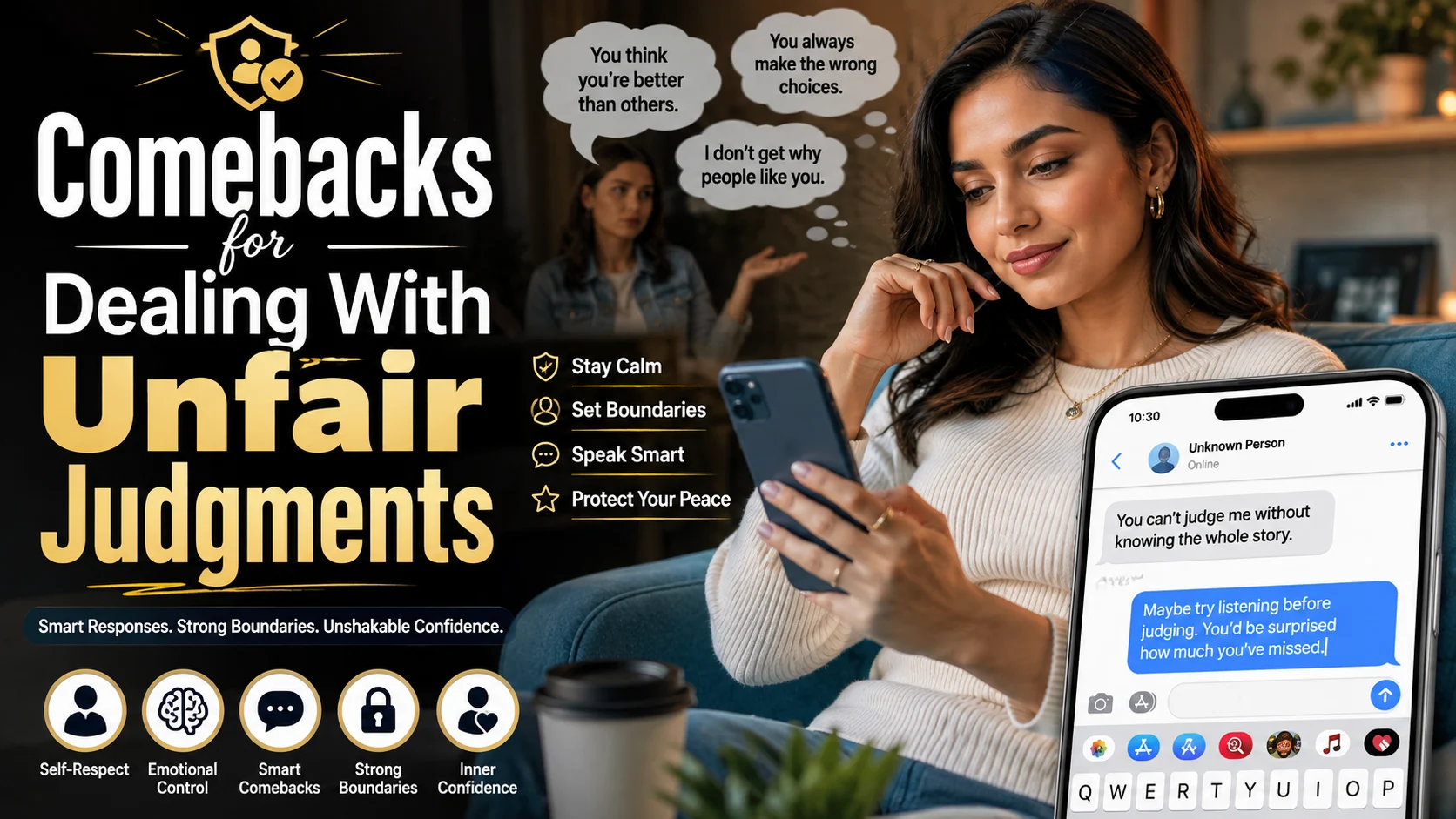
Being unfairly judged can be frustrating, especially when someone makes assumptions about you without knowing the full story. Whether it happens at work, in a relationship, among friends, or online, the right words can help you protect your dignity without turning a misunderstanding into a bigger argument.
The best comebacks for dealing with unfair judgments are not necessarily the harshest ones. A strong response can be calm, clever, confident, or even lightly humorous. The goal is to communicate boundaries, correct false assumptions, and remind others that they do not know everything about your situation.
1. “You’re judging me without knowing the whole story.”
Sometimes the simplest response makes the biggest impact. This comeback directly points out that the other person is forming an opinion without enough information.
Best for: Someone making assumptions about your choices.
Alternative: “You might want to hear the whole story before deciding what happened.”
Examples:
“Before you judge me, you should probably know what actually happened.”
“You’re making a conclusion without knowing all the facts.”
2. “That’s your assumption, not my reality.”
This is a confident way to separate someone’s opinion from the truth of your situation. It works especially well when someone speaks as though their interpretation is automatically correct.
Best for: Unfair assumptions and personal criticism.
Alternative: “That may be how you see it, but that doesn’t make it true.”
Examples:
“That’s your interpretation, not necessarily what happened.”
“You’re entitled to your opinion, but it isn’t my reality.”
3. “You don’t have to understand my choices.”
Not everyone will agree with your decisions, and you do not need everyone’s approval. This response communicates independence without being unnecessarily rude.
Best for: Personal lifestyle or relationship decisions.
Alternative: “You don’t have to agree with me for me to be comfortable with my choice.”
Examples:
“You may not choose the same thing, and that’s okay.”
“I understand you see it differently, but I’m comfortable with my decision.”
4. “I’d rather be understood than judged.”
This response shifts the conversation from criticism toward genuine communication. It is particularly useful when someone seems willing to listen.
Best for: Sensitive conversations with friends or family.
Alternative: “If you’re curious, ask me instead of assuming.”
Examples:
“I’d appreciate a conversation before a judgment.”
“If you want to know why I did it, just ask me.”
5. “You’re entitled to your opinion, and I’m entitled to ignore it.”
This comeback is firm with a touch of humor. It makes it clear that someone’s opinion does not automatically deserve your attention.
Best for: Persistent critics.
Alternative: “I respect your right to think that, but I don’t have to accept it.”
Examples:
“You can have that opinion. I just don’t need to carry it.”
“Thanks for sharing your view, but I’m not taking it personally.”
6. “That sounds more like an assumption than a fact.”
When someone presents speculation as truth, this is an excellent response. It encourages them to distinguish between what they know and what they believe.
Best for: False conclusions.
Alternative: “Do you know that for sure, or are you guessing?”
Examples:
“That’s an interesting assumption, but what facts support it?”
“You’re presenting an opinion as though it were a fact.”
7. “If you have a question, ask me directly.”
Indirect criticism can create unnecessary tension. This comeback invites honest communication instead of gossip or speculation.
Best for: Workplace, family, and friendship situations.
Alternative: “I’d rather answer a question than defend myself against an assumption.”
Examples:
“If something concerns you, just ask me.”
“You’ll get a better answer if you ask me directly.”
8. “You’re judging the situation from the outside.”
People often see only a small part of someone else’s circumstances. This response reminds them that they may not have the perspective necessary to judge fairly.
Best for: Complicated personal situations.
Alternative: “It looks different when you’re not the person living it.”
Examples:
“You’re seeing one moment, not everything that led to it.”
“It’s easy to judge when you’re not experiencing the situation yourself.”
9. “I know who I am, so your assumption doesn’t define me.”
This is a strong confidence-building response. It works when criticism feels personal or intentionally hurtful.
Best for: Personal attacks and character judgments.
Alternative: “Your opinion of me doesn’t determine my worth.”
Examples:
“I know my intentions, even if you misunderstand them.”
“I’m comfortable with who I am, regardless of your judgment.”
10. “You can disagree without disrespecting me.”
Disagreement is normal, but disrespect does not have to be accepted. This response establishes a clear boundary.
Best for: Arguments that become insulting.
Alternative: “We can have different opinions and still speak respectfully.”
Examples:
“I’m open to disagreement, but not disrespect.”
“You can challenge my opinion without attacking me personally.”
11. “I’m willing to explain, but I’m not going to beg to be believed.”
This response is useful when you have already explained yourself and someone continues to doubt you.
Best for: Repeated accusations or disbelief.
Alternative: “I’ve explained my side. What you choose to believe is up to you.”
Examples:
“I’ve given you the facts, and I won’t keep defending myself.”
“I can clarify my actions, but I can’t control your interpretation.”
12. “Maybe ask before assuming.”
Short, simple, and effective. It encourages better communication without escalating the disagreement.
Best for: Casual conversations and minor misunderstandings.
Alternative: “A question would have saved you from making that assumption.”
Examples:
“You could have asked me instead of guessing.”
“Next time, ask first. It might surprise you.”
13. “That judgment says more about your perspective than it does about me.”
This comeback redirects the focus toward the person making the judgment. It is especially effective when criticism reflects their personal expectations.
Best for: Judgment based on personal standards.
Alternative: “Your expectations aren’t universal rules.”
Examples:
“That may reflect how you see things, but it doesn’t describe me.”
“Not everyone has to live according to the same expectations.”
14. “I don’t need to prove my worth to everyone.”
Constantly trying to convince people of your value can become exhausting. This response reinforces self-respect.
Best for: Criticism about your personality, success, or choices.
Alternative: “My value isn’t determined by someone else’s approval.”
Examples:
“I know what I bring to the table.”
“I’m not going to measure myself by someone else’s standards.”
15. “You’re allowed to be wrong about me.”
This is a clever, composed comeback that refuses to get dragged into an argument.
Best for: Someone who is extremely confident in an incorrect opinion.
Alternative: “You don’t have to change your mind, but you can be mistaken.”
Examples:
“You’re welcome to think that. You’re still allowed to be wrong.”
“I’m not going to argue with an assumption you’ve already decided is true.”
16. “I won’t argue with a version of me you created in your head.”
This is one of the sharper comebacks for unfair judgments. It highlights how someone may be responding to an imaginary version of you rather than reality.
Best for: Persistent misunderstandings.
Alternative: “You’re arguing with an assumption, not with me.”
Examples:
“That version of me exists in your imagination, not in reality.”
“If you want to know me, talk to me instead of creating a story about me.”
17. “I hear your opinion, but I don’t have to accept it.”
You can acknowledge someone’s words without giving them authority over your decisions.
Best for: Maintaining boundaries respectfully.
Alternative: “I understand what you’re saying, but I see it differently.”
Examples:
“I’ve heard you, and I’m still comfortable with my position.”
“Your opinion is noted, but my decision remains the same.”
18. “Let’s stick to facts instead of assumptions.”
When emotions are running high, bringing the discussion back to facts can prevent unnecessary conflict.
Best for: Workplace disagreements and serious conversations.
Alternative: “Can we separate what we know from what we think?”
Examples:
“Let’s talk about what actually happened.”
“I’d rather discuss facts than interpretations.”
19. “You don’t know what I’ve been through.”
This response is particularly powerful when someone judges your behavior without understanding your experiences.
Best for: Personal struggles and emotional situations.
Alternative: “There’s more behind my actions than you can see.”
Examples:
“You’re judging the outcome without knowing the journey.”
“You haven’t seen everything that brought me to this point.”
20. “I’m not interested in defending myself against gossip.”
Gossip often thrives on incomplete information. This comeback shows that you will not participate in a conversation built around speculation.
Best for: Rumors and social drama.
Alternative: “If someone wants the truth, they can come to me.”
Examples:
“I’m not going to chase every rumor people create.”
“If there’s a real question, they know where to find me.”
21. “You can think what you want.”
Sometimes the most powerful response is refusing to argue. This short phrase communicates emotional control.
Best for: People who are trying to provoke you.
Alternative: “Believe whatever you feel you need to believe.”
Examples:
“You’re free to have that opinion.”
“I’m not going to spend my energy changing your mind.”
22. “That’s not an accurate picture of me.”
This is a polite but direct way to correct a negative characterization.
Best for: Character judgments and misunderstandings.
Alternative: “That description doesn’t reflect who I am.”
Examples:
“I understand why you might see it that way, but it isn’t accurate.”
“That conclusion doesn’t match my actual intentions.”
23. “If you want clarity, I’m happy to give it.”
Not every unfair judgment comes from bad intentions. Sometimes people simply lack information. This response leaves room for productive conversation.
Best for: Misunderstandings with people you care about.
Alternative: “If you’re willing to listen, I’ll explain.”
Examples:
“I’d rather clear this up than let you assume.”
“Ask me what happened, and I’ll tell you honestly.”
24. “I choose not to take that judgment personally.”
This response shows emotional maturity. Instead of reacting defensively, you acknowledge the criticism without allowing it to control your emotions.
Best for: Workplace criticism and social situations.
Alternative: “I know that opinion doesn’t have to become my reality.”
Examples:
“I’ve learned not every opinion deserves an emotional reaction.”
“I can hear criticism without letting it define me.”
25. “We clearly see this differently.”
Not every disagreement needs a winner. Sometimes accepting different perspectives is the healthiest way forward.
Best for: Conversations that are going in circles.
Alternative: “We may never agree on this, and that’s okay.”
Examples:
“I respect your perspective, even though I don’t share it.”
“We have different views, so let’s leave it there.”
26. “Before you judge me, put yourself in my position.”
This comeback encourages empathy and perspective-taking.
Best for: Situations where someone is being particularly insensitive.
Alternative: “Try looking at this from my side for a moment.”
Examples:
“If you were dealing with the same circumstances, you might see it differently.”
“Consider what you would do in my position before criticizing my choice.”
27. “I’m open to constructive criticism, not unfair judgment.”
There is a major difference between helpful feedback and personal attacks. This response makes that distinction clear.
Best for: Professional and personal development conversations.
Alternative: “If there’s something I can improve, tell me specifically.”
Examples:
“Useful feedback helps me grow; personal judgment doesn’t.”
“I’ll listen to criticism when it’s fair and specific.”
28. “You don’t have to like my decision.”
This comeback reinforces personal autonomy. People can disagree with your choices without having control over them.
Best for: Family, friendships, dating, and lifestyle choices.
Alternative: “You can disagree with my choice and still respect it.”
Examples:
“I understand you would have chosen differently.”
“It’s my decision, and I’m prepared to live with it.”
29. “I’d rather prove myself through my actions.”
When words are not changing someone’s mind, actions can speak more effectively.
Best for: Long-term misunderstandings.
Alternative: “Time will show you who I really am.”
Examples:
“I don’t need to convince you today. My actions will speak for themselves.”
“I’d rather demonstrate the truth than argue about it.”
30. “I know my truth, and I’m at peace with it.”
This is an excellent closing response when you no longer want to engage in an argument. It communicates confidence, emotional maturity, and self-respect.
Best for: Ending an unfair judgment conversation.
Alternative: “I know what happened, and I’m comfortable with where I stand.”
Examples:
“I’ve said what I needed to say. I’m choosing peace now.”
“You may see it differently, but I’m at peace with my side of the story.”
How to Choose the Right Comeback for an Unfair Judgment
The strongest response depends on the situation. If someone is genuinely confused, choose a calm clarification such as “If you want clarity, I’m happy to give it.” If someone is deliberately provoking you, a shorter response like “You can think what you want” may protect your peace better.
Try to match your response to the seriousness of the situation. A workplace disagreement may call for professional language, while a close friend may respond better to honesty and vulnerability. The objective is not always to deliver the cleverest comeback—it is to communicate clearly while maintaining your self-respect.
When You Should Ignore an Unfair Judgment
Not every judgment deserves a response. If someone is committed to misunderstanding you, repeatedly provoking you, or spreading negativity, continuing the conversation may only give the situation more energy.
Sometimes silence is the strongest comeback. You can acknowledge what was said, decide whether it has any useful value, and move forward without trying to win everyone’s approval.
Tips for Responding Without Escalating Conflict
A confident response does not need to be aggressive. Speak calmly, avoid insults, focus on facts, and use “I” statements when appropriate. For example, saying “I don’t think that’s an accurate description of what happened” is usually more productive than attacking the other person’s character.
If the conversation becomes disrespectful, establish a boundary. You can say, “I’m willing to discuss this respectfully, but I’m not going to continue while I’m being insulted.” Knowing when to walk away is also part of effective communication.
Why Calm Comebacks Are Often More Powerful
An angry response can give someone exactly the reaction they were hoping to get. A calm comeback shows that you are in control of your emotions and do not need to match another person’s negativity.
Confidence does not mean having the perfect insult. It means knowing when to speak, what to say, and when your energy is better spent elsewhere.
FAQs About Comebacks for Dealing With Unfair Judgments
1. What is the best comeback for someone who unfairly judges you?
A strong general response is: “You’re judging me without knowing the whole story.” It is direct, respectful, and gives the other person an opportunity to reconsider their assumption.
2. How do I respond to unfair criticism without being rude?
Stay calm and focus on the issue rather than attacking the person. Try saying, “I’m open to constructive criticism, but I don’t think that judgment is fair.”
3. What should I say when someone assumes things about me?
You can say, “That’s an assumption, not a fact. If you want to know what really happened, ask me.” This encourages direct communication.
4. Is ignoring unfair judgments sometimes better than responding?
Yes. If someone is simply trying to provoke you or refuses to listen, ignoring the judgment can protect your peace. You do not have to correct every opinion someone has about you.
5. How can I stay confident when people judge me?
Remember that someone else’s opinion does not automatically define your character or worth. Focus on your values, intentions, actions, and the people who genuinely know you.
Conclusion
The best comebacks for dealing with unfair judgments are confident without being cruel. Whether you choose a direct response like “You’re making an assumption, not stating a fact” or a peaceful one like “You can think what you want,” the goal is to protect your dignity and communicate your boundaries.
You do not need to win every argument or convince everyone to understand you. Sometimes the most powerful response is a calm explanation, sometimes it is a firm boundary, and sometimes it is simply walking away. Choose the response that fits the moment, stay true to yourself, and remember that another person’s judgment does not determine your worth.

I am Martin Joseph, a passionate writer who enjoys creating helpful, thoughtful, and engaging replies. I aim to make conversations easier by sharing practical responses for every situation.