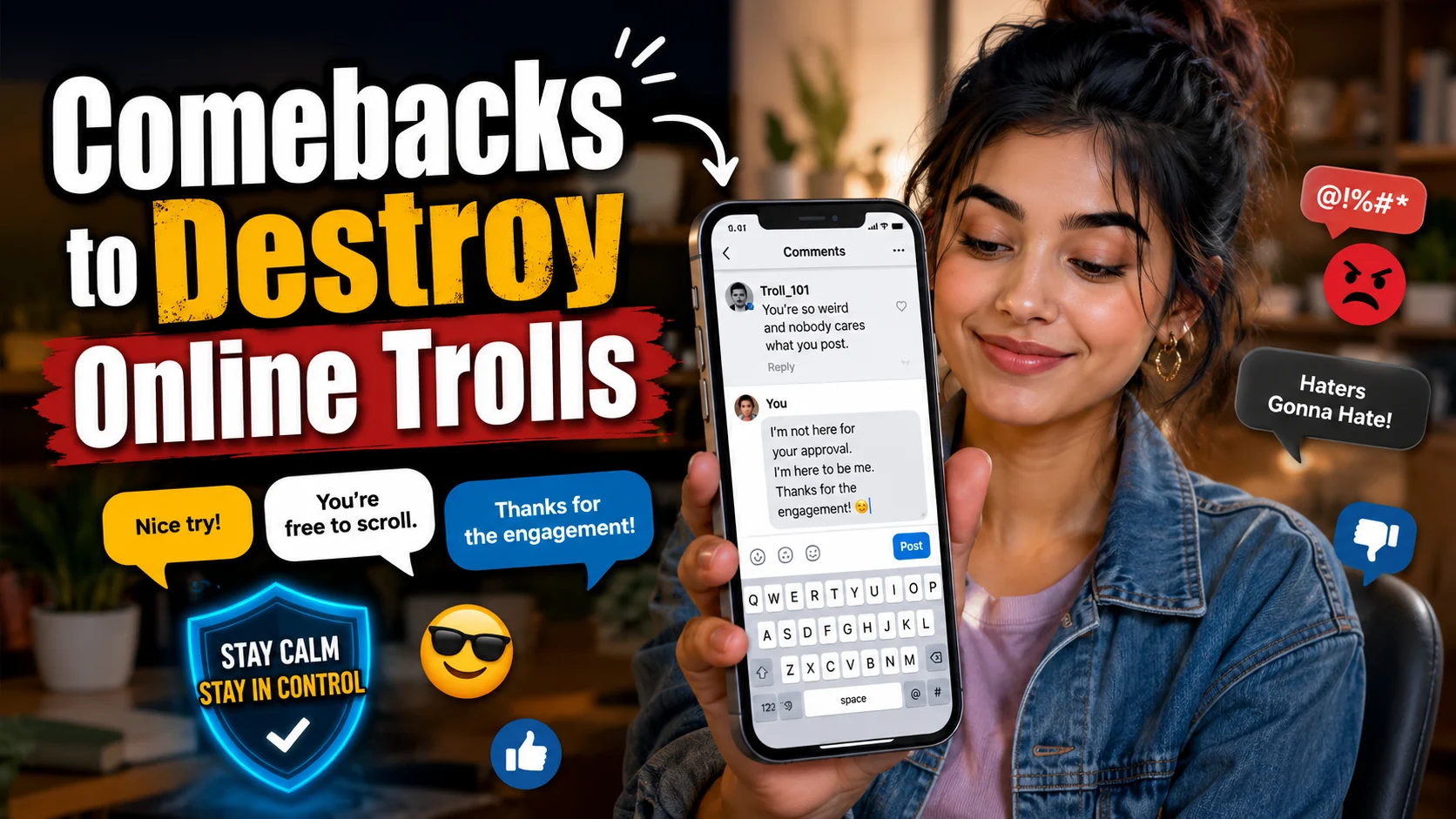
Dealing with online trolls can be frustrating, especially when someone deliberately leaves rude comments, insults, or provocative messages just to get a reaction. The best comebacks to destroy online trolls are not necessarily the harshest ones. Often, a clever, calm, or witty response works better because it shows that you are not easily bothered.
Whether you are responding to a stranger on social media, someone in a gaming community, or a person leaving unnecessary comments on your post, the goal should be to protect your peace while keeping your dignity. These responses give you different ways to handle online negativity, from playful sarcasm to confident one liners and sometimes, the smartest comeback is simply not responding at all.
1. “That sounded better in your head, didn’t it?”
Best for: A troll who makes an unnecessarily rude comment.
Alternative: “Did that seem clever when you typed it?”
Examples:
- “That sounded better in your head, didn’t it?”
- “You probably expected applause for that one.”
This response lightly exposes the weakness of the insult without turning the conversation into a serious argument.
2. “Thanks for the engagement!”
Best for: Social media trolls trying to get attention.
Alternative: “Appreciate the extra interaction.”
Examples:
- “Thanks for the engagement! The algorithm appreciates you.”
- “Every comment helps, so thanks for stopping by.”
This is a clever way to turn negativity into humor. It also shows that the troll has not upset you.
3. “I’ll give your opinion the attention it deserves.”
Best for: Someone whose criticism is not worth debating.
Alternative: “Noted. Moving on.”
Examples:
- “I’ll give your opinion the attention it deserves: approximately three seconds.”
- “Interesting opinion. I’ll file that under ‘not important.’”
The calm delivery makes this comeback particularly effective.
4. “You seem very invested in me.”
Best for: Trolls repeatedly commenting on your posts.
Alternative: “You follow my updates more closely than I do.”
Examples:
- “You seem very invested in me for someone who supposedly dislikes me.”
- “At this point, you’re basically part of my comment section team.”
It shifts the focus back onto the troll’s unusual level of attention.
5. “Is this your hobby?”
Best for: Someone who repeatedly posts negative comments.
Alternative: “Do you do this professionally?”
Examples:
- “Is this your hobby, or are you just having a slow day?”
- “You’ve commented again? Is this becoming a full-time job?”
A humorous question can make repetitive trolling look silly rather than intimidating.
6. “I hope your day gets better.”
Best for: Situations where you want to remain mature.
Alternative: “Wishing you a better mood.”
Examples:
- “I hope your day gets better. You seem to need it.”
- “Take care. Hopefully tomorrow treats you better.”
This response works when you want to end negativity without becoming rude yourself.
7. “That’s a lot of emotion for a stranger.”
Best for: A stranger becoming overly angry online.
Alternative: “You seem unusually passionate about this.”
Examples:
- “That’s a lot of emotion for someone you don’t know.”
- “You’re putting serious energy into a stranger’s post.”
It highlights how disproportionate the troll’s reaction is.
8. “You’re free to scroll.”
Best for: Someone complaining about your content.
Alternative: “The internet has a scroll button for a reason.”
Examples:
- “You’re free to scroll if this isn’t for you.”
- “No one is forcing you to stay in the comments.”
This is short, confident, and useful when someone acts as though they are entitled to control your content.
9. “Not every thought needs to be posted.”
Best for: Pointless or unnecessarily insulting comments.
Alternative: “Some thoughts are better left offline.”
Examples:
- “Not every thought needs to be posted, but thanks for demonstrating that.”
- “You could have kept that thought to yourself.”
This comeback calls out unnecessary negativity without using an aggressive insult.
10. “You tried. I’ll give you that.”
Best for: A weak attempt at being funny or insulting.
Alternative: “Points for effort.”
Examples:
- “You tried. I’ll give you that.”
- “Not your strongest joke, but points for effort.”
It works particularly well when the troll clearly expected their comment to be devastating.
11. “I’m not auditioning for your approval.”
Best for: People criticizing your choices or appearance.
Alternative: “Your approval wasn’t on my to-do list.”
Examples:
- “I’m not auditioning for your approval.”
- “Luckily, I don’t need your permission to enjoy my life.”
This is a confident response that reinforces personal boundaries.
12. “You can disagree without being dramatic.”
Best for: Trolls who turn simple disagreements into arguments.
Alternative: “Disagreement is fine. The attitude isn’t necessary.”
Examples:
- “You can disagree without turning it into a performance.”
- “Different opinions are normal. The drama is optional.”
This approach is useful when you want to establish boundaries while staying composed.
13. “Imagine being this bothered.”
Best for: Someone becoming excessively angry about harmless content.
Alternative: “That really got under your skin, huh?”
Examples:
- “Imagine being this bothered by a post you could have ignored.”
- “That seems like an impressive amount of anger for one little post.”
The comeback makes the troll’s reaction the subject instead of your original content.
14. “You’re proving my point.”
Best for: Someone responding exactly as negatively as expected.
Alternative: “And there’s the reaction I expected.”
Examples:
- “You’re proving my point without me having to explain anything.”
- “Thanks for providing the perfect example.”
This is especially effective during debates or discussions where the troll contradicts themselves.
15. “I’d respond seriously, but you’re making it difficult.”
Best for: Absurd or unserious comments.
Alternative: “I’m not sure how seriously you want me to take that.”
Examples:
- “I’d respond seriously, but that comment answered the question for me.”
- “I was going to debate you until I read that.”
It keeps the tone witty while refusing to treat nonsense as serious criticism.
16. “Bold opinion for someone behind a screen.”
Best for: Aggressive anonymous commenters.
Alternative: “The internet gives everyone extra confidence.”
Examples:
- “That’s a bold opinion from someone safely behind a username.”
- “Funny how fearless people become behind a screen.”
This comeback highlights the distance and anonymity of online interactions.
17. “You could simply keep scrolling.”
Best for: Trolls who complain about seeing your content.
Alternative: “Scrolling is completely free.”
Examples:
- “You could simply keep scrolling.”
- “There’s no subscription required to move past a post.”
A little humor makes this boundary-setting response less confrontational.
18. “Thanks for sharing your feelings.”
Best for: Personal attacks disguised as criticism.
Alternative: “I appreciate the emotional update.”
Examples:
- “Thanks for sharing your feelings. I’ll survive.”
- “Appreciate the emotional update, but I’m still going to do what I want.”
The response acknowledges the comment without giving the troll the emotional reaction they want.
19. “That insult needed more work.”
Best for: A weak attempt at a roast.
Alternative: “Come back when you’ve got a better one.”
Examples:
- “That insult needed more work.”
- “I expected better. At least make the next one interesting.”
Use this when the interaction is clearly playful rather than genuinely hostile.
20. “You’re entitled to your opinion, not my reaction.”
Best for: Someone demanding that you defend yourself.
Alternative: “You can have your opinion without owning my response.”
Examples:
- “You’re entitled to your opinion, not my reaction.”
- “You can say what you want. I decide whether it matters to me.”
This is one of the strongest mature comebacks because it reinforces emotional control.
21. “I’m going to let you argue with yourself.”
Best for: Trolls who refuse to stop debating.
Alternative: “I’ll leave you to your monologue.”
Examples:
- “I’m going to let you argue with yourself now.”
- “You seem to have this debate handled without me.”
It signals that you are ending the conversation rather than trying to win it.
22. “That’s enough internet for today.”
Best for: Someone behaving especially dramatically.
Alternative: “Maybe take a screen break.”
Examples:
- “That’s enough internet for today. Go drink some water.”
- “I think you’ve had enough comment-section time.”
This playful response can defuse tension while making the situation look less serious.
23. “I’ll survive your dislike.”
Best for: Someone announcing that they dislike you or your content.
Alternative: “Fortunately, I’ll be okay.”
Examples:
- “I’ll survive your dislike somehow.”
- “Good news: your approval isn’t required.”
The confidence comes from showing that rejection from an internet stranger has no real power over you.
24. “You don’t have to like me.”
Best for: Personal criticism or negative opinions.
Alternative: “We don’t all have to agree.”
Examples:
- “You don’t have to like me. I’m not everyone’s cup of tea.”
- “You’re allowed to dislike my content. I’m allowed to keep making it.”
This is a healthy response because it accepts disagreement without accepting disrespect.
25. “I’m not arguing with a comment section.”
Best for: Long, pointless online arguments.
Alternative: “This conversation has officially gone nowhere.”
Examples:
- “I’m not arguing with a comment section today.”
- “I came here to post, not participate in a 40-comment debate.”
Sometimes humor is the easiest way to exit an exhausting conversation.
26. “Your confidence is impressive.”
Best for: Someone making an obviously questionable claim.
Alternative: “I admire the confidence, if not the argument.”
Examples:
- “Your confidence is impressive considering the evidence.”
- “I admire the confidence behind that statement.”
This comeback works because it sounds complimentary at first but carries a subtle sarcastic edge.
27. “That’s one way to get attention.”
Best for: Trolls obviously trying to provoke you.
Alternative: “I see what you’re doing.”
Examples:
- “That’s one way to get attention.”
- “I recognize bait when I see it.”
Calling out the tactic can make trolling less rewarding because the person knows you understand what they are attempting.
28. “No reaction today.”
Best for: When you want to shut down bait.
Alternative: “Nice try.”
Examples:
- “No reaction today. You’ll have to try somewhere else.”
- “Nice try, but I’m not taking the bait.”
This is especially useful when you recognize obvious rage-bait or provocation.
29. “Mute is looking very tempting.”
Best for: Persistent trolls who refuse to stop.
Alternative: “I think this conversation has reached its mute button.”
Examples:
- “Mute is looking very tempting right now.”
- “I think we’ve reached the part where I stop reading.”
Remember that using platform tools such as mute, restrict, block, or report can be more effective than continuing an argument.
30. “You win. I’m giving you absolutely no more attention.”
Best for: Ending a conversation with a persistent troll.
Alternative: “Conversation over. Take care.”
Examples:
- “You win. I’m giving you absolutely no more attention.”
- “Congratulations—you’ve successfully wasted enough of my time.”
The strongest final comeback is sometimes removing your attention completely. Trolls often want emotional reactions, so refusing to provide one can end the interaction more effectively than another insult.
FAQs About Comebacks to Destroy Online Trolls
1. What are the best comebacks to destroy online trolls?
The best responses are usually clever, calm, and confident rather than extremely insulting. Examples include “You’re free to scroll,” “Thanks for the engagement,” and “I’m going to let you argue with yourself.”
2. Should I insult an online troll back?
Usually, no. A witty response can be satisfying, but escalating into personal attacks can create a bigger argument. If someone becomes abusive or threatening, blocking and reporting them is often the better choice.
3. What is the best response to a troll who keeps commenting?
Keep your response short and stop feeding the conversation. Try, “I think we’re done here,” or simply use the platform’s mute or block features.
4. Is ignoring an online troll a good comeback?
Absolutely. Ignoring a troll can be more effective than any clever phrase because it removes the attention they are trying to receive. Silence, muting, and blocking are all valid responses.
5. How can I respond to trolls without looking angry?
Use short, relaxed language and avoid lengthy explanations. Humor, confidence, and calm boundaries usually communicate that the comment did not upset you.
Conclusion
The most effective comebacks to destroy online trolls are not necessarily the meanest. A clever one-liner, calm boundary, playful response, or simple decision to walk away can show confidence without dragging you into unnecessary negativity.
Before replying, ask yourself what outcome you actually want. If the troll is joking, a playful comeback can keep things light. If they are deliberately provoking you, a short response—or no response at all—may work better. And if the behavior becomes harassment, threats, or repeated abuse, use blocking and reporting tools instead of trying to win the argument.
Your attention is valuable. You do not have to give it to everyone who asks for it through negativity.

I am Martin Joseph, a passionate writer who enjoys creating helpful, thoughtful, and engaging replies. I aim to make conversations easier by sharing practical responses for every situation.