
When your boyfriend is mad, finding the right words can feel surprisingly difficult. You may want to apologize, explain yourself, or simply let him know that you care without making the situation worse. The best replies to a mad boyfriend are usually calm, sincere, and focused on understanding rather than winning an argument.
if he is upset because of a misunderstanding, a disagreement, hurt feelings, or something you accidentally said, your response can set the tone for what happens next. Below, you’ll find practical messages for different situations, from gentle apologies to reassuring texts and mature responses that give him space while keeping communication open.
1. “I’m Sorry I Hurt You”
Sometimes a simple, genuine apology is the best place to start. Avoid adding excuses immediately after saying sorry.
Best for: When you know your actions hurt his feelings.
Alternative: “I’m really sorry. I never wanted to make you feel hurt.”
Examples:
“I’m sorry I hurt you. Your feelings matter to me.”
“I realize what I said upset you, and I genuinely regret it.”
2. “I Understand Why You’re Upset”
Acknowledging his feelings can help him feel heard instead of dismissed.
Best for: When you understand the reason behind his anger.
Alternative: “I can see why that situation bothered you.”
Examples:
“I understand why you’re upset, and I’m not going to pretend your feelings aren’t valid.”
“I see your point now, and I understand why that hurt you.”
3. “Can We Talk About It Calmly?”
If emotions are high, suggesting a calm conversation can prevent the disagreement from becoming bigger.
Best for: Serious arguments or misunderstandings.
Alternative: “I want to talk when we’re both calm enough to really listen.”
Examples:
“Can we talk about what happened without arguing? I want to understand you.”
“I don’t want us to fight. Let’s talk calmly when you’re ready.”
4. “I Never Meant to Hurt You”
Intent matters, but it should not replace accountability.
Best for: Accidental comments or actions.
Alternative: “Hurting you wasn’t my intention, even though I understand that it happened.”
Examples:
“I honestly never meant to hurt you. I’m sorry that my words came across that way.”
“My intention was different, but I understand that I still hurt you.”
5. “You Mean Too Much to Me”
A little reassurance can remind him that the relationship matters to you.
Best for: Emotional disagreements between partners.
Alternative: “Our relationship is important to me, and I don’t want this argument to come between us.”
Examples:
“You mean too much to me for me to let one argument define us.”
“I care about you deeply, even when we disagree.”
6. “Take the Time You Need”
Giving someone space can be healthier than repeatedly texting while they are angry.
Best for: When he needs time to cool down.
Alternative: “I’ll give you some space, but I’m here whenever you want to talk.”
Examples:
“Take the time you need. I’m not going anywhere.”
“I understand if you need some quiet time. We can talk when you feel ready.”
7. “I Don’t Want to Fight With You”
This response shifts the focus away from winning and toward solving the problem.
Best for: Heated arguments.
Alternative: “I’d rather fix this than keep arguing.”
Examples:
“I don’t want to fight with you. I want us to understand each other.”
“Being right isn’t more important to me than fixing what happened.”
8. “Tell Me What You’re Feeling”
Inviting honest communication can make it easier for him to explain why he is upset.
Best for: When you aren’t completely sure what caused his anger.
Alternative: “I want to hear your side. Tell me what’s bothering you.”
Examples:
“Please tell me what you’re feeling. I’m willing to listen.”
“I may not understand everything yet, but I want to hear you.”
9. “I’m Listening”
Sometimes people need to feel heard before they are ready to discuss solutions.
Best for: Emotional conversations.
Alternative: “You have my full attention. Tell me what happened.”
Examples:
“I’m listening. You don’t have to keep your feelings bottled up.”
“Go ahead and tell me what’s on your mind. I’m here.”
10. “Let’s Fix This Together”
A relationship works best when both people see the disagreement as a shared problem.
Best for: Couples who want to move forward after an argument.
Alternative: “I don’t want us against each other. I want us to solve this together.”
Examples:
“Let’s figure this out together instead of blaming each other.”
“I care about us, so I want to find a solution that works for both of us.”
11. “I Was Wrong”
Taking responsibility can be more powerful than trying to defend yourself.
Best for: When you genuinely made a mistake.
Alternative: “I made a mistake, and I should have handled things differently.”
Examples:
“I was wrong about that, and I’m sorry.”
“I should have thought before I spoke. I take responsibility for that.”
12. “I Hope We Can Move Past This”
This communicates optimism without forcing immediate forgiveness.
Best for: After apologizing for a disagreement.
Alternative: “I hope we can learn from this and become stronger.”
Examples:
“I hope we can move past this when you’re ready.”
“I know things are difficult right now, but I believe we can work through them.”
13. “I’m Here When You’re Ready”
This is a gentle response when he is not ready to talk.
Best for: Giving your boyfriend emotional space.
Alternative: “Whenever you’re ready to talk, I’ll be here.”
Examples:
“I won’t pressure you. I’m here whenever you’re ready.”
“Take your time. When you want to talk, I’ll listen.”
14. “Can I Give You a Hug?”
Physical affection can sometimes communicate care better than a long explanation, provided he is comfortable with it.
Best for: Couples who normally find comfort in physical affection.
Alternative: “Would a hug help right now?”
Examples:
“I know you’re upset. Can I give you a hug?”
“No pressure, but I’d love to hold you if you’re comfortable.”
15. “I Care About Your Feelings”
This reassures him that his emotions are not being ignored.
Best for: When he feels misunderstood or dismissed.
Alternative: “What you feel matters to me.”
Examples:
“I care about your feelings, even when we see things differently.”
“I never want you to feel like your emotions don’t matter to me.”
16. “I’m Sorry for My Words”
Words spoken during frustration can leave lasting hurt, so acknowledging them directly can help.
Best for: Arguments involving harsh comments.
Alternative: “I shouldn’t have said those things when I was angry.”
Examples:
“I’m sorry for the things I said. I let my frustration speak for me.”
“I wish I could take those words back. You didn’t deserve that.”
17. “Let’s Take a Break and Talk Later”
A temporary pause can be useful when neither person is thinking clearly.
Best for: Arguments that are becoming too heated.
Alternative: “Maybe we should cool down and continue this conversation later.”
Examples:
“I think we’re both too upset right now. Let’s talk later.”
“I don’t want to say something I’ll regret. Can we take a little break?”
18. “I Don’t Want You to Feel Alone”
Emotional reassurance can be especially meaningful after a difficult disagreement.
Best for: When your boyfriend is deeply upset.
Alternative: “Even when things are difficult, you don’t have to face them alone.”
Examples:
“I know you’re hurting, and I don’t want you to feel alone in this.”
“I’m beside you, even though we’re having a difficult moment.”
19. “You’re Important to Me”
Simple reassurance can soften a tense conversation.
Best for: Relationship conflicts involving insecurity or emotional distance.
Alternative: “Please remember how much you mean to me.”
Examples:
“You’re incredibly important to me, and I hate knowing that you’re hurting.”
“Nothing about this argument changes how much I care about you.”
20. “I Want to Understand Your Side”
Instead of immediately explaining yourself, give him room to speak.
Best for: Misunderstandings where both partners have different perspectives.
Alternative: “Help me understand how you saw the situation.”
Examples:
“I want to understand your side before I explain mine.”
“Tell me how you experienced the situation. I’m willing to listen.”
21. “I’ll Do Better Next Time”
An apology becomes more meaningful when it includes a commitment to improve.
Best for: Repeated mistakes or behavior that genuinely needs to change.
Alternative: “I’ll learn from this and handle things differently next time.”
Examples:
“I know saying sorry isn’t enough, so I’ll work on doing better.”
“I understand what I need to change, and I’ll make an effort.”
22. “I Don’t Expect You to Forgive Me Immediately”
This shows respect for his emotions and avoids pressuring him.
Best for: Significant disagreements.
Alternative: “Take whatever time you need to process everything.”
Examples:
“I’m sorry, and I understand if you need time before you’re ready to forgive me.”
“I won’t pressure you to feel okay immediately.”
23. “I Miss Us Being Okay”
This can be a sweet way to express affection without ignoring the problem.
Best for: Couples who have been distant after an argument.
Alternative: “I miss laughing and talking with you.”
Examples:
“I miss us being happy together. I hope we can get there again.”
“I hate this distance between us. I miss our normal conversations.”
24. “Let’s Focus on the Solution”
A mature response moves the conversation from blame toward improvement.
Best for: Practical relationship disagreements.
Alternative: “Instead of staying stuck on what happened, let’s figure out what we can do differently.”
Examples:
“Let’s focus on how we can fix this rather than who is to blame.”
“I want us to learn from this and find a better way forward.”
25. “I’m Not Trying to Dismiss You”
Sometimes anger grows because one partner feels unheard.
Best for: When your boyfriend thinks you’re ignoring his concerns.
Alternative: “I’m not trying to make your feelings seem unimportant.”
Examples:
“I’m sorry if I made you feel dismissed. That wasn’t fair to you.”
“I hear your concern, and I want to take it seriously.”
26. “You Have Every Right to Be Honest With Me”
Encouraging openness can strengthen communication.
Best for: When he has been holding back his feelings.
Alternative: “You can be honest with me, even when the conversation is uncomfortable.”
Examples:
“I want you to feel safe telling me what bothers you.”
“You never have to hide your feelings from me just to avoid an argument.”
27. “I Love You, and I Want to Work Through This”
For couples who are comfortable expressing love during conflict, this can be reassuring.
Best for: Emotional relationship disagreements.
Alternative: “I love you, and I don’t want one difficult moment to push us apart.”
Examples:
“I love you, and I want us to work through this together.”
“Even though we’re upset right now, I still choose us.”
28. “I Understand If You Need Space”
This combines reassurance with respect for boundaries.
Best for: When repeated messages could make things worse.
Alternative: “I’ll give you some breathing room and check in later.”
Examples:
“I understand if you need space. I’ll respect that.”
“I care about you enough to give you the room you need right now.”
29. “Can We Start Over?”
Sometimes the healthiest approach is to acknowledge the disagreement and make a fresh attempt at communication.
Best for: After both people have calmed down.
Alternative: “Can we put the argument aside and try talking again?”
Examples:
“Can we start over and talk about this without anger?”
“I don’t like how our conversation went. Can we try again?”
30. “I’m Ready to Talk When You Are”
This final response is simple, mature, and non-pressuring.
Best for: Almost any situation where your boyfriend is still angry.
Alternative: “Whenever you feel ready, I’m willing to have an honest conversation.”
Examples:
“I’m ready to talk whenever you are. I want us to understand each other.”
“I’ll give you the space you need, but I’m here when you’re ready.”
How to Choose the Right Reply to a Mad Boyfriend
The best response depends on why he is angry, how serious the disagreement is, and what he needs at that moment. If you made a clear mistake, apologize. If there is a misunderstanding, focus on communication. If emotions are extremely high, giving both of you time to cool down may be wiser than sending a long message.
Try to avoid responses that mock his feelings, shift all the blame onto him, or demand that he “get over it.” A calm tone, genuine accountability, and respectful boundaries usually create a much better opportunity for reconciliation.
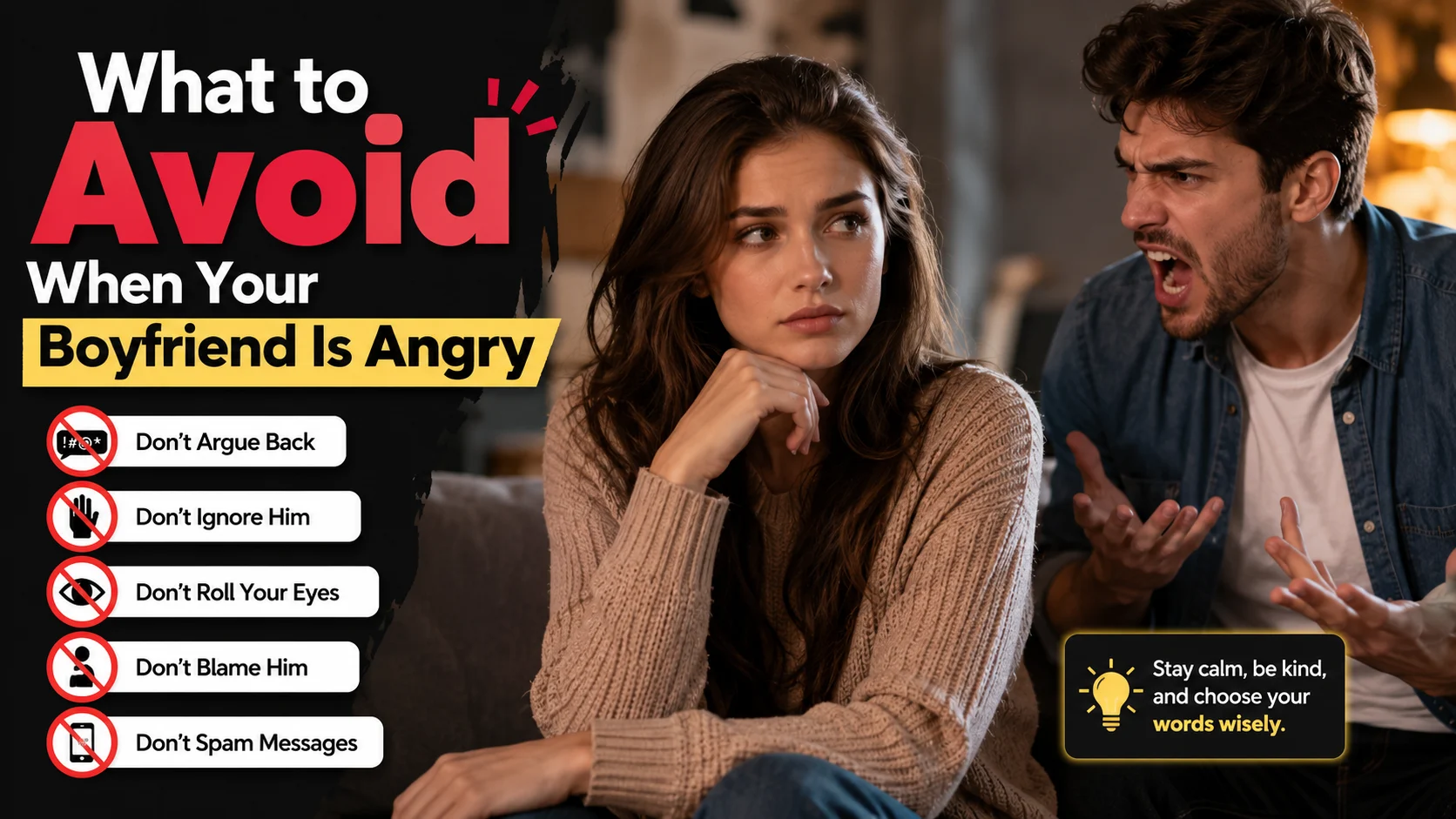
What to Avoid When Your Boyfriend Is Angry
Even a well-intended message can make an argument worse. Avoid sending multiple messages if he has asked for space, using sarcasm to provoke him, threatening to end the relationship during every disagreement, or apologizing only to stop the conversation.
Most importantly, healthy communication should go both ways. Being understanding does not mean accepting insults, intimidation, manipulation, or disrespect. You can be loving while still maintaining reasonable boundaries.
FAQs About Replies to a Mad Boyfriend
1. What should I text my boyfriend when he is mad at me?
Start with something sincere and calm, such as: “I’m sorry I hurt you. I care about you and I’d like to talk when you’re ready.” Avoid immediately defending yourself.
2. How do I make my angry boyfriend feel better over text?
Acknowledge his feelings, apologize if appropriate, and give him room to respond. A short, heartfelt message is often more effective than sending many texts.
3. Should I give my boyfriend space when he is angry?
Yes, if he asks for space or clearly needs time to calm down. Let him know you respect his need for space while keeping communication open.
4. What should I say if my boyfriend is mad because of a misunderstanding?
Try: “I think we misunderstood each other, and I don’t want this to turn into a bigger problem. Can we talk calmly about what happened?”
5. How can I apologize to my boyfriend after an argument?
Be specific about what you regret, avoid excuses, acknowledge his feelings, and explain how you intend to handle the situation better next time.
Conclusion
Finding the right replies to a mad boyfriend is less about choosing the perfect sentence and more about communicating with patience, honesty, and empathy. A sincere apology, thoughtful reassurance, or respectful offer to talk can help lower tension and create space for a healthier conversation.
Choose a message that genuinely matches your situation rather than sending something that simply sounds good. When both partners are willing to listen, take responsibility, respect boundaries, and work toward a solution, even difficult disagreements can become opportunities to strengthen the relationship.

I’m Victor Daniel, a passionate writer at ReplyLop. I enjoy creating helpful, friendly, funny, and thoughtful replies that make conversations easier, clearer, and more engaging.