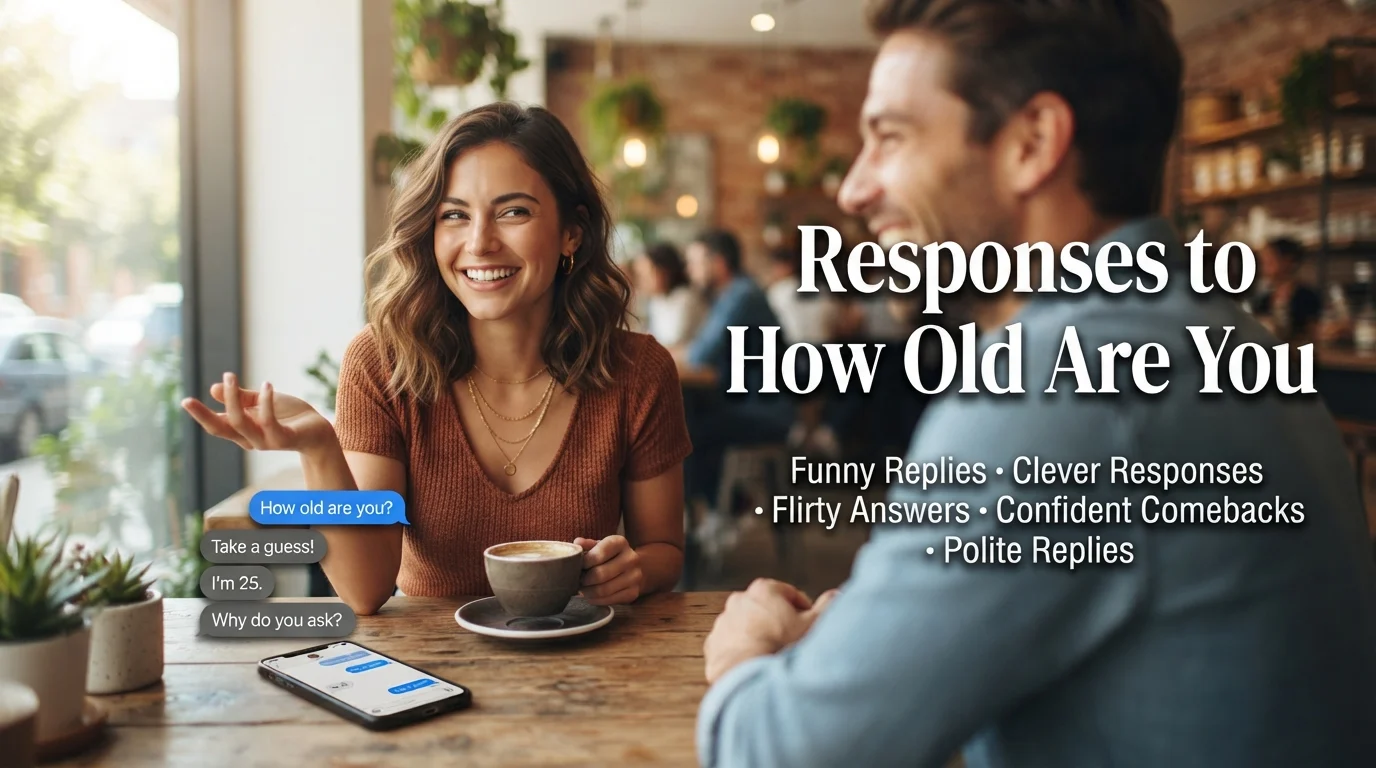
When someone asks, “How old are you?”, the best response depends on who is asking, your relationship with them, and how comfortable you feel sharing your age. You can answer directly, keep it playful, or politely avoid giving a specific number.
Having a few responses to “how old are you?” ready can make conversations easier. if you want a funny comeback, a flirty answer, a confident response, or a polite way to protect your privacy, the key is to match your reply to the situation.
1. Give a Simple, Direct Answer
Best for: Friends, classmates, coworkers, and casual conversations.
Alternative: Keep your answer brief if you don’t want to discuss your age further.
Examples:
“I’m 25.”
“I just turned 25.”
A straightforward answer is often the easiest choice when you’re comfortable sharing your age.
2. Give Your Birth Year
Best for: Situations where your birth year is more relevant than your exact age.
Alternative: Mention both your age and birth year.
Examples:
“I was born in 2001.”
“I’m a 2001 baby.”
This can sound natural when discussing birthdays or generations.
3. Use a Funny Response
Best for: Friends and people who appreciate humor.
Alternative: Turn the question into a light joke.
Examples:
“Old enough to know better, young enough to ignore that advice.”
“Let’s just say I’ve collected a few birthdays.”
A humorous answer can keep the conversation relaxed without sounding defensive.
4. Say “Guess My Age”
Best for: Playful conversations.
Alternative: Ask them to make their best guess.
Examples:
“Take a guess!”
“How old do you think I am?”
This works especially well when the conversation already feels friendly and casual.
5. Give a Playful Mystery Answer
Best for: People you want to tease a little.
Alternative: Keep your exact age mysterious.
Examples:
“That’s classified information.”
“I could tell you, but where’s the fun in that?”
This lets you avoid answering directly while keeping the conversation entertaining.
6. Use a Confident Response
Best for: When you want to answer without overthinking it.
Alternative: State your age casually and move on.
Examples:
“I’m 28, and I’m enjoying every year.”
“I’m 30, and honestly, I love it.”
Confidence often matters more than the actual wording.
7. Politely Decline to Answer
Best for: Strangers or situations where you value privacy.
Alternative: Redirect the conversation.
Examples:
“I usually keep personal details private.”
“I’d rather not share my age, if you don’t mind.”
You don’t have to give personal information simply because someone asks.
8. Say “Why Do You Ask?”
Best for: When the question feels unexpected.
Alternative: Ask about their reason before answering.
Examples:
“Interesting question—why do you ask?”
“What made you curious?”
This gives you time to understand the context.
9. Give a Flirty Answer
Best for: Lighthearted conversations with romantic interest.
Alternative: Pair the answer with a playful question.
Examples:
“Old enough to know when someone is flirting with me.”
“Does my age really matter if we’re having a good conversation?”
Keep flirty responses appropriate to the relationship and situation.
10. Make a “Forever Young” Joke
Best for: Casual social conversations.
Alternative: Use a playful age-related phrase.
Examples:
“Mentally? Still 21.”
“I’m permanently young at heart.”
This is an easy way to make an ordinary question more fun.
11. Answer With Your Exact Age
Best for: Professional or straightforward conversations.
Alternative: Include your birthday if relevant.
Examples:
“I’m 32.”
“I’m 32—I had my birthday last month.”
A clear response avoids unnecessary guessing.
12. Mention Your Age Range
Best for: When you don’t want to reveal your exact age.
Alternative: Give a general generation or decade.
Examples:
“I’m in my twenties.”
“I’m somewhere in my thirties.”
This gives useful context while maintaining some privacy.
13. Use a Clever Comeback
Best for: Friends who enjoy witty responses.
Alternative: Give a playful one-liner.
Examples:
“Old enough to remember when phones had buttons.”
“Let’s just say I remember life before Wi-Fi everywhere.”
Clever replies work best when the conversation is already informal.
14. Say “Old Enough”
Best for: When you want to answer without giving a number.
Alternative: Make the response slightly humorous.
Examples:
“Old enough to know what I want.”
“Old enough to pay my own bills.”
This shifts the focus from your exact age to your maturity.
15. Answer With Your Zodiac Sign
Best for: Casual conversations involving astrology.
Alternative: Give your birth date instead.
Examples:
“I’m a Leo—does that count?”
“I’ll give you my zodiac sign instead.”
This can turn the question into a broader conversation.
16. Use a Birthday Reference
Best for: Conversations where birthdays are already being discussed.
Alternative: Mention how recently you celebrated.
Examples:
“I just celebrated my 27th birthday.”
“I’ll be 30 later this year.”
This sounds natural and conversational.
17. Give a Generational Answer
Best for: Discussions about music, technology, childhood, or culture.
Alternative: Mention something from your childhood.
Examples:
“I’m a late-90s kid.”
“I grew up with DVDs before streaming took over.”
This can provide context without stating an exact age.
18. Respond With “How Old Do I Look?”
Best for: Playful conversations with people you know well.
Alternative: Invite an honest guess.
Examples:
“How old do I look?”
“Before I answer, what would you guess?”
Use this when you’re comfortable with whatever guess they might make.
19. Turn It Into a Conversation
Best for: Meeting someone new.
Alternative: Answer and ask their age too.
Examples:
“I’m 26. What about you?”
“I’m 29—are we around the same age?”
This keeps the conversation moving naturally.
20. Use a Sarcastic Response
Best for: Close friends who understand your humor.
Alternative: Give an exaggerated answer.
Examples:
“Approximately 400 years old.”
“I stopped counting after 25.”
Sarcasm can be funny, but avoid it when the person may interpret it literally.
21. Say “That’s a Personal Question”
Best for: When you want to establish a boundary.
Alternative: Politely explain that you don’t share personal information.
Examples:
“That’s a little personal for me.”
“I prefer keeping my age private.”
A respectful boundary is perfectly acceptable.
22. Give a Funny Age Comparison
Best for: Informal conversations.
Alternative: Compare your age with something familiar.
Examples:
“I’m old enough to remember dial-up internet.”
“I’m young enough to still enjoy staying up too late.”
These responses add personality without being overly complicated.
23. Respond With “Does It Matter?”
Best for: Situations where age isn’t relevant.
Alternative: Redirect attention toward the conversation.
Examples:
“Does it really matter?”
“Does my age change what we’re talking about?”
This works when you want to understand why the person needs the information.
24. Use a Cute Response
Best for: Friendly or affectionate conversations.
Alternative: Keep the answer light and warm.
Examples:
“Old enough to have learned a few lessons.”
“Just young enough to keep having fun.”
Cute answers can make the exchange feel more personal without being too serious.
25. Answer With Your Age and a Joke
Best for: People who appreciate directness and humor.
Alternative: Add a funny observation after your age.
Examples:
“I’m 27, but my back says 47.”
“I’m 30, but I still feel like I’m 22 sometimes.”
This is one of the easiest ways to combine honesty with personality.
26. Respond When a Stranger Asks
Best for: Unfamiliar people or online conversations.
Alternative: Politely decline if you’re uncomfortable.
Examples:
“I usually don’t share that with strangers.”
“I’m an adult, but I keep the exact number private.”
When speaking with strangers online, protecting personal information can be especially important.
27. Respond When a Crush Asks
Best for: Romantic or potentially romantic conversations.
Alternative: Answer confidently and ask what prompted the question.
Examples:
“I’m 24. Why, are you curious?”
“I’m 26. Is that what you were wondering about?”
A relaxed response can keep the conversation natural instead of making the question feel awkward.
28. Respond in a Professional Setting
Best for: Workplace conversations or networking situations.
Alternative: Redirect toward experience or qualifications if age isn’t relevant.
Examples:
“I prefer to focus on my experience rather than my age.”
“I’m happy to talk about my background and experience.”
In professional situations, age may not be relevant to the conversation, so a polite boundary can be appropriate.
29. Respond Online Without Oversharing
Best for: Social media, dating apps, forums, and new online contacts.
Alternative: Share only the information you’re comfortable making public.
Examples:
“I’m in my twenties.”
“I keep personal details private online.”
A simple answer can protect your privacy while still keeping the conversation friendly.
30. Give the Best All-Purpose Response
Best for: Almost any casual situation.
Alternative: Combine your age with a friendly follow-up.
Examples:
“I’m 28. How old are you?”
“I’m 25—what made you ask?”
This approach is useful because it is direct, natural, and keeps the conversation going.
FAQs About Responses to “How Old Are You?”
1. What is a good response to “How old are you?”
A simple response such as “I’m 25” works well when you’re comfortable sharing your age. For a playful conversation, try “Take a guess!”
2. How can I avoid answering how old I am?
You can politely say, “I prefer to keep my age private,” or give a general age range such as “I’m in my twenties.”
3. What is a funny response to “How old are you?”
Try something like “Old enough to know better, young enough to keep doing it anyway.” Another option is “I stopped counting after 25.”
4. How do I respond when my crush asks my age?
You can answer honestly and keep things relaxed: “I’m 26. Why, are you curious?” If you don’t want to share, you can simply say that you’d rather keep it private.
5. Should I tell a stranger my age?
You don’t have to. If the question makes you uncomfortable, a polite response such as “I don’t usually share personal details with people I don’t know” is completely reasonable.
Conclusion
Knowing different responses to how old are you makes it easier to handle the question naturally in almost any situation. You can be direct, funny, flirty, mysterious, or politely private depending on who is asking and how comfortable you feel.
The most important thing is to choose a response that feels authentic to you. if you give your exact age, offer a playful comeback, or set a personal boundary, a confident and respectful answer can keep the conversation comfortable and enjoyable.

I’m Victor Daniel, a passionate writer at ReplyLop. I enjoy creating helpful, friendly, funny, and thoughtful replies that make conversations easier, clearer, and more engaging.