Have you ever wondered if the correct spelling is “russle” or “rustle”? If you have encountered these words while writing an English sentence, reading a book, or studying vocabulary, you are not alone. Similar-sounding words can easily cause confusion, especially for students, beginners, and people learning English as a second language.
The correct spelling for the common English word meaning to make a soft, crackling sound or to move something noisily is “rustle.” The spelling “russle” is generally a misspelling of “rustle” when this meaning is intended. Rustle can describe the sound of dry leaves moving in the wind, paper being handled, or someone walking through bushes. It can also be used as a verb or a noun. Understanding its meaning, pronunciation, and usage will help you choose the right word in everyday writing and conversation.
Quick Answer: Russle or Rustle?
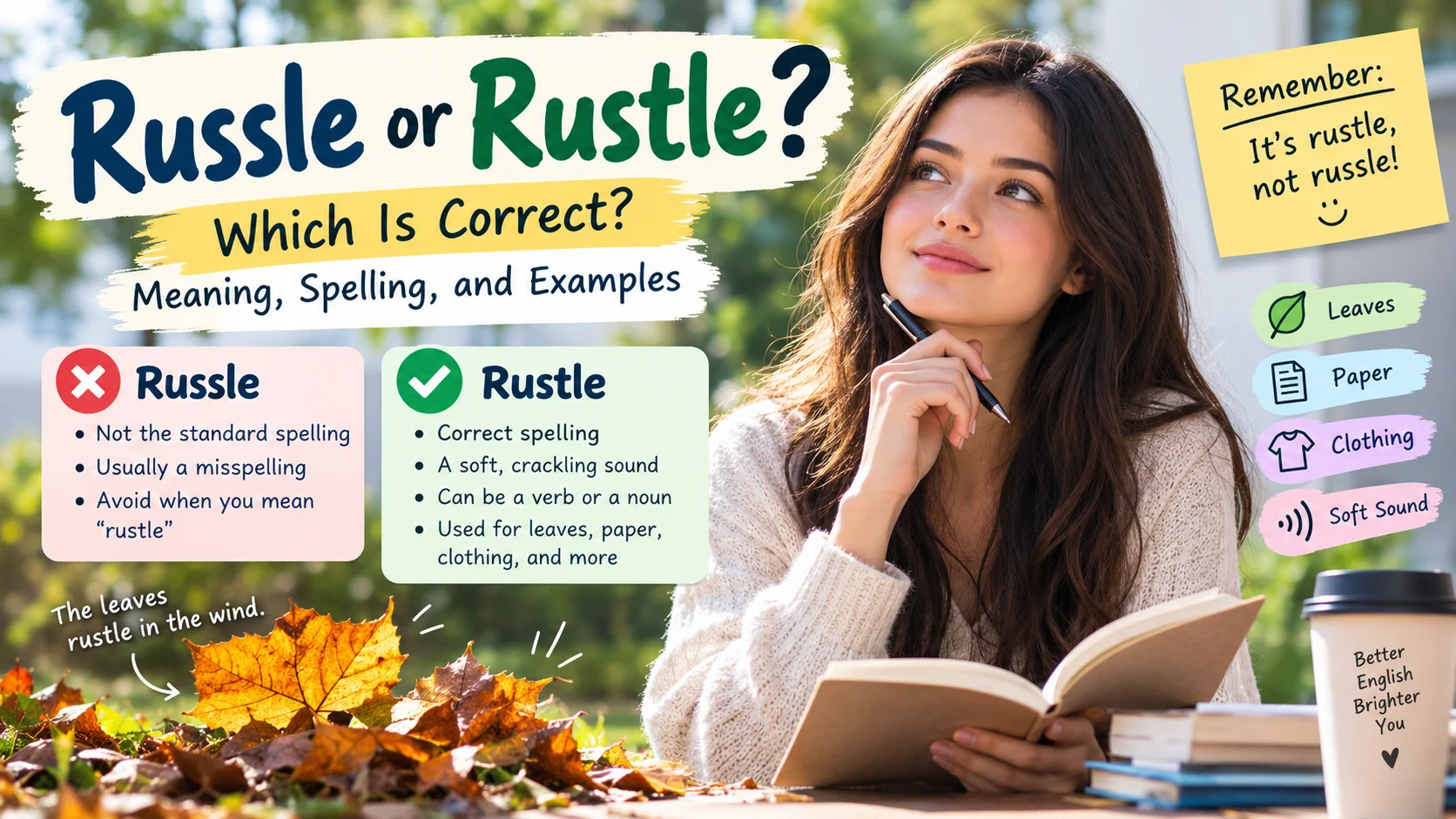
Rustle is the correct spelling when you mean a soft, crackling, or swishing sound made by leaves, paper, clothing, or similar materials. It can also mean moving something to produce that sound. “Russle” is not the standard spelling for this meaning. For example, “The leaves rustle in the wind” is correct.
Why Do People Confuse Russle and Rustle?
People often confuse “russle” and “rustle” because they look and sound similar. Both spellings begin with “rus,” and the difference lies in the middle consonant: “t” in rustle versus “s” in russle.
When speaking quickly, some English sounds can be difficult to distinguish, particularly for learners who are still developing their pronunciation skills. This can lead to spelling mistakes.
Another reason for the confusion is that English contains many words with unusual spelling patterns. Learners may try to spell a word according to how they hear it rather than how it is conventionally written.
Remember that if you are describing leaves moving, paper crackling, or clothing making a soft sound, the word you need is “rustle.”
First Word: Russle
Is Russle a Correct English Word?
“Russle” is not the standard spelling of the common English word that describes a soft, crackling sound. In ordinary writing, it is usually a spelling mistake for “rustle.”
If you write “I heard the leaves russle,” readers will probably understand what you mean, but the spelling is incorrect in standard English.
Examples of Incorrect Usage
Here are some examples showing how “russle” might mistakenly appear in a sentence:
- Incorrect: The dry leaves russle beneath my feet.
- Incorrect: I heard the paper russle in the quiet room.
- Incorrect: The wind made the trees russle.
In all three examples, replace “russle” with “rustle.”
Important: If you encounter “Russle” as a personal name, username, or other proper noun, its spelling may be intentional. However, it is not the standard spelling for the sound or action discussed in this article.
Second Word: Rustle
What Does Rustle Mean?
“Rustle” is a standard English word that can function as both a verb and a noun.
As a verb, it means to make a soft, crackling, swishing, or rubbing sound, often by moving dry leaves, paper, fabric, or similar materials.
As a noun, it refers to the soft sound itself.
Examples of Rustle in Sentences
- The leaves rustle in the gentle breeze.
- She heard someone rustle the papers on the desk.
- His jacket made a rustling sound as he walked.
- I heard a rustle in the bushes.
- The pages rustled as the student turned them.
These examples show how “rustle” works in different situations. It is commonly used when describing sounds in nature, everyday activities, and quiet environments.
Russle vs. Rustle: Comparison Table
| Feature | Russle | Rustle |
|---|---|---|
| Standard spelling for this meaning | No | Yes |
| Meaning | Usually a misspelling of “rustle” | A soft crackling or swishing sound or the action producing it |
| Part of speech | Not the standard word for this meaning | Verb and noun |
| Correct example | Not applicable | The leaves rustle in the wind. |
| Common context | Spelling mistakes | Nature, paper, clothing, and quiet sounds |
| Recommended usage | Avoid when you mean “rustle” | Use in standard English |
The main difference is straightforward: use “rustle” when describing the soft sound of something moving or the action that produces it.
When Should You Use Each Word?
When to Use Rustle
Use “rustle” when describing a soft, dry, crackling, or swishing sound.
Common situations include:
- Nature: Leaves rustle in the wind.
- Reading: Paper rustles as someone turns a page.
- Clothing: A silk dress rustles as someone walks.
- Movement: An animal rustles through the undergrowth.
- Quiet environments: A faint rustle comes from behind a curtain.
The word is especially useful in descriptive writing because it helps readers imagine the sound of a scene.
When to Use Russle
In standard English, do not use “russle” as a substitute for “rustle.”
If you are writing an essay, school assignment, email, story, or social media post, choose “rustle” when you mean a soft crackling or swishing sound.
If you see “Russle” used as a proper name, preserve the spelling when referring to that specific name.
15 Examples of Rustle in Sentences
The following examples demonstrate how to use “rustle” correctly in everyday English.
- The leaves rustle in the wind.
The moving leaves produce a soft, dry sound. - I heard a rustle behind the door.
A faint sound came from the other side of the door. - She heard the papers rustle on the table.
The papers made a soft sound as they moved. - The trees rustle gently on a windy evening.
The moving leaves create a quiet, natural sound. - His jacket began to rustle as he walked.
The fabric made a soft sound during movement. - A mouse made a rustle inside the cupboard.
Something moved quietly inside the cupboard. - The student turned the page with a rustle.
The paper made a sound as the page moved. - Dry grass rustled beneath our feet.
The grass made a crackling sound as we walked over it. - I heard something rustle in the bushes.
Something moved among the bushes. - The curtains rustled when the window opened.
Air movement caused the curtains to make a soft sound. - The bird disappeared into the leaves with a rustle.
The bird’s movement disturbed the leaves. - She tried not to rustle the paper during the exam.
She wanted to avoid making noise with the paper. - A gentle rustle came from the garden.
A soft sound could be heard outside. - The wind made the dry leaves rustle loudly.
The wind caused the leaves to move and make noise. - He heard a rustling sound while reading.
He noticed a soft sound nearby.
These examples cover both the verb and noun forms, making it easier to understand the word in different contexts.
Common Mistakes When Using Russle or Rustle
Even simple words can cause spelling and grammar problems. Here are some common mistakes to avoid.
1. Writing Russle Instead of Rustle
Incorrect: The leaves russle outside my window.
Correct: The leaves rustle outside my window.
Use “rustle” when describing the sound of moving leaves.
2. Using Rustle When Another Sound Word Is More Accurate
“Rustle” describes a soft, crackling or swishing sound. It is not always the best word for every noise.
For example:
- Use “crash” for a loud, sudden noise.
- Use “bang” for a sharp, forceful sound.
- Use “rustle” for the soft sound of leaves, paper, or fabric moving.
Choosing the right sound word makes your writing more precise.
3. Forgetting the Correct Verb Form
“Rustle” changes form depending on the sentence.
- Present: The leaves rustle.
- Past: The leaves rustled.
- Present participle: The leaves are rustling.
Using the correct form helps your sentences sound natural.
4. Confusing the Verb and Noun
Both forms are correct, but they serve different grammatical purposes.
- Verb: The paper rustles.
- Noun: I heard a rustle.
The verb describes the action, while the noun names the sound.
Memory Trick: How to Remember Rustle
A simple memory trick can help you remember the correct spelling.
Think of “rustle” as the sound of leaves moving.
Imagine walking through a garden on a windy day. Dry leaves move against one another, making a soft sound: rustle, rustle, rustle.
Now remember that the standard spelling contains the letter “t” before “le.”
You can also connect the word with familiar phrases:
- Rustling leaves
- Rustling paper
- Rustling clothes
Practising these phrases will help you recognize the correct spelling whenever you need it.
American vs. British English: Is There a Difference?
There is no significant spelling difference between American and British English for the word “rustle.”
Both varieties use “rustle,” “rustled,” and “rustling.”
Examples:
- American English: The leaves rustle outside the window.
- British English: The leaves rustle outside the window.
The spelling and basic meaning remain the same in both varieties.
Although pronunciation can vary slightly between individual speakers and regional accents, neither American nor British English uses “russle” as the standard spelling for this word.
Similar Words to Rustle
Learning related words can help you describe sounds more accurately and expand your English vocabulary.
1. Crackle
“Crackle” describes a series of small, sharp sounds.
Example: The fire began to crackle in the fireplace.
2. Swish
“Swish” describes a smooth, sweeping sound.
Example: The long skirt made a swish as she turned.
3. Whisper
“Whisper” means to speak very quietly.
Example: She whispered a secret to her friend.
4. Rattle
“Rattle” describes a series of quick, often hard or sharp sounds.
Example: The windows rattled during the storm.
5. Flutter
“Flutter” describes light, quick movements, sometimes accompanied by a soft sound.
Example: The pages fluttered in the breeze.
6. Creak
“Creak” describes a long, high, or squeaky sound, often made by a door or floorboard.
Example: The old door began to creak.
7. Sizzle
“Sizzle” describes a hissing sound, often produced by food cooking in hot oil.
Example: The bacon began to sizzle in the pan.
These words are related to sounds or movement, but each has a distinct meaning. “Rustle” is the best choice when you want to describe the characteristic soft sound of moving leaves, paper, or fabric.
Final Verdict: Russle or Rustle?
The correct choice is “rustle” when you mean a soft, crackling, or swishing sound made by moving leaves, paper, clothing, or similar materials.
“Russle” is generally a misspelling when used with this meaning. It should not replace “rustle” in standard English writing.
Remember these two examples:
- Correct: The leaves rustle in the breeze.
- Incorrect: The leaves russle in the breeze.
if you are writing a school assignment, an English lesson, a story, or an everyday message, choosing “rustle” will help you communicate clearly and accurately.
Frequently Asked Questions
1. Is it russle or rustle?
“Rustle” is the correct standard spelling for the word describing a soft, crackling or swishing sound. “Russle” is generally a misspelling when this meaning is intended.
2. What does rustle mean in simple English?
Rustle means to make a soft sound when something moves. For example, leaves rustle when the wind blows through a tree, and paper rustles when someone turns a page.
3. How do you spell rustle correctly?
The correct spelling is R-U-S-T-L-E: rustle. Remember the letter “t” before “le.”
4. Is rustle a verb or a noun?
“Rustle” can be both a verb and a noun. As a verb, it describes making a soft sound. As a noun, it refers to the sound itself.
Examples: “The leaves rustle” and “I heard a rustle.”
5. What is the past tense of rustle?
The past tense is “rustled.”
Example: “The dry leaves rustled beneath our feet.”
6. What is the difference between rustle and rattle?
“Rustle” usually describes a soft, dry sound made by moving leaves, paper, or fabric. “Rattle” usually describes a series of sharper sounds caused by something shaking or striking against another object.
Example: Leaves rustle in the wind, while loose coins rattle in a jar.
7. Is rustle spelled the same in American and British English?
Yes. “Rustle” is the standard spelling in both American and British English. There is no regional spelling difference for this word.
8. Can rustle describe the sound of clothing?
Yes. “Rustle” can describe the soft sound of fabric moving against itself or another surface.
Example: “Her dress rustled as she walked across the room.”
Remember This
- Rustle is the correct spelling for the soft sound of moving leaves, paper, or fabric.
- Russle is generally a misspelling when this meaning is intended.
- Rustle can be used as both a noun and a verb.
- The past tense is rustled, and the present participle is rustling.
- American and British English use the same spelling.
Conclusion
Choosing between “russle” and “rustle” becomes easy once you understand the meaning. When describing the soft, crackling sound of leaves, paper, or clothing, always use “rustle.” It is the standard spelling in both American and British English and works as both a noun and a verb. Remembering this simple distinction can help you avoid common spelling mistakes and write more confidently.
Keep practising with short sentences such as “The leaves rustle in the wind” and “I heard a rustle outside.” Reading examples aloud and using the word in your own writing will make it easier to remember. With a little practice, you will recognize “rustle” immediately and use it correctly in everyday English.

I’m Victor Daniel, a passionate writer at ReplyLop. I enjoy creating helpful, friendly, funny, and thoughtful replies that make conversations easier, clearer, and more engaging.