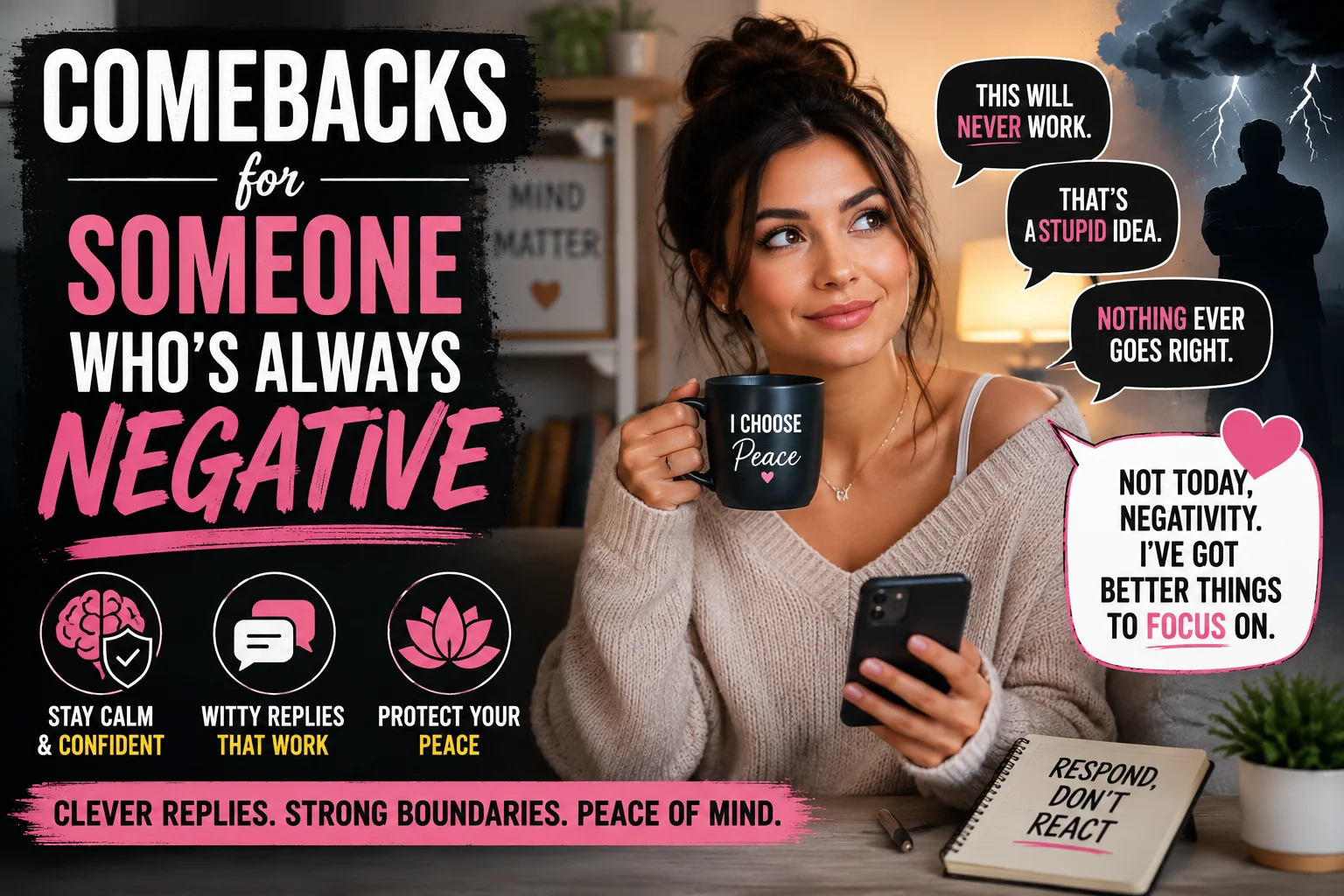
Dealing with someone who is always negative can be exhausting. Whether they constantly criticize your ideas, complain about everything, point out problems, or turn positive moments into pessimistic ones, knowing what to say can help you protect your peace without creating unnecessary drama. The best comebacks for someone whos always negative are not about being cruel they are about responding with confidence, humor, boundaries, and emotional maturity.
Sometimes, a lighthearted response can change the mood. Other times, a direct statement is more appropriate, especially when someone’s negativity repeatedly affects your confidence or relationships. The key is knowing your audience and choosing a response that fits the situation. Below are practical, witty, respectful, and assertive comebacks you can use when dealing with a chronic complainer or constant pessimist.
1. “Let’s Try Looking at the Bright Side”
When someone immediately focuses on everything that could go wrong, gently redirecting the conversation can work better than arguing.
Best for: Friends, coworkers, and casual conversations.
Alternative: “There might actually be something good about it.”
Examples:
- “I hear the concerns, but let’s see what could go right too.”
- “You’ve covered the negatives. Now give the positives a chance.”
2. “You Always Find the Cloud in Every Silver Lining”
This playful comeback works when you want to point out someone’s pessimistic habit without becoming aggressive.
Best for: Close friends who understand your humor.
Alternative: “You could find a problem in a perfect day.”
Examples:
- “You somehow found the cloud hiding behind the silver lining.”
- “Impressive—you found the negative angle again.”
3. “Not Everything Needs a Negative Review”
Some people instinctively criticize everything. This response reminds them that constant negativity isn’t always necessary.
Best for: Someone criticizing ordinary situations.
Alternative: “It doesn’t have to be perfect to be good.”
Examples:
- “It’s okay to enjoy something without reviewing every flaw.”
- “Sometimes good is simply good.”
4. “I’m Choosing to Focus on What I Can Control”
This is a calm and mature response when someone is stressing over things outside their control.
Best for: Serious conversations and stressful situations.
Alternative: “I’d rather focus on what we can actually change.”
Examples:
- “We can’t control that, but we can control how we respond.”
- “I’m going to put my energy into what I can influence.”
5. “You’re Allowed to Be Negative, but I Don’t Have to Join You”
This is an excellent boundary-setting response. It acknowledges their feelings without allowing their mood to become yours.
Best for: Repeated negativity that affects your mood.
Alternative: “I understand you feel that way, but I’m going to keep my perspective positive.”
Examples:
- “You can have that opinion, but I’m not adopting it.”
- “I respect your perspective, but I’m choosing a different one.”
6. “Is There Anything You Actually Like?”
A humorous question can expose how frequently someone complains without directly insulting them.
Best for: Lighthearted conversations with people you know well.
Alternative: “Have you approved anything today?”
Examples:
- “So far, has anything survived your criticism?”
- “What has passed today’s negativity test?”
7. “Let’s Not Borrow Trouble From Tomorrow”
Negative people sometimes worry endlessly about problems that haven’t happened yet.
Best for: Someone constantly predicting disaster.
Alternative: “Let’s deal with problems when they actually arrive.”
Examples:
- “That problem hasn’t happened yet, so let’s not solve it twice.”
- “We can handle tomorrow when tomorrow gets here.”
8. “I’d Rather Look for Solutions Than Problems”
This comeback changes the conversation from complaining to problem-solving.
Best for: Work, family, and practical situations.
Alternative: “Okay, what solution would you suggest?”
Examples:
- “We know what’s wrong. What can we do about it?”
- “Let’s spend less time describing the problem and more time fixing it.”
9. “Your Pessimism Is Working Overtime Today”
This playful line acknowledges excessive negativity without turning the conversation into an argument.
Best for: Friends and people who appreciate sarcasm.
Alternative: “Your inner pessimist is having a very productive day.”
Examples:
- “Your pessimism definitely showed up early today.”
- “Your negativity department is fully staffed.”
10. “I Don’t Think Everything Is as Bad as It Seems”
Sometimes a gentle reality check is all someone needs.
Best for: Someone exaggerating a minor problem.
Alternative: “Maybe we should take a step back and look at the bigger picture.”
Examples:
- “It’s frustrating, but I don’t think it’s a disaster.”
- “This is a setback, not the end of everything.”
11. “You’re Making a Mountain Out of a Molehill”
This classic comeback works when someone is turning a small inconvenience into a major crisis.
Best for: Minor problems being dramatically exaggerated.
Alternative: “It’s annoying, but it’s manageable.”
Examples:
- “That sounds frustrating, but it’s not quite a catastrophe.”
- “Let’s keep the problem in proportion.”
12. “I’m Not Looking for Reasons to Feel Worse”
This response establishes an emotional boundary when someone’s negativity is becoming draining.
Best for: Personal conversations and emotionally sensitive moments.
Alternative: “I need encouragement right now, not more negativity.”
Examples:
- “I already know what could go wrong. I’m trying to stay focused.”
- “I’d appreciate a little encouragement instead.”
13. “Can We Give Optimism a Chance?”
This short comeback invites the other person to change the tone without attacking them.
Best for: Friendly conversations.
Alternative: “Maybe we can approach this with a little more hope.”
Examples:
- “We’ve considered the worst-case scenario. What about the best-case?”
- “Let’s give positive thinking five minutes.”
14. “You Don’t Have to Like Everything”
Constant criticism can come from unrealistic expectations. This response gently reminds someone that imperfection is normal.
Best for: People criticizing every detail.
Alternative: “Something can be imperfect and still worthwhile.”
Examples:
- “It doesn’t have to be flawless to be enjoyable.”
- “You can dislike it without convincing everyone else to dislike it too.”
15. “That’s One Way to Look at It”
This neutral response prevents an argument while making it clear that their negative interpretation isn’t the only one.
Best for: Difficult conversations where you want to remain calm.
Alternative: “That’s your perspective; mine is different.”
Examples:
- “That’s certainly one interpretation.”
- “I see where you’re coming from, although I see it differently.”
16. “Let’s Keep This Conversation Productive”
When negativity becomes repetitive, redirecting the conversation can be more effective than exchanging insults.
Best for: Workplace conversations and serious discussions.
Alternative: “I’m happy to discuss solutions, but I don’t want to keep going in circles.”
Examples:
- “If we can find a solution, I’m in. If not, repeating the complaint won’t help.”
- “Let’s focus on what we can actually accomplish.”
17. “You’ve Made Your Point”
Sometimes a negative person repeats the same criticism because they want others to agree.
Best for: Repetitive complaints.
Alternative: “I understand your position.”
Examples:
- “I heard you the first time.”
- “Your point is clear; we don’t need to keep repeating it.”
18. “I’m Going to Keep My Positive Energy”
This confident response works when someone tries to bring down your excitement.
Best for: Personal goals, celebrations, and exciting plans.
Alternative: “I’m excited about this, and I’m going to enjoy it.”
Examples:
- “You don’t have to be excited, but I am.”
- “I appreciate your concern, but I’m keeping my enthusiasm.”
19. “Not Every Conversation Needs to Be a Complaint Session”
This is direct but still respectful.
Best for: Chronic complainers.
Alternative: “Can we talk about something more positive?”
Examples:
- “I’d love to hear about something that’s going well.”
- “We’ve talked about what’s wrong. Tell me what’s going right.”
20. “If You Want Advice, I’m Happy to Help”
Sometimes constant negativity is really a request for support. Asking whether they want advice can change the interaction.
Best for: Friends, family, and coworkers.
Alternative: “Do you want me to listen or help you find a solution?”
Examples:
- “I’m here for you. Do you want support or suggestions?”
- “If you want to fix it, let’s figure out what to do next.”
21. “I’m Not Going to Argue With Your Pessimism”
This comeback helps you avoid getting pulled into an endless debate.
Best for: Someone who always expects the worst.
Alternative: “We clearly see this differently, and that’s okay.”
Examples:
- “You expect the worst; I’m willing to see what happens.”
- “I don’t need to convince you to be optimistic.”
22. “You’re Really Committed to the Negative Version”
This witty response works when someone consistently chooses the worst possible interpretation.
Best for: Playful conversations.
Alternative: “You found the most pessimistic interpretation possible.”
Examples:
- “That’s definitely the darkest version of the story.”
- “You somehow skipped every positive possibility.”
23. “I’m Choosing Peace Over This Conversation”
When someone’s negativity becomes emotionally exhausting, walking away can be healthier than producing a clever insult.
Best for: Heated or repetitive arguments.
Alternative: “I don’t think continuing this is good for me.”
Examples:
- “We don’t have to agree, so I’m going to leave it here.”
- “I’m stepping away before this becomes unnecessarily negative.”
24. “Your Concern Has Been Noted”
This short, slightly sarcastic response is useful when you’ve already heard someone’s criticism.
Best for: Repeated unsolicited opinions.
Alternative: “Thanks for sharing your perspective.”
Examples:
- “Noted. I’ll decide what works for me.”
- “I appreciate the input; I’ll keep it in mind.”
25. “Let’s See What Actually Happens”
Negative people often make confident predictions about failure. This response brings the conversation back to reality.
Best for: Someone predicting that your plans will fail.
Alternative: “We won’t know until we try.”
Examples:
- “Maybe it will work, maybe it won’t. I’m willing to find out.”
- “I’d rather test the idea than assume it will fail.”
26. “I Appreciate the Reality Check, but I’m Still Going for It”
This is an excellent response when criticism contains a little truth but shouldn’t stop you from pursuing something.
Best for: Goals, career decisions, relationships, and personal projects.
Alternative: “I understand the risks, but I’m comfortable moving forward.”
Examples:
- “I know there are challenges, and I’m prepared to handle them.”
- “Thanks for pointing out the risks. I’m still willing to try.”
27. “Can We Talk Without Assuming the Worst?”
This encourages healthier communication and challenges automatic pessimism.
Best for: Relationships and close friendships.
Alternative: “Let’s not jump to conclusions.”
Examples:
- “There may be another explanation.”
- “Before we assume the worst, let’s get the facts.”
28. “Your Negativity Doesn’t Have to Become My Reality”
This is a powerful boundary when someone repeatedly undermines your confidence.
Best for: People who constantly discourage you.
Alternative: “Your opinion doesn’t determine what happens to me.”
Examples:
- “You may not believe in this, but I do.”
- “I respect your opinion, but I won’t let it define my choices.”
29. “I’m Going to Pass on the Doom and Gloom”
A little humor can make a boundary feel less confrontational.
Best for: Friends, casual conversations, and social situations.
Alternative: “I’m not signing up for the negativity today.”
Examples:
- “Thanks, but I’ll skip today’s doom-and-gloom package.”
- “I’m keeping my mood intact, so I’m going to pass.”
30. “You Can Keep the Negativity I’ll Keep My Peace”
This is one of the strongest closing comebacks because it focuses on your own behavior rather than attacking the other person.
Best for: Persistent negativity and situations where you need a firm boundary.
Alternative: “We don’t have to share the same energy.”
Examples:
- “You can see it negatively; I’m choosing peace and perspective.”
- “I’m not interested in carrying someone else’s negativity.”
How to Choose the Right Comeback
Not every situation requires a sarcastic response. If you’re dealing with a close friend who is simply having a bad day, empathy may work better than humor. If someone is repeatedly criticizing you or undermining your confidence, a clear boundary is usually more effective.
A useful rule is to match the response to the level of negativity:
- Mild negativity: Use humor or gentle redirection.
- Repeated complaining: Ask for solutions.
- Personal criticism: Set a clear boundary.
- Emotional conflict: Stay calm and avoid escalating.
- Toxic or disrespectful behavior: End the conversation when necessary.
The goal isn’t to “win” against a negative person. The goal is to protect your emotional energy while communicating clearly.
Why Calm Comebacks Work Better Than Insults
A harsh insult may feel satisfying for a moment, but it can quickly turn a small disagreement into a larger conflict. Calm comebacks give you control without unnecessarily hurting someone.
A confident response also communicates emotional maturity. You can disagree without becoming defensive, sarcastic without becoming cruel, and firm without being disrespectful.
Tips for Dealing With a Chronic Complainer
If someone in your life is constantly negative, consider changing the pattern of your conversations. Instead of repeatedly reassuring them, ask questions that encourage action.
Try asking:
- “What would make this situation better?”
- “Is there something you can change?”
- “Do you want advice or do you just need me to listen?”
- “What is one positive thing happening right now?”
These questions can move a conversation from endless complaining toward constructive thinking.
When You Should Stop Using Comebacks
Sometimes the best comeback is no comeback.
If someone repeatedly insults you, manipulates conversations, attacks your character, or refuses to respect boundaries, you don’t need to keep producing clever responses. You can end the conversation, change the subject, or create some distance.
Protecting your peace isn’t rude. It is a reasonable response to repeated disrespect.
FAQs About Comebacks for Someone Whos Always Negative
1. What is a good comeback for someone who is always negative?
A good response is: “I understand your concerns, but I’m choosing to focus on what I can control.” It is confident without being unnecessarily rude.
2. How do you shut down a negative person politely?
Try saying, “I hear you, but I don’t want to keep focusing on the negative. Let’s talk about what we can actually do.” This acknowledges their feelings while redirecting the conversation.
3. What is a funny comeback for a negative person?
A playful option is: “You somehow found the cloud hiding behind the silver lining.” Use humorous comebacks only when the relationship can handle sarcasm.
4. How do you deal with someone who constantly complains?
Listen briefly, determine whether they want advice, and encourage solutions. If the complaining becomes repetitive or affects your mood, set a clear boundary.
5. Should I respond to someone who is always negative?
Not always. If the person’s negativity is harmless, a light response can work. If they’re disrespectful or intentionally trying to bring you down, disengaging may be healthier than arguing.
Conclusion
Knowing the right comebacks for someone whos always negative can help you handle pessimism without becoming negative yourself. Whether you choose a witty response, a calm reality check, a direct boundary, or simply walk away, the most effective approach is the one that protects your peace and keeps the situation from escalating.
Remember, you don’t have to convince a negative person to become positive. You only need to decide how much of their negativity you are willing to carry. Stay calm, communicate clearly, and choose responses that reflect confidence, self-respect, and emotional maturity.

I am Marcus James, Administrator at ReplyLop. I enjoy creating helpful, friendly, professional, and creative reply ideas that make conversations easier, clearer, and more engaging for everyone.