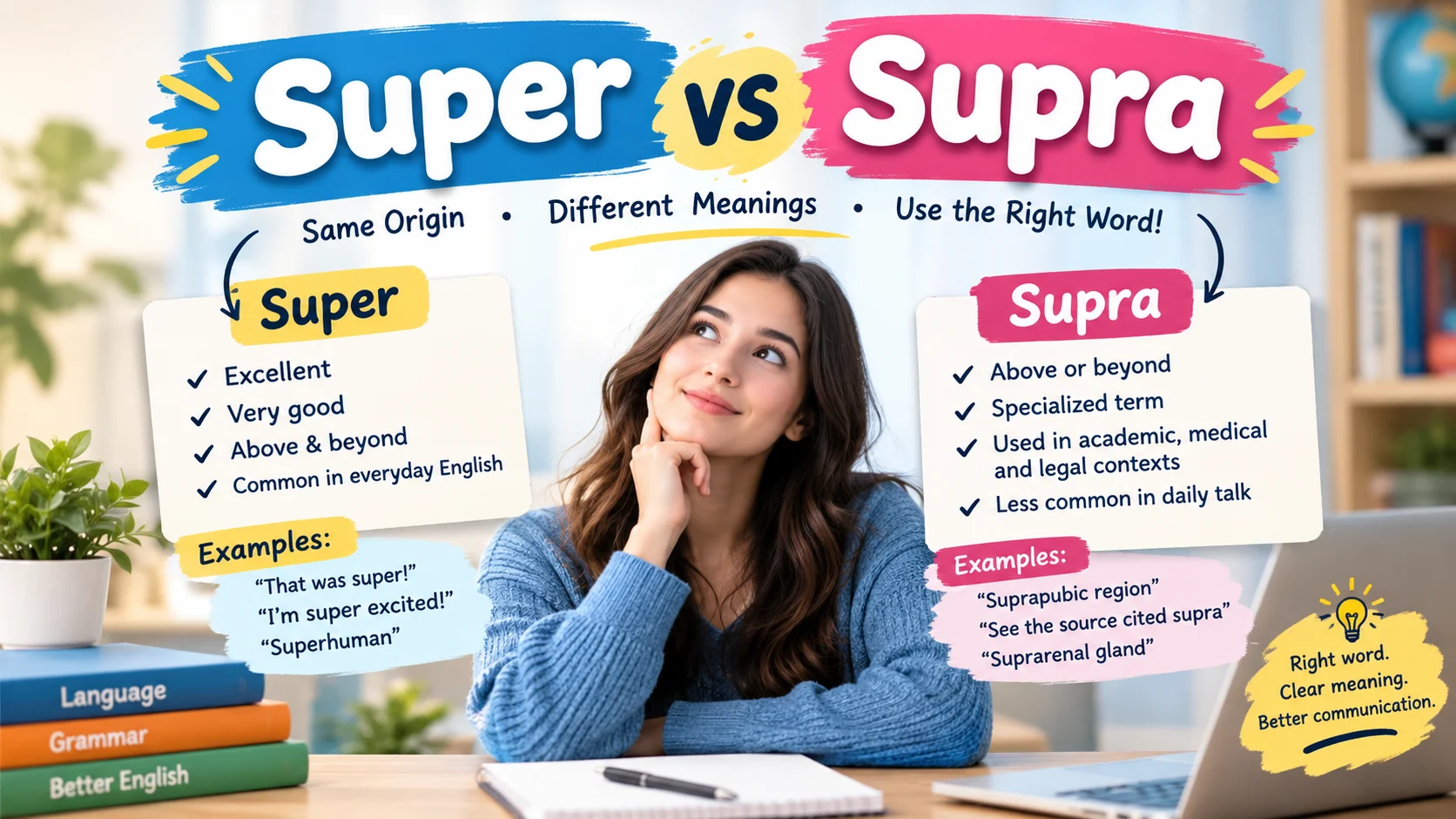
Have you ever wondered if to use super or supra in writing? Although these two words share a similar Latin origin and can both suggest something above or beyond, they have different meanings and uses in modern English. Understanding the difference helps you choose the correct word for everyday conversations, academic writing, and specialized contexts.
The word super is common in everyday English. It can mean excellent, very good, above, or beyond, depending on the context. For example, you might describe a movie as “super” or use super- in words such as superhuman and supermarket. In contrast, supra is a more specialized term that generally means “above” or “beyond.” It appears frequently in academic, scientific, medical, and legal writing. Learning when to use each word will make your English clearer and more precise.
Quick Answer: Super vs Supra
Super is a common English word meaning excellent, very good, or above and beyond. Supra is a more specialized term meaning above or beyond, often used in academic, scientific, medical, and legal contexts. Use super in everyday communication and supra when the context specifically requires its technical or formal meaning.
Why Do People Confuse Super and Supra?
People confuse super and supra because both words are associated with the idea of being above or beyond something. They also share a Latin connection.
However, their modern uses differ.
- Super: Common in everyday English, informal expressions, and compound words.
- Supra: More specialized and often associated with technical terminology and formal writing.
- Super-: A productive prefix used to form words such as supernatural and superpower.
- Supra-: A prefix used in specialized terminology to indicate something above, over, or beyond a reference point.
The main difference is not simply formality. The meaning and grammatical role of each word matter, too.
1. What Does Super Mean?
Super is a versatile English word that can function as an adjective, adverb, noun, or prefix, depending on the context.
Common Meanings of Super
1. Excellent or very good
In informal English, super expresses enthusiasm or approval.
Examples:
- The concert was super!
- You did a super job on your presentation.
- We had a super time at the beach.
2. Very or extremely
Super can intensify an adjective in informal conversation.
Examples:
- This room is super clean.
- I’m super excited about the trip.
- The instructions were super helpful.
3. Above or beyond
As a prefix, super- can suggest something that exceeds an ordinary level or exists above something else.
Examples:
- Superhuman means beyond normal human abilities.
- Supernatural refers to phenomena beyond what is considered natural.
- Superstructure refers to a structure built above a base or foundation.
4. A noun referring to a person or thing
In some contexts, super is a noun. For example, in American English, a super can refer to a building superintendent.
When Should You Use Super?
Use super when you want to express enthusiasm, describe something as excellent, intensify an adjective informally, or form a familiar compound word.
Example: “Your explanation was super helpful.”
Here, super means very. It is natural in casual conversation but may sound too informal in some professional or academic writing.
2. What Does Supra Mean?
Supra comes from Latin and generally means “above,” “over,” or “beyond.” In modern English, it is most often encountered in specialized vocabulary and formal references.
Common Uses of Supra
1. In academic and scholarly writing
Supra can indicate that a source or point was mentioned earlier in a document. Its use depends on the relevant citation style.
Example:
“See the discussion supra.”
This means to consult an earlier discussion. However, the precise citation convention varies by discipline and style guide.
2. In legal writing
Legal writers sometimes use supra to refer readers to an earlier citation or authority.
Example:
“Smith v. Jones, supra.”
The expression directs the reader to a previously cited case. Legal citation rules vary by jurisdiction and citation system, so writers should follow the applicable style guide.
3. In medical and scientific terminology
The prefix supra- identifies a position above or over a particular anatomical structure or reference point.
Examples:
- Suprarenal: Located above the kidney or associated with the region above it.
- Suprapubic: Located above the pubic bone.
- Supraspinatus: Refers to a muscle situated above the spine of the scapula.
These terms demonstrate how supra- communicates a specific spatial relationship.
When Should You Use Supra?
Use supra when you are writing in a field where the term has an established meaning, such as legal citation, or when it forms part of a recognized technical term.
Example: “The report discusses the suprapubic region.”
Here, supra- forms part of a medical term describing a location above the pubic bone.
In ordinary conversation, supra is generally not a natural replacement for super.
Super vs Supra: Comparison Table
| Feature | Super | Supra |
|---|---|---|
| General meaning | Excellent, very good, or above and beyond | Above, over, or beyond |
| Everyday use | Very common | Uncommon |
| Tone | Often casual, but also used in established terminology | Usually specialized or formal |
| Grammatical role | Adjective, adverb, noun, or prefix | Often a prefix or a specialized Latin-derived term |
| Informal conversation | Very suitable | Usually unsuitable |
| Academic writing | Suitable when the meaning fits | Suitable in established technical or citation contexts |
| Legal writing | Used when appropriate to the meaning | Used in certain citation conventions |
| Medical terminology | Appears in established terms | Common in terms involving position above a structure |
| Example | “That was a super performance.” | “See the authority cited supra.” |
| Best choice | Everyday English and familiar expressions | Specialized terminology and appropriate formal references |
When to Use Super vs Supra
Choosing the right word becomes easier when you consider your audience, subject, and intended meaning.
Use Super in Everyday Conversations
Choose super when describing something positively or emphasizing a feeling.
Examples:
- “Your new haircut looks super!”
- “I’m super happy for you.”
- “That was a super idea.”
These expressions sound natural in casual English.
Use Super in Compound Words
Use super- in established words that express something extraordinary, excessive, or above a normal level.
Examples:
- Superhero
- Superpower
- Superhuman
- Supernatural
- Superstar
The prefix’s precise meaning depends on the word.
Use Supra in Specialized Terminology
Choose supra- when it is part of a recognized technical term.
Examples:
- Suprarenal
- Suprapubic
- Supraspinatus
In these examples, supra- communicates a specific relationship to an anatomical reference point.
Use Supra in Appropriate Legal Citations
In legal writing, supra may refer to a previously cited source.
Example:
“See the analysis supra.”
Use this construction only when it fits the citation rules governing your document. In general writing, “see the earlier analysis” is often clearer.
12 Examples of Super vs Supra in Sentences
The following examples show how the two words work in different contexts.
Examples of Super
1. Expressing enthusiasm
“The birthday party was super!”
Here, super means excellent or very enjoyable.
2. Describing a person positively
“She did a super job organizing the event.”
The word expresses approval.
3. Intensifying an adjective
“I’m super excited about my new job.”
Here, super means very.
4. Describing something helpful
“This guide is super useful for beginners.”
The word emphasizes the guide’s usefulness.
5. Referring to extraordinary abilities
“The superhero has superhuman strength.”
The prefix super- indicates abilities beyond ordinary human capabilities.
6. Describing something beyond ordinary experience
“The story includes supernatural events.”
Here, super- contributes to the meaning of phenomena beyond the natural world.
Examples of Supra
7. Describing an anatomical location
“The suprapubic region is located above the pubic bone.”
The prefix supra- indicates a position above a particular structure.
8. Referring to a location above the kidney
“The term suprarenal describes a location above the kidney.”
This is an example of specialized anatomical vocabulary.
9. Naming a muscle
“The supraspinatus is one of the muscles of the rotator cuff.”
The word identifies a specific anatomical structure.
10. Referring to an earlier discussion
“See the discussion supra for additional details.”
In a context that follows this citation convention, supra directs readers to an earlier passage.
11. Referring to a previously cited legal authority
“The court considered the reasoning in the case cited supra.”
The expression refers to an authority mentioned earlier, subject to the applicable citation rules.
12. Using the terms in context
“The presentation was super, and the report explained the suprapubic anatomy.”
The first word expresses a positive opinion, while the second appears in medical terminology.
These examples show that super and supra are not interchangeable simply because their meanings overlap.
Common Mistakes When Using Super and Supra
Understanding their meanings is important, but avoiding common errors is equally useful.
Mistake 1: Using Supra to Mean Excellent
Incorrect: “Your presentation was supra!”
Correct: “Your presentation was super!”
Why? Super is a natural informal expression of praise. Supra does not ordinarily mean excellent in modern English.
Mistake 2: Replacing Super With Supra in Everyday Speech
Incorrect: “I’m supra excited about the weekend.”
Correct: “I’m super excited about the weekend.”
Why? Super is commonly used as an informal intensifier, while supra does not normally serve that function.
Mistake 3: Treating Every Word With Super as Informal
Incorrect assumption: All words beginning with super- are casual.
Correct examples: Superstructure, supernatural, and superconductivity.
Why? The prefix super- appears in formal, scientific, and technical vocabulary as well as everyday language.
Mistake 4: Assuming Supra Is Always Interchangeable With Above
Incorrect approach: Replacing every instance of above with supra.
Better approach: Use above in ordinary prose unless supra is the established term or citation convention.
Why? A word’s Latin origin does not mean it can replace every English expression with a similar meaning.
Mistake 5: Ignoring Specialized Citation Rules
Incorrect approach: Using supra in every academic or legal reference.
Better approach: Check the required style guide and follow its rules for repeated citations.
Why? The use of supra varies across legal systems, academic disciplines, and citation formats.
Memory Trick: How to Remember Super vs Supra
Use this simple memory trick:
- Super = Superb: Think of super as something excellent, impressive, or very good.
- Supra = Situated above: Think of supra- as indicating a position above a reference point.
For example:
- “The food was super.” This expresses a positive opinion.
- “The suprapubic region is above the pubic bone.” This describes an anatomical location.
Remember that these are memory aids, not complete definitions. Both words can have additional meanings depending on the context.
American vs British English: Super vs Supra
The basic distinction between super and supra is broadly consistent in American and British English.
American English
In the United States, super is common in casual expressions such as:
- “That’s super cool!”
- “I’m super busy today.”
- “You did a super job.”
The word also appears in formal compounds and technical terminology.
British English
In the United Kingdom, super is also widely used to mean excellent or very good.
Examples:
- “That sounds super!”
- “We had a super weekend.”
- “It’s super convenient.”
The word may sound enthusiastic or informal, depending on the situation.
What About Supra?
In both varieties of English, supra is associated mainly with specialized vocabulary and formal reference conventions rather than everyday conversation.
Neither American nor British English generally uses supra as a direct substitute for super when expressing enthusiasm.
Key point: The difference is primarily one of meaning and context, not a major American-versus-British spelling distinction.
Similar Words to Super and Supra
Several English words have meanings related to super or supra, but they are not always interchangeable.
| Word | Meaning | Example |
|---|---|---|
| Excellent | Extremely good | “The performance was excellent.” |
| Superb | Exceptionally good | “She gave a superb presentation.” |
| Great | Very good | “We had a great time.” |
| Outstanding | Remarkably good | “He delivered outstanding results.” |
| Above | At a higher position | “The picture hangs above the desk.” |
| Over | Higher than or across | “The plane flew over the city.” |
| Beyond | Farther than or outside a limit | “The cost is beyond our budget.” |
| Superior | Higher in quality, rank, or status | “This material is superior in strength.” |
| Super- | A prefix suggesting above, beyond, or an intensified degree | “Superhuman strength” |
| Supra- | A prefix indicating above or over in specialized terminology | “Suprapubic region” |
Which Alternative Should You Choose?
Choose excellent, superb, or great when you want a more specific or natural alternative to super in a positive sentence.
Choose above, over, or beyond when you need an ordinary English expression for position, direction, or limits.
Use supra- when it forms part of an established technical term or when a particular formal citation convention calls for supra.
Final Verdict: Super or Supra?
The correct choice depends on what you want to communicate.
Choose super when you mean excellent, very good, or very, or when you are using an established word containing the prefix super-.
Choose supra when you mean above or beyond in a specialized context, particularly in technical terminology or certain legal and academic citation conventions.
For example, “That was a super idea” is natural everyday English, while “suprapubic” is an established anatomical term.
The key is to understand the context rather than choosing a word based only on its origin.
Frequently Asked Questions
1. What is the main difference between super and supra?
Super is commonly used to mean excellent, very good, or very. It also appears as a prefix in many English words. Supra generally means above or beyond and is used mainly in specialized terminology and certain formal citation conventions.
2. Is supra a real English word?
Yes. Supra is an established word in English, derived from Latin. It appears in technical vocabulary, particularly medical terminology, and in some academic and legal citation practices. It is not, however, a common everyday expression of praise.
3. Can I use super and supra interchangeably?
No. Although both are associated with the idea of being above or beyond, their modern uses differ. You can describe an enjoyable experience as super, but you would not normally use supra to express the same feeling.
4. Does super mean excellent?
Yes. In informal English, super can mean excellent, very good, or enjoyable. For example, “We had a super evening” means that the evening was very enjoyable.
5. What does supra mean in medical terminology?
In medical terminology, the prefix supra- generally indicates a position above or over a particular anatomical structure. For example, suprapubic refers to the area above the pubic bone.
6. What does supra mean in legal writing?
In some legal citation systems, supra directs readers to a source cited earlier. Its precise use depends on the applicable citation rules. It should not automatically be used in place of every repeated citation.
7. Is super formal or informal?
Super can be either informal or part of formal terminology. Using it to mean “very” is generally conversational, as in “I’m super busy.” However, words such as superstructure and superconductivity are appropriate in formal and technical contexts.
8. Is there a difference between super and supra in British and American English?
Their basic meanings are similar in both varieties. Super is widely used in everyday English in the United States and the United Kingdom, while supra remains more specialized. The distinction depends primarily on meaning and context rather than regional spelling.
Remember This
Keep these three points in mind:
- Super = excellent, very good, or very.
- Supra = above or beyond, especially in specialized terminology.
- Context matters = choose the word that fits your sentence and intended meaning.
If you are talking casually with friends, super will usually be the natural choice. If you are writing a technical document or following a citation convention that uses supra, make sure the term fits that context.
Conclusion
The difference between super and supra becomes simple once you understand their meanings and uses. Super is a versatile English word used in everyday conversations, positive descriptions, and compound words. Supra is more specialized and generally indicates something above or beyond a reference point, particularly in technical vocabulary and certain citation systems.
Before choosing either word, consider your sentence and audience. Use super when expressing enthusiasm or describing something as very good, and reserve supra for contexts where its specialized meaning is appropriate. With this distinction in mind, you can use both words confidently and accurately.

I am Martin Joseph, a passionate writer who enjoys creating helpful, thoughtful, and engaging replies. I aim to make conversations easier by sharing practical responses for every situation.