English has many words that sound alike but have completely different meanings. Wear vs were vs we’re vs where is a common source of confusion because these four words have similar pronunciations, especially in everyday conversation. However, each word has a different spelling, meaning, and grammatical function.
Understanding the difference between wear, were, we’re, and where can help you write clearer sentences, avoid spelling mistakes, and communicate more confidently. if you are a student, an English learner, or someone who wants to improve everyday writing, learning when to use each word is important.
The easiest way to remember them is to connect each word with its purpose: wear relates to clothing or putting something on, were is a past-tense form of the verb be, we’re means we are, and where asks about or describes a place. Once you understand these basic meanings, choosing the correct word becomes much easier.
Quick Answer: What Is the Difference Between Wear, Were, We’re, and Where?
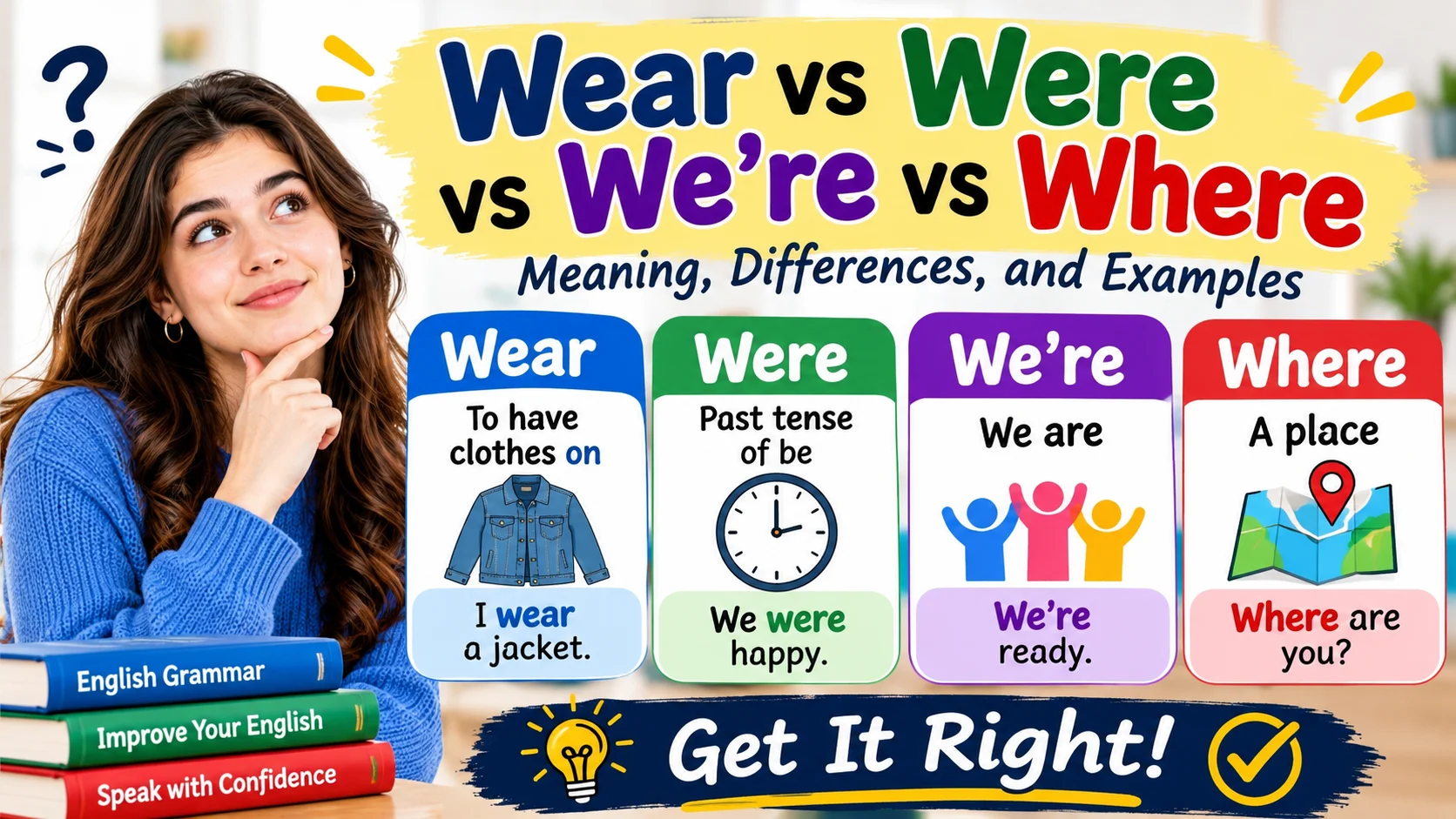
Wear means to have clothing or accessories on your body. Were is the past-tense form of are or be. We’re is a contraction of we are. Where refers to a place or asks about a location. These words may sound similar, but their meanings and grammatical uses are different.
Why Do People Confuse Wear, Were, We’re, and Where?
People often confuse these four words because they have similar sounds in spoken English. Depending on someone’s accent, wear, where, were, and we’re can sound very similar.
Their spellings also create confusion because they differ by only a few letters or punctuation marks.
Here are the main reasons for the confusion:
- Similar pronunciation: Some speakers pronounce these words almost identically.
- Different grammatical functions: They can act as a verb, contraction, or question word.
- Fast communication: People sometimes choose words based on sound rather than meaning when typing quickly.
- Spelling similarities: The words contain familiar letter combinations that are easy to mix up.
The best way to avoid mistakes is to understand what each word means and how it works in a sentence.
1. Wear: Meaning and Usage
Wear is a verb that means to have clothing, shoes, jewelry, or accessories on your body. It can also describe using something regularly or showing a particular expression.
It is commonly used when talking about clothes, fashion, and personal appearance.
Examples of Wear
- I like to wear comfortable clothes at home.
- She will wear a beautiful dress to the wedding.
- He always wears glasses when reading.
- You should wear a jacket because it is cold outside.
- They wear uniforms at school.
Other Meanings of Wear
Wear can also have other meanings depending on the context.
- To become damaged through use: These shoes show signs of wear.
- To display an expression: He wore a big smile on his face.
- To use or display something: She wears her confidence proudly.
Is Wear a Verb or a Noun?
Wear is primarily a verb, but it can also be used as a noun.
- Verb: I wear a blue shirt.
- Noun: The furniture shows signs of wear.
2. Were: Meaning and Usage
Were is the past-tense form of the verb be. It is used with subjects such as you, we, and they. It is also used with plural nouns.
It describes a past situation, condition, or action.
Examples of Were
- We were happy to see our friends.
- They were at the shopping mall yesterday.
- You were right about the answer.
- The children were playing outside.
- My parents were busy last weekend.
When Is Were Used?
Were is commonly used in three situations.
1. To describe a past condition
- We were tired after the journey.
- They were excited about the trip.
2. To describe a past location
- You were at home yesterday.
- The students were in the classroom.
3. In hypothetical or unreal situations
Were is also used in certain imaginary or conditional statements.
- If I were rich, I would travel around the world.
- If she were here, she would help us.
Were vs Was
Both were and was are past forms of the verb be, but they are used with different subjects in ordinary past-tense statements.
- I was happy.
- He was tired.
- She was at school.
- We were excited.
- They were ready.
3. We’re: Meaning and Usage
We’re is a contraction of the words we are. The apostrophe replaces the missing letter or letters in the original expression.
It is used in everyday conversations, informal writing, emails, and many other situations.
Examples of We’re
- We’re going to the park this afternoon.
- We’re excited about our vacation.
- We’re learning English together.
- We’re ready for the examination.
- We’re happy with the results.
How to Use We’re in a Sentence
We’re can be used before adjectives, verbs ending in -ing, and other expressions that follow we are.
Before adjectives:
- We’re happy with our new home.
- We’re confident about the future.
Before present participles:
- We’re watching a movie.
- We’re preparing dinner.
Before other descriptions:
- We’re students.
- We’re the winners of the competition.
We’re vs We Are
Both expressions have the same meaning.
| We’re | We Are |
|---|---|
| We’re ready. | We are ready. |
| We’re friends. | We are friends. |
| We’re studying. | We are studying. |
| We’re excited. | We are excited. |
Use we’re for a shorter, more conversational expression. Use we are when you want a more formal tone or extra emphasis.
4. Where: Meaning and Usage
Where is an adverb or conjunction used to refer to a place or location. It is most commonly used to ask questions about someone’s location or the position of something.
It can also introduce clauses that describe places.
Examples of Where
- Where do you live?
- Where is my phone?
- Where are you going?
- Do you know where she works?
- This is the restaurant where we first met.
How to Use Where in a Sentence
Where is used in different ways depending on the sentence.
1. Asking about a location
- Where is your school?
- Where did you buy this dress?
2. Describing a place
- This is the house where I grew up.
- I visited the town where my grandparents live.
3. Introducing a situation or position
- Where possible, try to arrive early.
- Put the books where they belong.
Where vs Were
These two words are often confused because they sound similar in some accents.
- Where refers to a location.
- Were describes a past state or situation.
Examples:
- Where were you yesterday?
- They were waiting where we had agreed to meet.
Remember that where asks about a place, while were is a form of the verb be.
Wear vs Were vs We’re vs Where: Comparison Table
The following table summarizes the meanings, grammatical roles, and examples of all four words.
| Word | Meaning | Grammar | Example |
|---|---|---|---|
| Wear | Put on clothing or have it on | Verb / noun | I wear glasses. |
| Were | Past form of be | Verb | We were tired. |
| We’re | We are | Contraction | We’re ready. |
| Where | A place or location | Adverb / conjunction | Where are you? |
The easiest distinction is to remember that wear relates to clothing, were relates to the past, we’re means we are, and where relates to a place.
When Should You Use Wear, Were, We’re, and Where?
Choosing the correct word becomes simple when you identify what you want to communicate.
Use Wear When Talking About Clothing
Choose wear when discussing clothes, shoes, glasses, jewelry, or something someone has on their body.
Examples:
- What should I wear to the party?
- He likes to wear black shoes.
- I wear a watch every day.
Use Were When Talking About the Past
Choose were when describing a past condition, location, or situation involving you, we, or they.
Examples:
- We were late for class.
- You were very helpful.
- They were at the office.
Use We’re When You Mean We Are
Choose we’re when you can replace it with we are without changing the meaning.
Examples:
- We’re going shopping.
- We’re very busy today.
- We’re ready to leave.
Use Where When Talking About a Place
Choose where when asking about a location or describing the place where something happens.
Examples:
- Where is your house?
- Where did you put my keys?
- This is where I work.
10+ Examples of Wear vs Were vs We’re vs Where in Sentences
Here are 16 practical examples showing how these words work in everyday English.
- I usually wear comfortable shoes when traveling.
- We were excited about the school trip.
- We’re planning a surprise birthday party.
- Where did you buy that beautiful dress?
- They were waiting outside the restaurant.
- We’re going to visit our grandparents tomorrow.
- You should wear warm clothes during winter.
- Where are my car keys?
- The children were playing in the garden.
- We’re happy to help you with your project.
- She likes to wear silver jewelry.
- Where were you last night?
- If I were you, I would accept the offer.
- We’re looking forward to meeting you.
- This is the school where my mother studied.
- They were wearing their new uniforms.
Notice that the correct word depends on the meaning of the entire sentence, not simply how it sounds.
Common Mistakes When Using Wear, Were, We’re, and Where
Even fluent English speakers sometimes make mistakes with words that sound alike. Here are some common errors and their corrections.
| Incorrect | Correct | Explanation |
|---|---|---|
| I were a blue shirt. | I wear a blue shirt. | Wear refers to clothing. |
| Where happy yesterday. | We were happy yesterday. | Were describes a past condition. |
| Were going home. | We’re going home. | We’re means we are. |
| Wear do you live? | Where do you live? | Where asks about location. |
| We where late. | We were late. | Were is the past form of be. |
| I like to where jeans. | I like to wear jeans. | Wear means to have clothes on. |
| Were are you? | Where are you? | Where asks about a place. |
Mistakes to Avoid
- Do not use wear when you mean where.
- Do not write were when you mean we’re.
- Do not forget the apostrophe in we’re.
- Do not use where to describe a past condition.
- Do not confuse were with was when choosing the correct subject.
Easy Memory Tricks to Remember the Difference
If you struggle to remember these four words, use these simple tricks.
W
Wear = Wardrobe
Both begin with W. Think about clothes, shoes, and accessories.
W
Were = Was
Both are forms of the verb be used in past-tense situations.
W
We’re = We Are
The apostrophe reminds you that letters have been removed.
W
Where = Whereabouts
Both relate to a place or location.
Another helpful trick is to replace we’re with we are. If the sentence still makes sense, we’re is probably the correct choice.
For example:
- We’re going home.
- We are going home.
Both sentences make sense, so we’re is correct.
American vs British English: Are There Any Differences?
The meanings and standard spellings of wear, were, we’re, and where are the same in American and British English.
However, pronunciation can vary depending on regional accents.
- Wear: The vowel sound may vary slightly by accent.
- Were: Some speakers pronounce it with a stronger or weaker R sound.
- We’re: Pronunciation may sound similar to wear or where.
- Where: The R sound is more noticeable in most American accents than in many non-rhotic British accents.
Although pronunciation differs, the spelling and grammatical rules remain the same.
You should use the same spelling and meanings if writing for an American or British audience.
Similar Words You Should Know
Learning related words can help you understand the differences between similar-sounding English expressions.
| Word Pair | Difference |
|---|---|
| Wear vs Where | Wear relates to clothing; where relates to location. |
| Were vs We’re | Were is past tense; we’re means we are. |
| Were vs Was | Both are past forms of be, but their usual subjects differ. |
| Where vs Were | Where refers to a place; were describes a past state. |
| Your vs You’re | Your shows possession; you’re means you are. |
| There vs Their vs They’re | They refer to a place, possession, and they are, respectively. |
| To vs Too vs Two | They express direction, addition, and the number 2. |
These word pairs are useful to study because they demonstrate how small spelling differences can change the meaning of an entire sentence.
Final Verdict: Wear vs Were vs We’re vs Where
Although wear, were, we’re, and where sound similar, they have four different meanings.
- Wear: To have clothing or accessories on your body.
- Were: The past-tense form of the verb be.
- We’re: A contraction of we are.
- Where: A word used to ask about or describe a location.
Always consider the meaning of your sentence before choosing one of these words. If you are talking about clothes, use wear. If you are describing the past, use were. If you mean we are, use we’re. If you are asking about a place, use where.
Frequently Asked Questions (FAQs)
1. What is the difference between wear, were, we’re, and where?
Wear means to have clothing on your body, were is the past form of be, we’re means we are, and where refers to a place or location. They have different meanings and grammatical functions despite their similar pronunciation.
2. Are wear and where pronounced the same?
In many English accents, wear and where are pronounced the same or very similarly. However, pronunciation can vary by region. Their meanings are different: wear relates to clothing, while where relates to location.
3. Is we’re the same as were?
No. We’re is a contraction of we are, while were is the past-tense form of the verb be. For example, “We’re happy” describes the present, while “We were happy” describes the past.
4. When should I use wear instead of where?
Use wear when talking about clothing, shoes, or accessories. Use where when asking about a location or describing a place.
For example:
- I wear a jacket in winter.
- Where is your jacket?
5. Is were always used in the past tense?
Were is generally used as a past-tense form of be, but it also appears in hypothetical or unreal statements. For example, “If I were rich, I would travel the world” describes an imaginary situation.
6. Can we’re be used in formal writing?
Yes. We’re is grammatically correct in many types of writing. However, in very formal or academic writing, some writers prefer the complete form we are.
7. How can I remember the difference between these four words?
Use four simple associations: wear means wardrobe, were relates to the past, we’re means we are, and where means whereabouts. You can also replace we’re with we are to check if it is correct.
Remember This
Four words, four different meanings:
- WEAR = Clothing
- WERE = Past tense
- WE’RE = We are
- WHERE = Location
Quick test: Complete this sentence:
“_____ going to _____ our new clothes. _____ should we meet?”
First blankWereWe’reWhere
Second blankwearwerewhere
Third blankWereWe’reWhere
Check answers
Conclusion
Understanding the difference between wear, were, we’re, and where is an important step toward improving your English grammar and spelling. Although these words can sound alike, each has a specific purpose. Remember that wear relates to clothing, were describes the past, we’re means we are, and where refers to a location.
The best way to master these commonly confused words is through regular reading, writing, and practice. Pay attention to the meaning of each sentence instead of relying only on pronunciation. With these simple rules and examples, you can use all four words correctly and write with greater confidence.

I am Martin Joseph, a passionate writer who enjoys creating helpful, thoughtful, and engaging replies. I aim to make conversations easier by sharing practical responses for every situation.