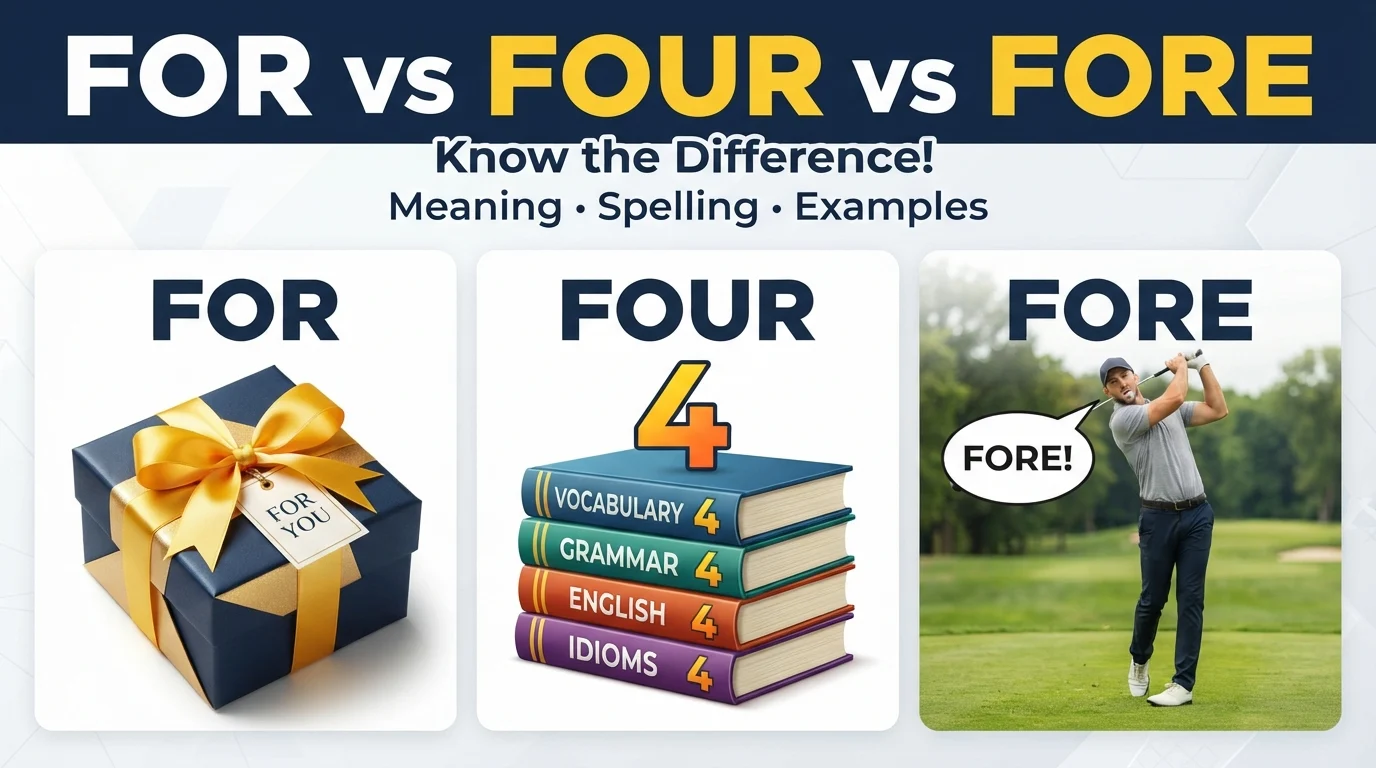
Have you ever wondered if to write for, four, or fore? These three words sound exactly alike, but they have completely different meanings and uses. Choosing the correct one can be confusing, especially when writing quickly or learning English. Understanding the difference between for vs four vs fore will help you avoid common spelling mistakes and communicate more clearly.
The main difference is simple: for is a preposition or conjunction used to express purpose, reason, or benefit; four is the number 4; and fore refers to something situated at the front or is a warning shouted in golf. Although they share the same pronunciation, their meanings, grammatical roles, and contexts are different. In this guide, you will learn how to use each word correctly, explore practical examples, and discover easy tricks to remember the difference.
Quick Answer: For vs Four vs Fore
For expresses purpose, reason, duration, or benefit, as in “This gift is for you.” Four represents the number 4, as in “I have four books.” Fore refers to the front part of something or is a warning shouted in golf when a ball is heading toward someone. All three sound alike but have different meanings.
Why Do People Confuse For, Four, and Fore?
The words for, four, and fore are examples of homophones. Homophones are words that have the same pronunciation but different meanings and spellings.
People often confuse them because:
- Identical pronunciation: All three words generally sound like “for.”
- Different spellings: Each word has a different spelling despite sounding alike.
- Different meanings: They represent a preposition, a number, and a word associated with the front or golf.
- Fast writing: People sometimes choose the wrong spelling when typing without checking the sentence’s meaning.
The easiest way to avoid confusion is to understand what each word communicates in a sentence.
1. What Does For Mean?
For is a common English preposition and can also function as a conjunction. It expresses purpose, reason, benefit, duration, or intended use.
It helps explain why something happens, who receives something, or how long an activity continues.
Common Uses of For
1. To show purpose
- I went to the store for some groceries.
- She studies hard for her future.
2. To show benefit or intended recipient
- This present is for my mother.
- I bought a coffee for my friend.
3. To describe duration
- We waited for two hours.
- He lived in London for five years.
4. To express a reason
- Thank you for your kindness.
- I apologize for being late.
5. To show support or agreement
- I am for this new idea.
- They voted for the proposal.
For in a Sentence
- I am looking for my keys.
- This book is for beginners.
- We stayed there for three days.
- She is famous for her beautiful paintings.
- He works for an international company.
Remember: Use for when talking about purpose, benefit, reason, duration, or support.
2. What Does Four Mean?
Four is a cardinal number that represents the numerical value 4. It comes after three and before five.
It is used when counting people, objects, events, quantities, or anything that has a numerical value.
Common Uses of Four
1. Counting objects
- I have four pencils.
- There are four chairs in the room.
2. Describing age
- My little brother is four years old.
- The child turned four last week.
- The meeting starts at four o’clock.
- I will arrive at quarter past four.
4. Describing quantities
- She bought four apples.
- We need four tickets for the concert.
5. Referring to groups
- The team has four members.
- There are four seasons in a year.
Four in a Sentence
- I have four brothers.
- She ordered four cups of tea.
- We need four more days to finish the project.
- My house has four bedrooms.
- The school has four main buildings.
Remember: Use four whenever you mean the number 4.
3. What Does Fore Mean?
Fore is a less common English word that refers to the front part or forward position of something. It is also widely recognized as a warning shouted in golf.
Unlike for and four, it usually appears in specific contexts.
Common Uses of Fore
1. To refer to the front
The word fore can describe something located toward the front of an object, vehicle, or structure.
- The fore part of the boat was damaged.
- The fore section of the aircraft contains important equipment.
2. In golf
In golf, players shout “Fore!” to warn others that a golf ball may be heading toward them.
- The golfer shouted “Fore!” after hitting the ball.
- Everyone moved aside when they heard “Fore!”
3. In compound words
Fore also appears in words that describe something positioned at the front or happening beforehand.
Examples include:
- Forehead: The front part of the head.
- Forefront: The leading or most important position.
- Forearm: The part of the arm between the elbow and wrist.
- Foreword: An introductory section in a book.
Fore in a Sentence
- The golfer shouted “Fore!” to warn the spectators.
- The fore part of the ship faced the waves.
- The company is at the forefront of technological innovation.
- She wrote a foreword for her friend’s book.
- He injured his forearm while playing tennis.
Remember: Use fore when referring to the front or a warning in golf.
For vs Four vs Fore: Comparison Table
The following table highlights the main differences between these three homophones.
| Feature | For | Four | Fore |
|---|---|---|---|
| Meaning | Purpose, reason, benefit | Number 4 | Front or golf warning |
| Word type | Preposition, conjunction | Number | Noun, adjective, interjection |
| Pronunciation | /fɔːr/ | /fɔːr/ | /fɔːr/ |
| Frequency | Very common | Very common | Less common |
| Example | This is for you. | I have four pens. | Fore! Watch out! |
The key difference: Their pronunciation is the same, but their meanings and grammatical functions are different.
When Should You Use For, Four, or Fore?
Choosing the right word becomes easier when you consider the meaning of your sentence.
Use For When:
- You are explaining a purpose.
- You are describing a reason.
- You are talking about a benefit or recipient.
- You are expressing a duration.
- You are showing support for something.
Example: I bought flowers for my teacher.
Use Four When:
- You are counting objects.
- You are describing a quantity.
- You are referring to the number 4.
- You are mentioning someone’s age or a specific numerical amount.
Example: There are four people in my family.
Use Fore When:
- You are describing the front part of something.
- You are talking about golf.
- You are using a compound word such as forefront or forehead.
Example: The golfer shouted Fore! to warn the people nearby.
15 Examples of For vs Four vs Fore in Sentences
Here are practical examples to help you understand how these words work in everyday English.
Examples Using For
- This beautiful gift is for my sister.
- I have been waiting for an hour.
- She went outside for some fresh air.
- Thank you for helping me with my homework.
- He works for a famous company.
Examples Using Four
- I bought four new notebooks.
- There are four windows in my bedroom.
- My daughter is four years old.
- We need four more chairs.
- The journey will take four hours.
Examples Using Fore
- The golfer shouted “Fore!” before the ball landed.
- The fore part of the ship was painted white.
- The company is at the forefront of scientific research.
- He injured his forearm during the match.
- She wrote a foreword for the new book.
Common Mistakes When Using For, Four, and Fore
Even experienced English speakers sometimes make homophone spelling mistakes. Here are some common errors and their corrections.
| Incorrect Sentence | Correct Sentence |
|---|---|
| This gift is four you. | This gift is for you. |
| I have for apples. | I have four apples. |
| The golfer shouted “Four!” | The golfer shouted “Fore!” |
| I waited four two hours. | I waited for two hours. |
| There are for students. | There are four students. |
| The fore of the boat was damaged. | The fore part of the boat was damaged. |
How to Avoid These Mistakes
- Check whether the sentence expresses a purpose or benefit.
- Look for numerical quantities before choosing four.
- Remember that fore is associated with the front or golf warnings.
- Read the entire sentence to understand its intended meaning.
- Proofread your writing, especially when using commonly confused words.
Easy Memory Trick to Remember For vs Four vs Fore
You do not need to memorize complicated grammar rules to distinguish these words. Just use these simple memory tricks.
FOR
FOR = Purpose
Think: “This is for you.” Remember the idea of giving something to someone or doing something for a reason.
4
FOUR = Number
Think: Four has four letters and represents the number 4.
FORE
FORE = Front
Think: Forehead, forefront, and the golf warning “Fore!”
A quick way to remember all three:
- For = Why or for whom?
- Four = How many?
- Fore = Where is the front?
American vs British English: For, Four, and Fore
There is no meaningful spelling difference between American and British English when using these three words.
Both varieties use:
- For to express purpose, reason, or benefit.
- Four to represent the number 4.
- Fore to describe the front or give a golf warning.
The pronunciation can vary slightly depending on regional accents.
For example, some British speakers pronounce the final R less strongly than most American speakers. However, all three words remain homophones within the same accent.
Important: You do not need to change the spelling of these words when switching between American and British English.
Similar Words You Should Know
If you are learning English, understanding other commonly confused homophones can improve your spelling and vocabulary.
| Word Pair | Difference |
|---|---|
| Their vs There vs They’re | Possession, place, and they are |
| To vs Too vs Two | Direction, also, and number 2 |
| Your vs You’re | Possession and you are |
| Here vs Hear | Place and listening |
| Right vs Write | Correct or direction and writing |
| Sea vs See | Ocean and looking |
| No vs Know | Negative response and understanding |
| One vs Won | Number 1 and past tense of win |
These words may sound alike or similar, but their meanings and grammatical uses are different.
Final Verdict: For vs Four vs Fore
The difference between for, four, and fore comes down to their meanings and how they are used in sentences.
- For: Use it to express purpose, reason, benefit, duration, or support.
- Four: Use it when referring to the number 4.
- Fore: Use it to describe the front or as a warning in golf.
Although all three words sound alike, they cannot be used interchangeably. Always consider the meaning of your sentence before choosing the spelling.
Frequently Asked Questions (FAQs)
1. What is the difference between for, four, and fore?
For expresses purpose, reason, benefit, or duration. Four is the number 4. Fore refers to the front part of something or is a warning used in golf. All three words have the same pronunciation but different meanings.
2. Are for, four, and fore homophones?
Yes. For, four, and fore are homophones because they share the same pronunciation but have different spellings and meanings. Their pronunciation may vary slightly across accents, but they sound alike within most English varieties.
3. Is it for or four?
It depends on the meaning of your sentence. Use for when expressing purpose, benefit, or duration. Use four when referring to the number 4.
Examples:
- This letter is for you.
- I have four letters.
4. What does fore mean in golf?
In golf, “Fore!” is a warning shouted when a golf ball may hit another player or spectator. It alerts people to move out of the ball’s path and protect themselves.
5. Is fore a real English word?
Yes. Fore is a real English word that refers to the front part or forward position of something. It is also used as a warning in golf and appears in compound words such as forehead and forefront.
6. Why do for, four, and fore sound the same?
These words have developed different spellings and meanings while sharing the same pronunciation. English contains many such words, known as homophones, which can make spelling confusing for learners.
7. Can for, four, and fore be used interchangeably?
No. They have different meanings and grammatical functions. Using one in place of another can change the meaning of a sentence or create a spelling mistake. Always choose the word that matches your intended meaning.
Remember This
- FOR = Purpose, reason, or benefit.
- FOUR = The number 4.
- FORE = Front or a golf warning.
All three sound alike, but their meanings are different. Understanding the context is the easiest way to choose the correct word.
Conclusion
Understanding the difference between for vs four vs fore is easier than it first appears. Although these three words sound identical, each has its own meaning and purpose. For is used to express purpose, reason, and benefit; four represents the number 4; and fore refers to the front or serves as a warning in golf.
The next time you use these words, think about what you want to communicate. Are you describing a purpose, counting something, or referring to the front? This simple habit will help you choose the correct spelling, avoid common homophone mistakes, and become a more confident English writer.

I am Marcus James, Administrator at ReplyLop. I enjoy creating helpful, friendly, professional, and creative reply ideas that make conversations easier, clearer, and more engaging for everyone.