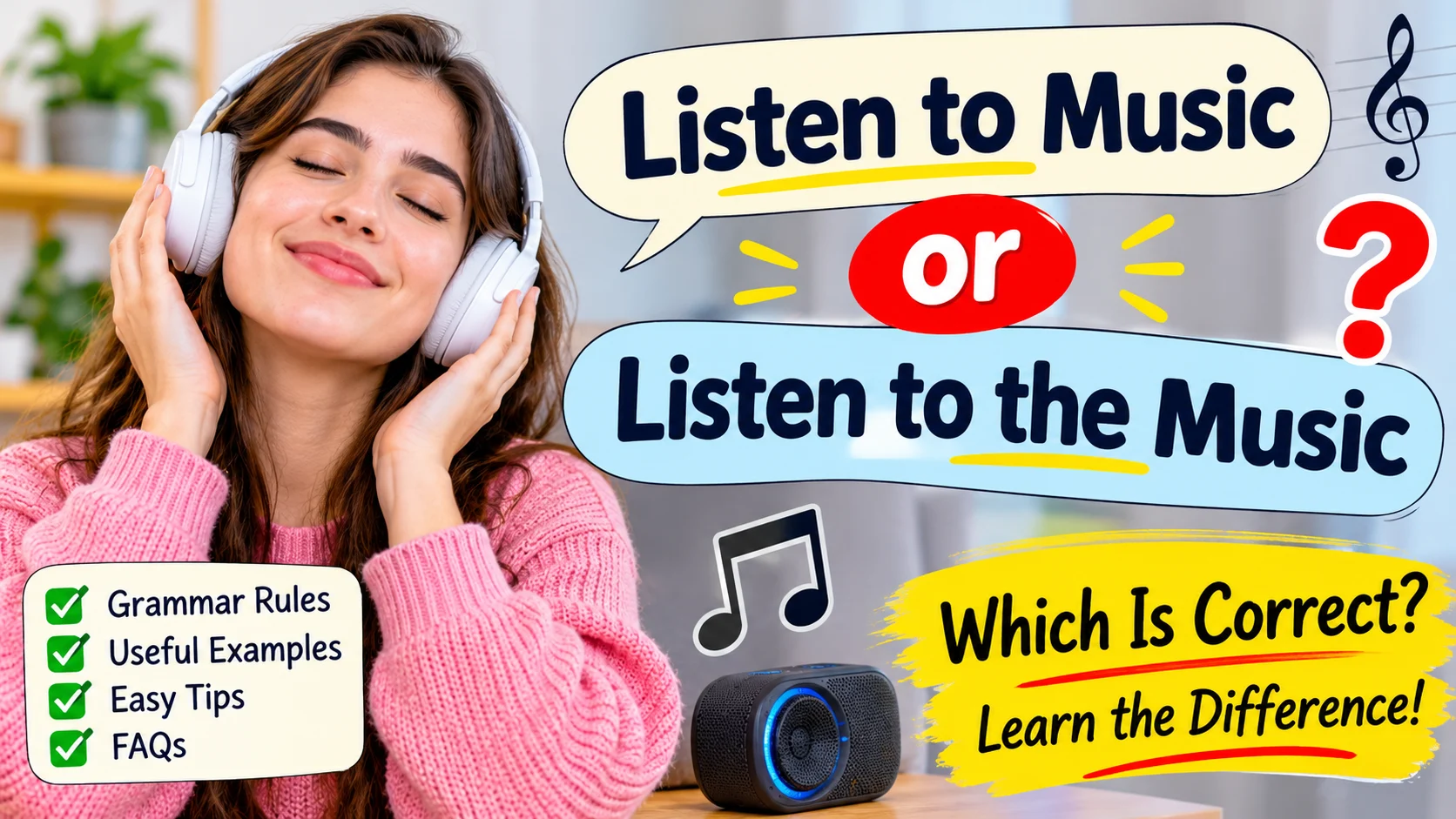
Have you ever wondered if to say “listen to music” or “listen to the music”? Both expressions are grammatically correct, but they are used in different situations. The difference depends on if you are talking about music in general or a particular piece of music. Understanding this small difference can help you speak and write more naturally in English.
Many English learners find this expression confusing because the word music is an uncountable noun. However, uncountable nouns can sometimes be used with the definite article “the” when the speaker refers to something specific. Once you understand when to use the article and when to leave it out, choosing the correct expression becomes much easier. In this guide, you will learn the meanings, grammar rules, differences, and everyday examples of both phrases.
Quick Answer
“Listen to music” is used when talking about music in general, without referring to a particular song or piece. “Listen to the music” is used when referring to specific music that the speaker and listener can identify. Both are correct, but the context determines which expression sounds natural.
Why Do People Confuse Listen to Music and Listen to the Music?
People often confuse these expressions because both contain the same words, and both are grammatically correct.
The main difference is the definite article “the.”
- Without “the,” music refers to music as a general activity or concept.
- With “the,” music refers to particular music that is already known, identified, or available in the situation.
For example:
- I love to listen to music. (Music in general.)
- Listen to the music playing in the background. (Specific music.)
The difference is small, but it changes the meaning of the sentence.
First Phrase: Listen to Music
Listen to music is the natural expression when talking about music generally.
It means enjoying, hearing, or paying attention to music without identifying a particular song, artist, or musical piece.
Here, music is an uncountable noun used in a general sense. Therefore, it does not need the definite article “the.”
When Should You Use Listen to Music?
Use this expression when:
- Talking about your general hobbies or interests.
- Describing your daily routine.
- Discussing music as a form of entertainment.
- Explaining what you enjoy doing in your free time.
- Talking about listening habits.
Examples of Listen to Music
- I love to listen to music while studying.
- She listens to music every morning.
- My brother likes to listen to music before sleeping.
- We often listen to music during long journeys.
- He enjoys listening to music in his free time.
- I usually listen to music when I feel stressed.
- They listen to music while working out.
- Listening to music helps me relax.
- Do you like to listen to music?
- Children often listen to music for entertainment.
- My father prefers to listen to classical music.
- I sometimes listen to music while cooking.
In all these examples, the speaker is referring to music generally rather than one particular piece.
Second Phrase: Listen to the Music
Listen to the music is used when referring to specific music that the speaker or listener can identify.
The word “the” indicates that the music is particular or already known from the context.
For example:
- Listen to the music coming from that room.
- I love the music in this movie.
In these sentences, the speaker is talking about identifiable music, not music in general.
When Should You Use Listen to the Music?
Use this expression when:
- Referring to a particular song or musical piece.
- Talking about music playing nearby.
- Discussing the soundtrack of a movie.
- Asking someone to pay attention to specific music.
- Referring to music already mentioned in a conversation.
Examples of Listen to the Music
- Listen to the music playing outside.
- I love the music in this movie.
- Can you listen to the music for a moment?
- The children are dancing to the music.
- Listen to the music coming from the speakers.
- We enjoyed listening to the music at the concert.
- She asked me to listen to the music she had composed.
- The music in this restaurant is beautiful.
- Everyone stopped talking to listen to the music.
- I recognized the music from that television show.
- Please listen to the music before giving your opinion.
- The music you selected sounds wonderful.
Here, “the music” refers to particular music that can be identified from the situation or conversation.
Listen to Music vs Listen to the Music: Comparison Table
| Feature | Listen to music | Listen to the music |
|---|---|---|
| Meaning | Music in general | Specific music |
| Article | No article | Uses “the” |
| Grammar | Correct | Correct |
| Context | General activities | Identifiable music |
| Example | I listen to music daily. | Listen to the music outside. |
| Common use | Hobbies and routines | Particular songs or sounds |
When to Use Each Expression
Choosing between these phrases becomes easier when you understand the context.
1. Talking About General Hobbies
Use listen to music when describing music as one of your hobbies.
Example: I listen to music every evening.
You are describing a regular activity, not a specific song.
2. Referring to a Particular Song
Use listen to the music when talking about identifiable music.
Example: Listen to the music in this video.
The phrase refers to the particular music included in the video.
3. Talking About Daily Habits
Use listen to music to describe regular listening habits.
Example: My mother listens to music while cleaning.
4. Talking About Background Music
Use listen to the music when referring to particular music playing in the background.
Example: Listen to the music playing in the café.
5. Discussing Musical Preferences
Use listen to music when discussing your general musical interests.
Example: I prefer to listen to music rather than watch television.
Common Mistakes to Avoid
Here are some mistakes English learners should avoid when using these expressions.
Mistake 1: Adding “The” When Talking About Music Generally
Incorrect: I like listening to the music.
Better: I like listening to music.
The second sentence is more natural when expressing a general preference.
Mistake 2: Removing “The” When Referring to Specific Music
Less natural: Listen to music playing in the background.
Better: Listen to the music playing in the background.
The definite article makes it clear that you mean particular music.
Mistake 3: Forgetting the Preposition “To”
Incorrect: I listen music every day.
Correct: I listen to music every day.
The verb listen is normally followed by the preposition “to” when introducing what someone listens to.
Mistake 4: Confusing Listen and Hear
These words have different meanings:
- Listen: To pay attention to sounds intentionally.
- Hear: To perceive sounds through your ears.
Example: I can hear the music, but I am not listening to it carefully.
Easy Memory Trick
Remember this simple rule:
- Music without “the” = Music in general.
- The music = Particular or identifiable music.
Think of these examples:
- I enjoy listening to music. (General interest.)
- I enjoy listening to the music you recommended. (Specific music.)
Whenever you are unsure, ask yourself: Am I talking about music generally or a particular piece of music?
Your answer will help you choose the correct phrase.
American vs British English
There is no meaningful grammatical difference between American and British English when using these expressions.
Both varieties use:
- Listen to music for general musical activities.
- Listen to the music for particular or identifiable music.
Examples:
American English: I usually listen to music in my car.
British English: I usually listen to music in my car.
Both sentences are correct and natural.
The same rule applies to other English-speaking regions.
Similar Words and Expressions
Understanding these related expressions can help you use English more accurately.
1. Listen to Songs
Used when referring to songs generally or particular songs, depending on context.
Example: I enjoy listening to songs in different languages.
2. Listen to the Song
Used when referring to one particular song.
Example: Listen to the song I sent you yesterday.
3. Listen to Music
Used when discussing music as a general activity.
Example: She listens to music while exercising.
4. Listen to the Music
Used when referring to identifiable music.
Example: Listen to the music in the background.
5. Hear Music
Used when referring to perceiving music through your ears.
Example: I can hear music coming from the next room.
Frequently Asked Questions (FAQs)
1. Is it correct to say “listen to music”?
Yes. “Listen to music” is grammatically correct and commonly used when talking about music in general. For example, “I listen to music every day” describes a general habit.
2. Is “listen to the music” grammatically correct?
Yes. “Listen to the music” is correct when referring to specific or identifiable music. For example, “Listen to the music playing in the garden.”
3. Why don’t we use “the” before music?
We generally omit “the” because music is an uncountable noun when used in a general sense. For example, “I love music” and “I enjoy listening to music.”
4. Should I say “I listen to music” or “I listen to the music”?
Use “I listen to music” when describing your general listening habits. Use “I listen to the music” when referring to particular music already identified by the context.
5. Is music a countable or uncountable noun?
Music is generally an uncountable noun. You cannot normally say “a music” when referring to music in general. However, you can say “a piece of music” or “a song.”
6. Can I say “listening to the music”?
Yes. It is perfectly correct when referring to particular music. For example, “I enjoy listening to the music in this film.”
7. What is the difference between listen to music and hear music?
“Listen to music” means intentionally paying attention to music. “Hear music” means perceiving music through your ears, if or not you are paying attention.
Remember This
- Listen to music: Use it for music in general.
- Listen to the music: Use it for specific or identifiable music.
- Both expressions are grammatically correct.
- Music is generally an uncountable noun.
- The preposition “to” normally follows the verb “listen.”
Conclusion
The difference between “listen to music” and “listen to the music” is simple once you understand how the definite article works. Use “listen to music” when discussing music as a general activity, hobby, or interest. Use “listen to the music” when referring to particular music that is identifiable from the situation or conversation.
Both expressions are correct in everyday English. Pay attention to the context, remember the role of “the,” and practice using these phrases in your daily conversations. With a little practice, you will know exactly which expression to choose.

I am Martin Joseph, a passionate writer who enjoys creating helpful, thoughtful, and engaging replies. I aim to make conversations easier by sharing practical responses for every situation.