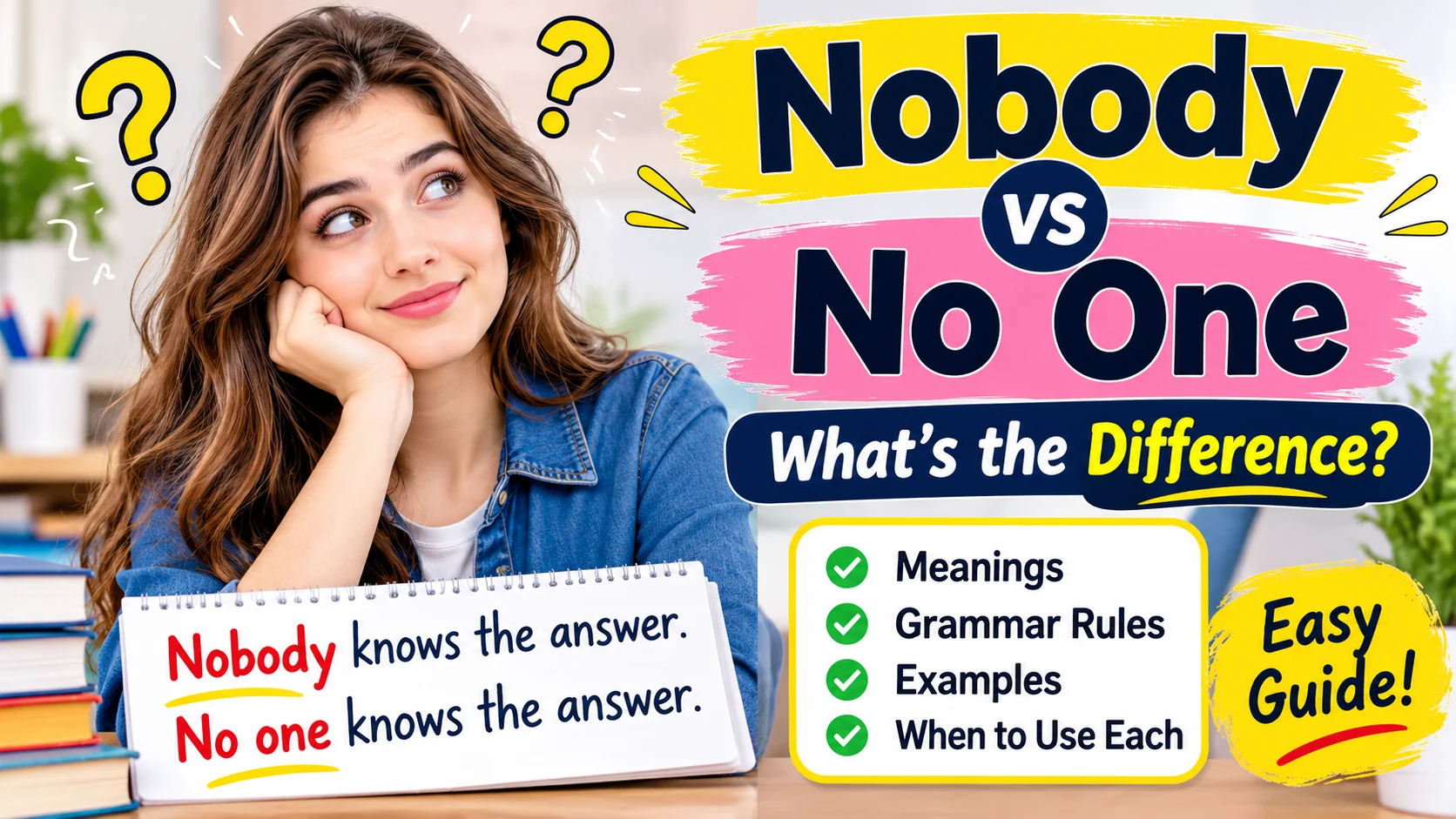
Have you ever wondered if to write nobody or no one? Both expressions are common in English, and they are often used to talk about the absence of people. Although they look different, they have almost the same meaning. Understanding how to use them correctly can help you write clearer sentences and communicate more naturally.
The main difference between nobody and no one is their spelling and grammatical form, not their meaning. Both are indefinite pronouns that mean “not any person.” For example, you can say, “Nobody knows the answer” or “No one knows the answer.” Both sentences are grammatically correct. However, there are a few differences in spelling, style, and usage worth understanding, especially when writing formal documents, emails, or everyday conversations.
Quick Answer: Nobody vs No One
Nobody and no one both mean “not any person” or “not a single person.” They are interchangeable in most sentences and take singular verbs. The main difference is that nobody is written as one word, while no one is written as two words. Neither expression is generally more correct than the other.
Why Do People Confuse Nobody and No One?
People often confuse these expressions because they have the same basic meaning and perform the same grammatical function.
Both are indefinite pronouns used when referring to zero people or when saying that a person does not exist in a particular situation.
For example:
- Nobody called me yesterday.
- No one called me yesterday.
Both sentences communicate exactly the same idea.
The confusion usually comes from three things:
- Similar meanings: Both expressions refer to the absence of people.
- Different spellings: Nobody is one word, whereas no one is two words.
- Similar grammar: Both generally require singular verbs.
The good news is that you can use either expression in most everyday and formal situations.
1. Nobody: Meaning, Definition, and Usage
Nobody is an indefinite pronoun that means no person, not anybody, or not a single person.
It refers to the absence of people in a particular situation. It is commonly used in conversations, emails, stories, and everyday writing.
How to Use Nobody in a Sentence
Use nobody when you want to express that no person performed an action, knows something, or is present.
Examples:
- Nobody answered the phone.
- Nobody knows where she went.
- Nobody was waiting outside.
- Nobody understands the problem.
- Nobody invited me to the party.
Grammatical Rules for Nobody
Here are some important grammar rules to remember:
1. Nobody takes a singular verb.
Although nobody refers to zero people, it is grammatically singular.
- Correct: Nobody is available.
- Incorrect: Nobody are available.
2. Nobody does not need another negative word.
Nobody already expresses a negative meaning.
- Correct: Nobody came to the meeting.
- Incorrect: Nobody didn’t come to the meeting.
3. Nobody can be used with possessive forms.
You can use the possessive form nobody’s when referring to something belonging to no person.
Example: Nobody’s opinion was ignored.
4. Nobody can refer to an unknown or unspecified person.
Example: Nobody knows who left the door open.
2. No One: Meaning, Definition, and Usage
No one is an indefinite pronoun that means not any person or nobody.
It is used to describe a situation in which not a single person is involved, present, or responsible for something.
Like nobody, no one takes a singular verb.
How to Use No One in a Sentence
Use no one when you want to emphasize that not a single person is involved in an action or situation.
Examples:
- No one answered my question.
- No one was home when I arrived.
- No one knows the truth.
- No one helped him with the project.
- No one noticed the mistake.
Grammatical Rules for No One
1. No one takes a singular verb.
- Correct: No one is perfect.
- Incorrect: No one are perfect.
2. No one is always written as two separate words.
The standard spelling is no one, not noone.
- Correct: No one understands me.
- Incorrect: Noone understands me.
3. No one does not require an additional negative.
- Correct: No one called me.
- Incorrect: No one didn’t call me.
4. Use the possessive form no one’s when necessary.
Example: No one’s belongings were missing.
3. Nobody vs No One: Comparison Table
Although both expressions have the same basic meaning, their spelling and presentation are different.
| Feature | Nobody | No One |
|---|---|---|
| Meaning | Not any person | Not any person |
| Word count | One word | Two words |
| Part of speech | Indefinite pronoun | Indefinite pronoun |
| Verb agreement | Singular | Singular |
| Formal writing | Acceptable | Acceptable |
| Informal writing | Common | Common |
| Possessive form | Nobody’s | No one’s |
| Negative meaning | Yes | Yes |
| Interchangeable | Usually | Usually |
Key takeaway: Nobody and no one are grammatically correct alternatives. Choose whichever sounds more natural in your sentence.
4. When Should You Use Nobody or No One?
Since both expressions have almost identical meanings, choosing between them is usually a matter of personal preference and writing style.
When to Use Nobody
Use nobody when you prefer a shorter, direct, and conversational expression.
It works naturally in everyday conversations and informal writing.
Examples:
- Nobody told me about the changes.
- Nobody wants to lose the game.
- Nobody is answering the door.
- Nobody believes his story.
When to Use No One
Use no one when you prefer a slightly more deliberate or neutral expression.
It is also suitable for academic writing, professional communication, and formal documents.
Examples:
- No one was able to explain the situation.
- No one should be treated unfairly.
- No one has submitted the assignment.
- No one knows what will happen next.
Important: These are style preferences, not strict grammatical rules. Both expressions are appropriate in formal and informal English.
5. Nobody vs No One: 15 Practical Examples
The following examples show how both expressions work in everyday English.
| Nobody | No One |
|---|---|
| Nobody called me. | No one called me. |
| Nobody was home. | No one was home. |
| Nobody knows the answer. | No one knows the answer. |
| Nobody helped her. | No one helped her. |
| Nobody likes waiting. | No one likes waiting. |
| Nobody came to the party. | No one came to the party. |
| Nobody noticed the change. | No one noticed the change. |
| Nobody understands him. | No one understands him. |
| Nobody opened the door. | No one opened the door. |
| Nobody believed the story. | No one believed the story. |
| Nobody is perfect. | No one is perfect. |
| Nobody wants to leave. | No one wants to leave. |
| Nobody remembered my birthday. | No one remembered my birthday. |
| Nobody was listening. | No one was listening. |
| Nobody answered the question. | No one answered the question. |
More Examples in Different Situations
In everyday conversations:
- Nobody is answering my messages.
- No one seems interested in the movie.
At school:
- Nobody completed the homework.
- No one knew the correct answer.
At work:
- Nobody attended the morning meeting.
- No one has approved the proposal yet.
In relationships:
- Nobody understands how I feel.
- No one makes me smile like you do.
In social situations:
- Nobody invited us to dinner.
- No one recognized him at the event.
6. Common Mistakes When Using Nobody and No One
Even though these expressions are easy to understand, some common grammatical mistakes can cause confusion.
Mistake 1: Using a Plural Verb
Both nobody and no one are singular indefinite pronouns.
- Incorrect: Nobody are here.
- Correct: Nobody is here.
- Incorrect: No one know the answer.
- Correct: No one knows the answer.
Mistake 2: Writing No One as One Word
The correct spelling is always two separate words.
- Incorrect: Noone called me.
- Correct: No one called me.
Mistake 3: Using Double Negatives
Both expressions already have negative meanings, so avoid adding another negative word in standard English.
- Incorrect: Nobody didn’t help me.
- Correct: Nobody helped me.
- Incorrect: No one never listens.
- Correct: No one listens.
Mistake 4: Confusing Nobody With Anybody
Nobody and anybody have different meanings depending on the sentence.
- Nobody came to the office. (Not a single person came.)
- Did anybody come to the office? (Asks if at least one person came.)
Mistake 5: Using an Incorrect Possessive Form
Both expressions can show possession with an apostrophe and the letter s.
- Correct: Nobody’s phone was ringing.
- Correct: No one’s phone was ringing.
7. Memory Trick: How to Remember Nobody vs No One
A simple way to remember these expressions is to focus on their spelling.
- Nobody = No + body: One complete word.
- No one = No + one: Two separate words.
Remember that both expressions mean zero people and require singular verbs.
Easy trick: If you remember that no one is always written as two words, you will avoid one of the most common spelling mistakes.
8. Nobody vs No One in American and British English
Both nobody and no one are standard expressions in American and British English.
There is no major difference in their meaning, spelling, or grammatical usage between these varieties.
| English Variety | Nobody | No One |
|---|---|---|
| American English | Correct | Correct |
| British English | Correct | Correct |
| Canadian English | Correct | Correct |
| Australian English | Correct | Correct |
Both expressions are widely understood across English-speaking countries.
You can confidently use either one in school assignments, professional emails, conversations, and general writing.
9. Similar Words and Expressions
Understanding related expressions can help you expand your English vocabulary and choose the right words for different situations.
1. Somebody vs Someone
Both mean an unspecified person.
Examples:
- Somebody is waiting outside.
- Someone left their bag here.
2. Anybody vs Anyone
Both refer to any person and are commonly used in questions and negative sentences.
Examples:
- Does anybody know her?
- Can anyone help me?
3. Everybody vs Everyone
Both refer to all people in a group.
Examples:
- Everybody is welcome.
- Everyone enjoyed the celebration.
4. Nobody vs Anybody
These expressions have different meanings.
- Nobody was there. (Zero people were present.)
- Anybody can participate. (Any person can participate.)
5. No One vs None
No one refers specifically to people, while none can refer to people or things.
Examples:
- No one attended the event.
- None of the books were missing.
10. Final Verdict: Nobody or No One?
The choice between nobody and no one is simple: both are correct and mean “not any person.”
Use nobody when you prefer a single-word expression, and use no one when you prefer a two-word expression. Neither is grammatically superior, and both work in everyday conversations, academic writing, and professional communication.
The most important rule is to remember that both expressions take singular verbs. Once you understand this rule, you can use them confidently without worrying about choosing the wrong expression.
Frequently Asked Questions (FAQs)
1. Is nobody or no one grammatically correct?
Both nobody and no one are grammatically correct. They have the same basic meaning and can usually replace each other without changing the meaning of a sentence.
2. What is the difference between nobody and no one?
The main difference is spelling. Nobody is written as one word, while no one is written as two words. Both mean not any person and function as singular indefinite pronouns.
3. Is no one two words or one word?
No one is always written as two separate words in standard English. Writing it as noone is incorrect.
4. Should I use nobody is or nobody are?
Use nobody is because nobody is a singular indefinite pronoun.
Correct: Nobody is available today.
Incorrect: Nobody are available today.
5. Is nobody more informal than no one?
Nobody can sound slightly more conversational in some contexts, while no one may sound slightly more deliberate. However, both are acceptable in formal and informal writing.
6. What is the possessive form of nobody and no one?
The possessive forms are nobody’s and no one’s.
Examples:
- Nobody’s car was damaged.
- No one’s opinion was ignored.
7. Can nobody and no one be used interchangeably?
Yes. They can be used interchangeably in most situations because they have the same meaning and grammatical function.
For example:
- Nobody knows the truth.
- No one knows the truth.
Both sentences are correct.
Remember This
- Nobody and no one have the same basic meaning.
- Nobody is written as one word.
- No one is written as two words.
- Both are singular indefinite pronouns.
- Use singular verbs with both expressions.
- Avoid double negatives in standard English.
- Both are correct in American and British English.
Conclusion
Understanding the difference between nobody and no one is easy once you know that both expressions mean “not any person.” They are interchangeable in most situations, and neither is considered more grammatically correct than the other. The main distinction is simply how they are written: nobody is one word, whereas no one consists of two words.
if you are writing an email, completing a school assignment, or having a casual conversation, you can confidently use either expression. Just remember to pair them with singular verbs and avoid unnecessary double negatives. With these simple rules and examples, choosing between nobody and no one will become much easier.

I am Martin Joseph, a passionate writer who enjoys creating helpful, thoughtful, and engaging replies. I aim to make conversations easier by sharing practical responses for every situation.