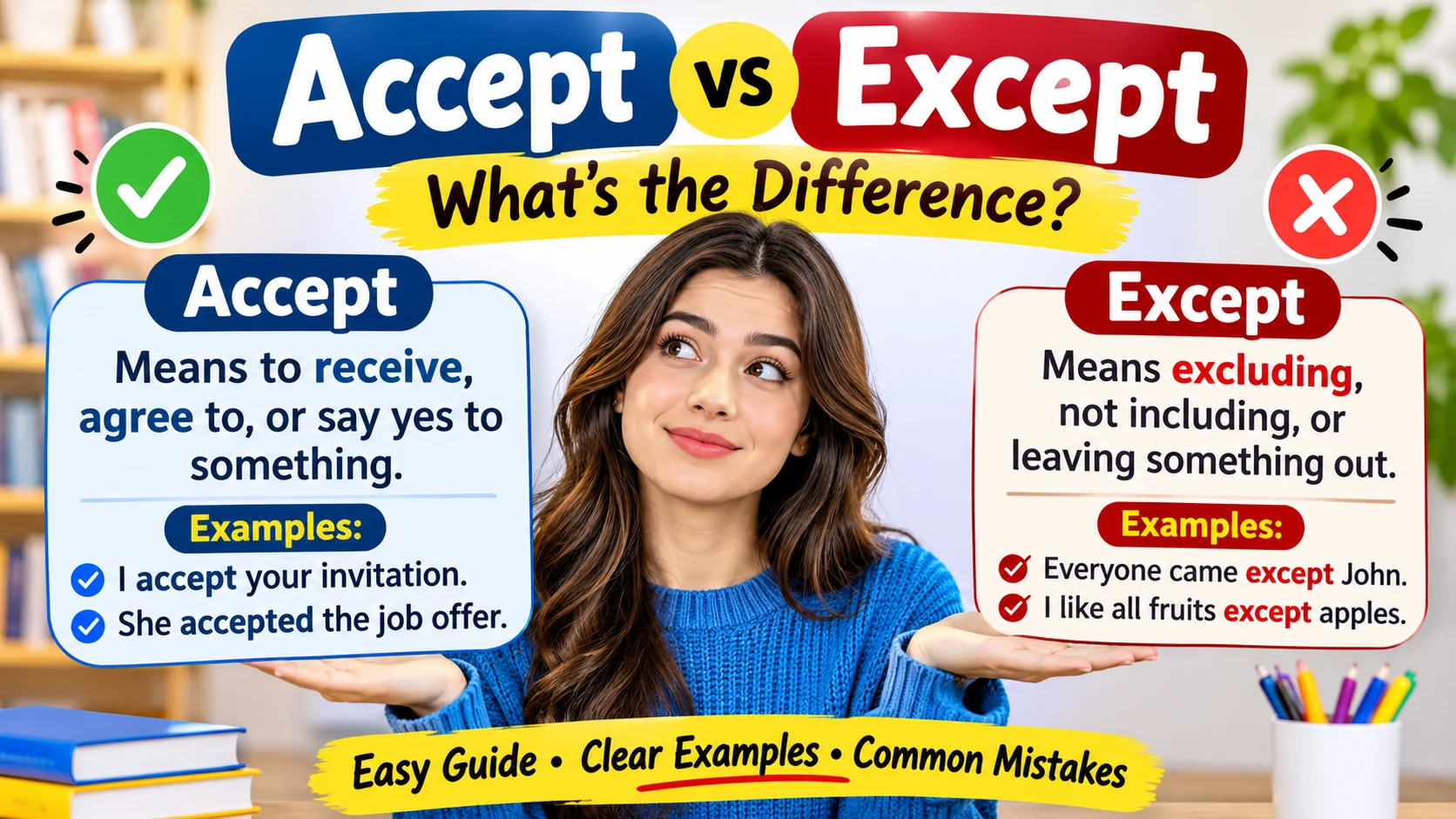
The words accept and except sound almost identical, but they have completely different meanings. This makes them easy to confuse, especially for English learners, students, and people who are improving their writing skills. Knowing when to use accept vs except can help you avoid common spelling and grammar mistakes.
The main difference is simple: accept is a verb that means to receive, agree to, or say yes to something. Except usually works as a preposition meaning excluding or not including someone or something. For example, you accept an invitation, but you invite everyone except your neighbor. Although these words sound similar, they cannot be used interchangeably. Understanding their meanings, grammatical roles, and everyday uses will help you choose the correct word in conversations, emails, academic writing, and professional communication.
Quick Answer: Accept vs Except
Accept means to receive, agree to, or willingly take something. Except means excluding someone or something. Accept is a verb, while except is usually a preposition or conjunction. For example, “I accept your offer” means I agree to it, while “Everyone came except John” means John did not come.
Why Do People Confuse Accept and Except?
People often confuse accept and except because they have very similar pronunciations. Both words begin with the letter combination “ex” or “ac” and have similar ending sounds.
However, their meanings and grammatical functions are different.
Here are three main reasons for the confusion:
- Similar pronunciation: In everyday speech, the words can sound alike, especially for non-native English speakers.
- Similar spelling: Both words contain six letters and share a similar letter pattern.
- Different meanings: One describes receiving or agreeing to something, while the other identifies an exclusion.
The easiest way to avoid confusion is to remember what each word communicates.
1. Accept: Meaning, Definition, and Usage
Accept is a verb that means to receive something willingly, agree to something, or recognize something as true or valid.
It describes a positive action or willingness to take something.
Different Meanings of Accept
Accept can be used in several situations.
1. To receive something willingly
When you take something that someone offers you, you accept it.
Examples:
- She accepted the gift from her friend.
- I accepted the invitation to dinner.
- He accepted the award with a smile.
2. To agree to an offer or proposal
Accept can mean saying yes to an opportunity, suggestion, or arrangement.
Examples:
- She accepted the job offer.
- They accepted our proposal.
- He accepted the invitation to join the team.
3. To recognize something as true
Accept can also mean acknowledging a fact or situation.
Examples:
- You must accept the truth.
- He accepted responsibility for his mistake.
- It is difficult to accept the reality of the situation.
4. To tolerate or approve of something
The word can describe being willing to recognize or allow something.
Examples:
- Our school accepts students from different backgrounds.
- The company does not accept late applications.
- Everyone should accept different opinions.
Accept in a Sentence
Here are some additional examples:
- I happily accept your apology.
- She did not accept the terms of the agreement.
- We accept credit cards at this store.
- He accepted the challenge confidently.
- My parents accepted my decision.
2. Except: Meaning, Definition, and Usage
Except is usually a preposition that means excluding, not including, or leaving someone or something out.
It identifies a person, object, or situation that is not part of a group.
Different Meanings of Except
Except is commonly used in the following situations.
1. To exclude someone or something
Use except when you want to identify what is not included in a group.
Examples:
- Everyone attended the meeting except Sarah.
- I like all fruits except papaya.
- The store is open every day except Sunday.
2. To indicate an exception to a rule
Except can show that something does not follow a general statement or condition.
Examples:
- All students passed except two.
- The entire team agreed except the manager.
- Every room was clean except the kitchen.
3. To introduce a contrasting situation
Except can also function as a conjunction meaning but or only that.
Examples:
- I would help you, except I am busy.
- The plan sounds perfect, except we have no time.
- I wanted to attend, except something unexpected happened.
Except in a Sentence
Here are more examples:
- Nobody knows the answer except Maria.
- Everything is ready except the final report.
- We work every day except Saturday.
- All the shops were closed except one.
- I have no complaints except the noise.
Accept vs Except: Comparison Table
The following table highlights the important differences between accept and except.
| Feature | Accept | Except |
|---|---|---|
| Meaning | To receive or agree | Excluding or leaving out |
| Part of speech | Verb | Usually preposition; also conjunction |
| Main purpose | Shows agreement or receiving | Shows exclusion |
| Pronunciation | /əkˈsept/ | /ɪkˈsept/ |
| Example | I accept your offer. | Everyone came except Tom. |
| Opposite idea | Reject or refuse | Include |
| Common use | Accept an invitation | Everyone except me |
Remember: Accept is about receiving or agreeing, while except is about excluding or leaving something out.
When Should You Use Accept or Except?
Choosing the correct word becomes easier when you understand the situation.
When to Use Accept
Use accept when discussing:
- Receiving gifts, invitations, or awards.
- Agreeing to offers or proposals.
- Taking responsibility for something.
- Recognizing facts or situations.
- Approving or allowing something.
Examples:
- I accept your invitation.
- She accepted the new position.
- We accept online payments.
- He accepted responsibility for the accident.
When to Use Except
Use except when discussing:
- Excluding someone from a group.
- Identifying something that is not included.
- Making an exception to a general statement.
- Introducing a contrasting condition.
Examples:
- Everyone is invited except Mark.
- I eat everything except seafood.
- The office is open every day except Friday.
- I would go except I have an appointment.
15 Examples of Accept vs Except in Sentences
Understanding both words through examples is one of the best ways to remember their correct usage.
Here are 15 practical examples.
Examples Using Accept
1. I accept your apology.
This means you are willing to forgive someone.
2. She accepted the job offer yesterday.
This means she agreed to take the job.
3. He accepted the invitation to the wedding.
This means he agreed to attend the wedding.
4. We accept different opinions in our classroom.
This means different viewpoints are welcomed.
5. Please accept this small gift from me.
This means you are offering someone something.
6. They accepted our business proposal.
This means they agreed to the proposal.
7. You should accept your mistakes and learn from them.
This means you should acknowledge your mistakes.
8. The restaurant does not accept cash payments.
This means the restaurant does not allow customers to pay with cash.
Examples Using Except
9. Everyone passed the examination except Daniel.
This means Daniel did not pass.
10. I love all colors except orange.
This means orange is the only color excluded.
11. The library is open every day except Sunday.
This means the library is closed on Sunday.
12. All my friends attended the party except Lisa.
This means Lisa did not attend.
13. Nobody was home except my brother.
This means only your brother was home.
14. Everything was ready except the food.
This means the food was not ready.
15. I would buy that phone except it is too expensive.
This means the price is the reason you will not buy it.
Common Mistakes When Using Accept and Except
Even experienced English speakers sometimes confuse these words. Here are common mistakes and their correct forms.
Mistake 1: Using Except Instead of Accept
Incorrect:
I except your invitation.
Correct:
I accept your invitation.
Why? You are agreeing to an invitation, so accept is the correct verb.
Mistake 2: Using Accept Instead of Except
Incorrect:
Everyone came accept John.
Correct:
Everyone came except John.
Why? John is excluded from the group, so except is required.
Mistake 3: Confusing Accept With Expect
Incorrect:
I accept you to arrive tomorrow.
Correct:
I expect you to arrive tomorrow.
Why? Expect means to think something will happen. Accept means to receive or agree to something.
Mistake 4: Using Accept When Describing Exclusions
Incorrect:
All students accept two were present.
Correct:
All students except two were present.
Why? Except identifies the two students who were not included.
Mistake 5: Assuming Both Words Are Interchangeable
Accept and except have different grammatical functions and meanings. Replacing one with the other can completely change your sentence.
Always check if you mean receiving something or excluding something.
Easy Memory Trick: How to Remember Accept vs Except
Here is a simple trick to remember the difference.
Accept = Agree or Allow
Think of the letter A in accept as standing for Agree.
- Accept a gift.
- Accept an invitation.
- Accept an apology.
- Accept responsibility.
Except = Exclude
Think of except as a word that removes something from a group.
- Everyone except John.
- All days except Sunday.
- Everything except chocolate.
Quick memory guide
A
ACCEPT = AGREE
Receive, approve, or say yes.
E
EXCEPT = EXCLUDE
Leave something or someone out.
Accept vs Except in American and British English
There is no meaningful difference between accept and except in American and British English.
Both varieties use the same spelling, meanings, and grammatical rules.
| Usage | American English | British English |
|---|---|---|
| Receive something | Accept | Accept |
| Agree to an offer | Accept | Accept |
| Exclude someone | Except | Except |
| Everyone except John | Correct | Correct |
| Accept the invitation | Correct | Correct |
For example:
- American English: I accept your offer.
- British English: I accept your offer.
Both sentences are correct.
The distinction between these words is about meaning, not regional spelling.
Similar Words You Should Know
Learning related words can help you expand your vocabulary and avoid other common English mistakes.
1. Accept vs Except vs Expect
These three words sound similar but have different meanings.
- Accept: To receive or agree to something.
- Except: To exclude someone or something.
- Expect: To believe something will happen.
Examples:
- I accept your invitation.
- Everyone came except James.
- I expect him to arrive soon.
2. Accept vs Reject
These words have opposite meanings.
- Accept: To agree to or receive something.
- Reject: To refuse or say no to something.
Examples:
- She accepted the offer.
- She rejected the offer.
3. Except vs Exclude
Both words relate to leaving something out.
- Except: Used to identify what is not included.
- Exclude: To deliberately leave someone or something out.
Examples:
- Everyone attended except Peter.
- They decided to exclude Peter from the group.
4. Accept vs Agree
These words are related but are not always interchangeable.
- Accept: To receive or approve something.
- Agree: To have the same opinion or consent to something.
Examples:
- I accept your invitation.
- I agree with your opinion.
Frequently Asked Questions (FAQs)
1. What is the main difference between accept and except?
Accept means to receive, agree to, or approve something. Except means excluding someone or something. For example, “I accept your offer” expresses agreement, while “Everyone came except John” identifies someone who was not included.
2. Is accept a verb or a noun?
Accept is a verb. It describes an action, such as receiving a gift, agreeing to an offer, or acknowledging a situation.
Example: She accepts every challenge with confidence.
The related noun is acceptance.
3. Is except a preposition or a conjunction?
Except is commonly used as a preposition, meaning excluding or not including. It can also function as a conjunction meaning but or only that.
Examples:
- Everyone came except Sarah.
- I would help, except I am busy.
4. How do you use accept and except in one sentence?
You can use both words in the same sentence when their meanings are different.
Example: I accept everyone into my team except those who refuse to cooperate.
Here, accept means to welcome or allow, while except identifies the people who are excluded.
5. What is the opposite of accept?
The most common opposite of accept is reject or refuse.
Example:
- I accepted the invitation.
- I rejected the invitation.
Both words describe opposite responses to an offer.
6. Can except be used at the beginning of a sentence?
Yes. Except can appear at the beginning of a sentence, especially when introducing an exception or qualification.
Example: Except for John, everyone completed the assignment.
This means John did not complete the assignment.
7. Are accept and except pronounced the same?
They are very similar in pronunciation but are not necessarily identical. Accept is commonly pronounced /əkˈsept/, while except is commonly pronounced /ɪkˈsept/. Their first vowel sounds are different.
Remember This: Accept vs Except
Here is the simplest way to remember these two words:
- Accept = Receive, agree, or approve.
- Except = Exclude, leave out, or not include.
Examples:
- I accept your invitation.
- Everyone attended except David.
Whenever you are unsure, ask yourself one question: Am I receiving or agreeing to something, or am I leaving something out?
If you are receiving or agreeing, use accept. If you are excluding something, use except.
Conclusion
Understanding the difference between accept and except is important for clear and correct English communication. Although these words sound similar, they have different meanings and grammatical uses. Accept is a verb that means to receive, agree to, or acknowledge something, while except usually means excluding or leaving something out.
The easiest way to remember the distinction is to associate accept with agreeing and except with excluding. Practice using both words in everyday sentences, conversations, and writing. With a little practice, you will be able to choose the correct word confidently and avoid this common English mistake.

I am Martin Joseph, a passionate writer who enjoys creating helpful, thoughtful, and engaging replies. I aim to make conversations easier by sharing practical responses for every situation.