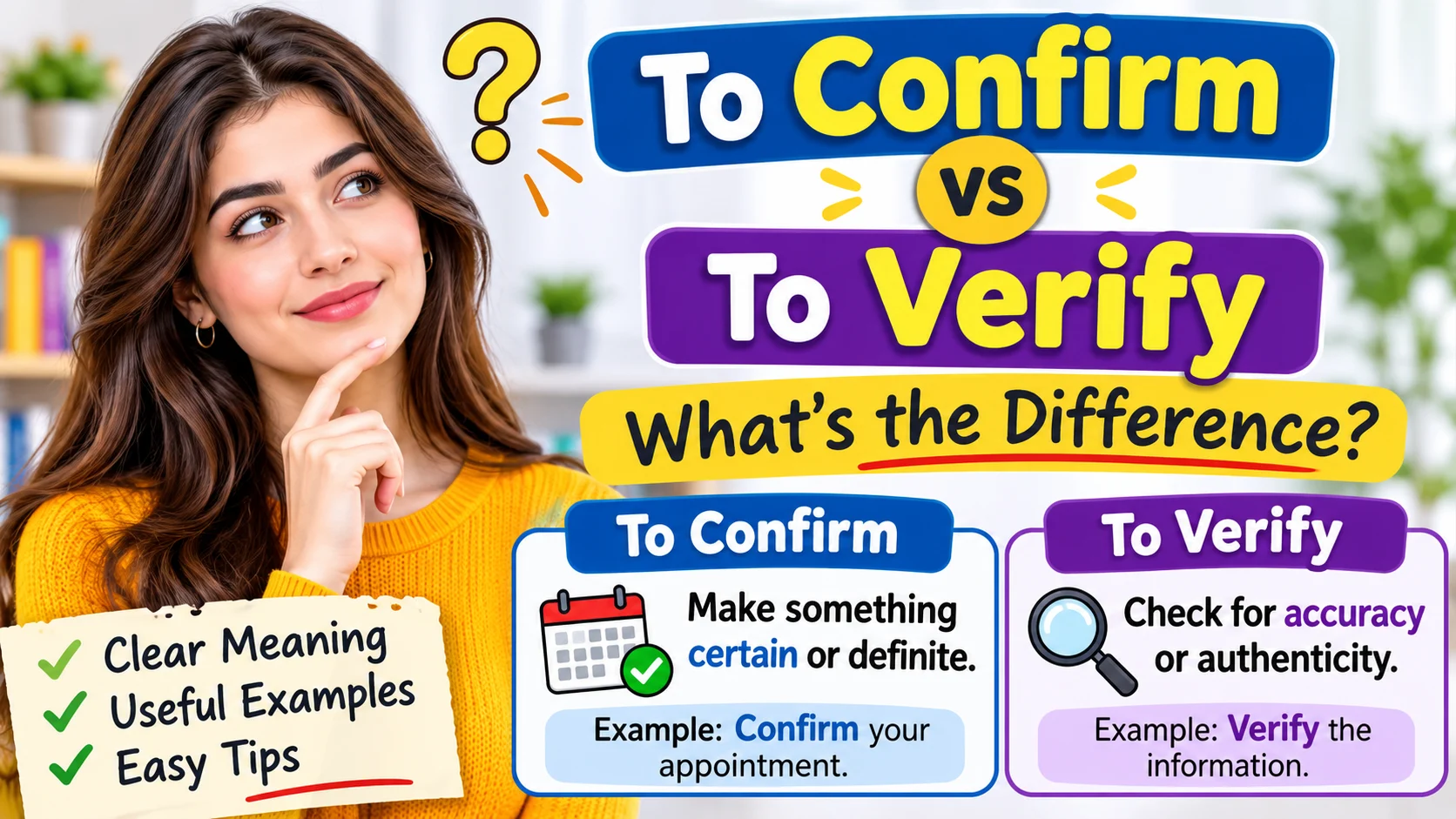
English learners often confuse to confirm and to verify because both expressions involve checking information to make sure it is correct. However, they are not exactly the same. Although they can sometimes be used in similar situations, each word has a different purpose and emphasis.
Understanding the difference between to confirm and to verify can help you communicate more clearly in everyday conversations, professional emails, academic writing, and formal situations. For example, you might confirm a meeting time with a colleague, but verify a person’s identity before giving them access to an account. Both actions involve checking something, but the reason for checking is different.
Quick Answer: To Confirm vs To Verify
To confirm means to establish that something is true, correct, agreed upon, or definite. To verify means to check or investigate something to establish its accuracy, authenticity, or truth. Use confirm when acknowledging or making something certain, and verify when checking evidence or facts.
Why Do People Confuse To Confirm and To Verify?
People confuse these expressions because they share an important idea: making sure something is correct.
Both words are commonly used when checking information, appointments, details, decisions, and statements.
For example:
- Please confirm your appointment.
- Please verify your appointment details.
Both sentences are grammatically correct, but they communicate slightly different intentions.
In the first sentence, the person is being asked to acknowledge or finalize the appointment. In the second, the person is being asked to check if the appointment information is accurate.
The difference becomes clearer when you understand each word separately.
1. What Does To Confirm Mean?
To confirm means to establish that something is true, correct, definite, or agreed upon. It can also mean to officially approve or acknowledge information that was previously suggested, discussed, or expected.
It is commonly used in everyday conversations, professional communication, business situations, and formal announcements.
Examples of To Confirm
- Please confirm your attendance at the meeting.
- I called the hotel to confirm my reservation.
- She confirmed that the information was correct.
- Can you confirm the delivery date?
- The manager confirmed the new schedule.
- We received an email confirming the appointment.
- He confirmed his decision yesterday.
- Please confirm if you can attend the event.
- The company confirmed the job offer.
- My teacher confirmed that the examination would take place on Monday.
Common Uses of Confirm
Use confirm when you want to:
- Acknowledge information: Confirm that you received the message.
- Finalize arrangements: Confirm your hotel reservation.
- Establish certainty: The results confirmed our expectations.
- Approve a decision: The director confirmed the proposal.
- Agree to something: Please confirm your participation.
Synonyms of Confirm
- Affirm
- Validate
- Acknowledge
- Approve
- Establish
- Substantiate
- Corroborate
The best synonym depends on the sentence and its intended meaning.
2. What Does To Verify Mean?
To verify means to check, examine, or investigate something to establish if it is accurate, genuine, or true.
It often involves comparing information with reliable sources, documents, records, evidence, or other available details.
Verify is especially common in education, technology, business, banking, research, and official procedures.
Examples of To Verify
- Please verify your email address before logging in.
- The police verified the suspect’s identity.
- I need to verify the information before publishing it.
- The bank verified my account details.
- She checked the documents to verify their authenticity.
- We must verify the accuracy of these figures.
- The teacher verified the students’ examination results.
- Please verify the address before sending the package.
- Researchers verified their findings using additional evidence.
- The company verified the applicant’s employment history.
Common Uses of Verify
Use verify when you want to:
- Check accuracy: Verify the spelling of a name.
- Confirm identity through evidence: Verify someone’s identity.
- Check authenticity: Verify if a document is genuine.
- Examine facts: Verify the information before sharing it.
- Validate records: Verify financial or personal details.
Synonyms of Verify
- Authenticate
- Check
- Validate
- Establish
- Substantiate
- Corroborate
- Confirm
Remember that these synonyms are not always interchangeable. The context determines which word is most appropriate.
To Confirm vs To Verify: Comparison Table
| Feature | To Confirm | To Verify |
|---|---|---|
| Meaning | Establish that something is certain or agreed upon | Check if something is accurate or genuine |
| Main focus | Certainty and acknowledgment | Accuracy and evidence |
| Common purpose | Finalizing or acknowledging information | Examining information |
| Typical situations | Meetings, reservations, decisions | Identity checks, documents, research |
| Evidence required | Not always | Often involves checking evidence |
| Example | Confirm the appointment | Verify the appointment details |
| Tone | Neutral or formal | Neutral or formal |
The main difference: Confirm emphasizes making something certain or acknowledging it, while verify emphasizes checking something for accuracy or authenticity.
When Should You Use Each Expression?
Choosing between confirm and verify depends on what you want to communicate.
When to Use Confirm
Use confirm when someone needs to acknowledge information, agree to an arrangement, or establish that something is definite.
Examples:
- Please confirm your booking.
- I am writing to confirm our meeting.
- The manager confirmed the final decision.
- Can you confirm that you received my email?
In these examples, the focus is on acknowledgment, agreement, or certainty.
When to Use Verify
Use verify when you need to examine information, compare details, or check if something is genuine or accurate.
Examples:
- Please verify your account information.
- We need to verify the customer’s identity.
- Verify the figures before submitting the report.
- The journalist verified the facts before publishing the story.
Here, the emphasis is on checking information rather than simply acknowledging it.
Can Confirm and Verify Be Used Interchangeably?
Sometimes, yes. Both words can describe establishing that information is correct.
For example:
- I need to confirm the details.
- I need to verify the details.
Both sentences are correct.
However, confirm suggests establishing or acknowledging the details, while verify emphasizes checking their accuracy.
Therefore, they are related but not always interchangeable.
15 Examples of To Confirm vs To Verify in Sentences
The following examples show how these expressions work in different situations.
| To Confirm | To Verify |
|---|---|
| Please confirm your attendance. | Please verify your identity. |
| I confirmed the meeting time. | I verified the meeting details. |
| She confirmed the reservation. | She verified the reservation number. |
| The manager confirmed the decision. | The manager verified the figures. |
| He confirmed his address. | He verified his address using an official document. |
| Please confirm the delivery date. | Please verify the delivery information. |
| The company confirmed the announcement. | The company verified the reported information. |
| I confirmed that the payment was received. | I verified the payment transaction. |
| They confirmed their participation. | They verified the participants’ names. |
| The doctor confirmed the appointment. | The doctor verified the patient’s medical records. |
| We confirmed the final schedule. | We verified the schedule for accuracy. |
| She confirmed the job offer. | She verified the company’s credentials. |
| The school confirmed the examination date. | The school verified the examination results. |
| He confirmed the news. | He verified the news using reliable sources. |
| Please confirm your order. | Please verify your order details. |
These examples demonstrate that confirm often relates to acknowledgment or certainty, whereas verify focuses on checking information.
Common Mistakes When Using Confirm and Verify
Even fluent English speakers sometimes use these words without considering their differences.
Here are some mistakes to avoid.
1. Treating Both Words as Exactly the Same
Incorrect understanding: Confirm and verify always mean the same thing.
Better understanding: They overlap in meaning, but confirm emphasizes certainty or acknowledgment, while verify emphasizes checking accuracy.
2. Using Verify When You Mean Acknowledge
Less natural:
– Please verify your attendance at tomorrow’s meeting.
More natural:
– Please confirm your attendance at tomorrow’s meeting.
The second sentence is better when asking someone to let you know if they will attend.
3. Using Confirm When You Mean Check Authenticity
Less precise:
– Please confirm if this document is genuine.
More precise:
– Please verify if this document is genuine.
Verify is particularly appropriate when checking authenticity.
4. Forgetting the Correct Grammatical Forms
Both words can be used as verbs and have different forms.
| Base Form | Past Tense | Past Participle | -ing Form |
|---|---|---|---|
| Confirm | Confirmed | Confirmed | Confirming |
| Verify | Verified | Verified | Verifying |
Examples:
- I confirm the information.
- She confirmed the information.
- They have verified the details.
- He is verifying the documents.
5. Confusing Confirm With Prove
Confirm does not always mean prove.
For example:
– The results confirmed our expectations.
This means the results supported or established what was expected. It does not necessarily mean someone proved something beyond all doubt.
Memory Trick: How to Remember Confirm vs Verify
A simple memory trick can help you remember the difference.
CONFIRM = Make Certain
Think of confirming a meeting, reservation, decision, or agreement.
VERIFY = Check for Accuracy
Think of verifying an email address, identity, document, or piece of information.
Remember these two simple examples:
- Confirm your appointment.
- Verify your identity.
When you need someone to acknowledge or finalize something, use confirm. When you need to examine something for accuracy or authenticity, use verify.
American vs British English: Confirm and Verify
There is no major difference between American and British English in the meaning or general usage of confirm and verify.
Both expressions are standard in American English and British English.
| Expression | American English | British English |
|---|---|---|
| Confirm an appointment | Correct | Correct |
| Verify an identity | Correct | Correct |
| Confirm a reservation | Correct | Correct |
| Verify information | Correct | Correct |
| Confirm a decision | Correct | Correct |
Both varieties use these words in everyday, academic, and professional communication.
The spelling also remains the same:
- Confirm / Confirmed
- Verify / Verified
There is no need to learn separate American and British spellings for these two verbs.
Similar Words: Confirm vs Verify vs Validate vs Authenticate
English has several words related to checking if something is correct or genuine. However, their meanings are slightly different.
| Word | Meaning | Example |
|---|---|---|
| Confirm | Establish that something is certain or agreed upon | Confirm the meeting time. |
| Verify | Check if something is accurate or genuine | Verify the account details. |
| Validate | Establish that something meets requirements or is acceptable | Validate the information. |
| Authenticate | Prove that something is genuine or comes from a claimed source | Authenticate the document. |
| Check | Examine something for accuracy or mistakes | Check the spelling. |
| Authenticate | Establish the genuineness of something | Authenticate the signature. |
Confirm vs Validate
Confirm focuses on establishing certainty or acknowledgment. Validate focuses on showing that something is acceptable, legitimate, or meets specific requirements.
Example:
- Confirm the appointment.
- Validate the application.
Verify vs Authenticate
Verify means checking if something is correct or genuine. Authenticate specifically means establishing that something is genuine or comes from its claimed source.
Example:
- Verify the information.
- Authenticate the signature.
Understanding these related words helps you choose more precise language.
Final Verdict: To Confirm or To Verify?
Both to confirm and to verify are correct English expressions, but they serve slightly different purposes.
Choose to confirm when you want to acknowledge information, establish certainty, finalize an arrangement, or agree to something.
Choose to verify when you want to check information, examine evidence, establish accuracy, or determine if something is genuine.
For example:
- Confirm your appointment.
- Verify your identity.
The easiest way to remember the difference is that confirming is about making something certain, while verifying is about checking if something is correct.
Frequently Asked Questions (FAQs)
1. What is the main difference between confirm and verify?
Confirm means to establish that something is true, certain, or agreed upon. Verify means to check something to determine if it is accurate, authentic, or genuine. Confirm often involves acknowledgment, while verify usually involves examination or checking.
2. Is it correct to say “confirm the details”?
Yes, “confirm the details” is grammatically correct. It means to establish or acknowledge that the information is correct. For example: “Please confirm the details of your booking before we finalize the reservation.”
3. Is it correct to say “verify the information”?
Yes, “verify the information” is correct and commonly used. It means to check information against reliable sources or evidence to determine if it is accurate. For example: “Always verify information before sharing it online.”
4. Can I use confirm instead of verify?
Sometimes, yes. Both words can be used when establishing if something is correct. However, confirm emphasizes certainty or acknowledgment, while verify emphasizes checking accuracy or authenticity. The intended meaning determines which word is better.
5. Does verify mean confirm?
Not exactly. Verify means to check something to establish its accuracy or authenticity. Confirm means to establish or acknowledge that something is true or certain. Verification can lead to confirmation, but the words have different meanings.
6. Should I say “confirm my identity” or “verify my identity”?
Both expressions are grammatically possible, but “verify my identity” is generally more precise when someone needs to check your identity using identification documents, account information, or other evidence.
7. Is confirm more formal than verify?
Neither word is automatically more formal than the other. Both are appropriate in professional, academic, and everyday communication. The choice depends on the context and what you want to express.
Remember This
- Confirm = Establish certainty, acknowledge, or finalize something.
- Verify = Check something for accuracy, authenticity, or truth.
- Confirm a meeting, reservation, or decision.
- Verify an identity, document, or piece of information.
- Both words are correct, but they are not always interchangeable.
Conclusion
Understanding the difference between to confirm and to verify makes your English clearer and more precise. Although both words relate to checking information, confirm focuses on establishing certainty or acknowledging something, while verify focuses on examining information to determine if it is accurate or genuine.
Whenever you are unsure which word to choose, think about your purpose. If you want someone to acknowledge or finalize something, use confirm. If you need to check facts, documents, or details for accuracy, use verify. With regular practice and these practical examples, you can use both expressions confidently in everyday and professional communication.

I am Martin Joseph, a passionate writer who enjoys creating helpful, thoughtful, and engaging replies. I aim to make conversations easier by sharing practical responses for every situation.