Have you ever wondered if to say “I plan to do something” or “I plan on doing something”? Both expressions are common in English, but understanding how they work can help you speak and write more naturally. If you are learning English, preparing for an exam, or improving your grammar, knowing the difference between these phrases is useful.
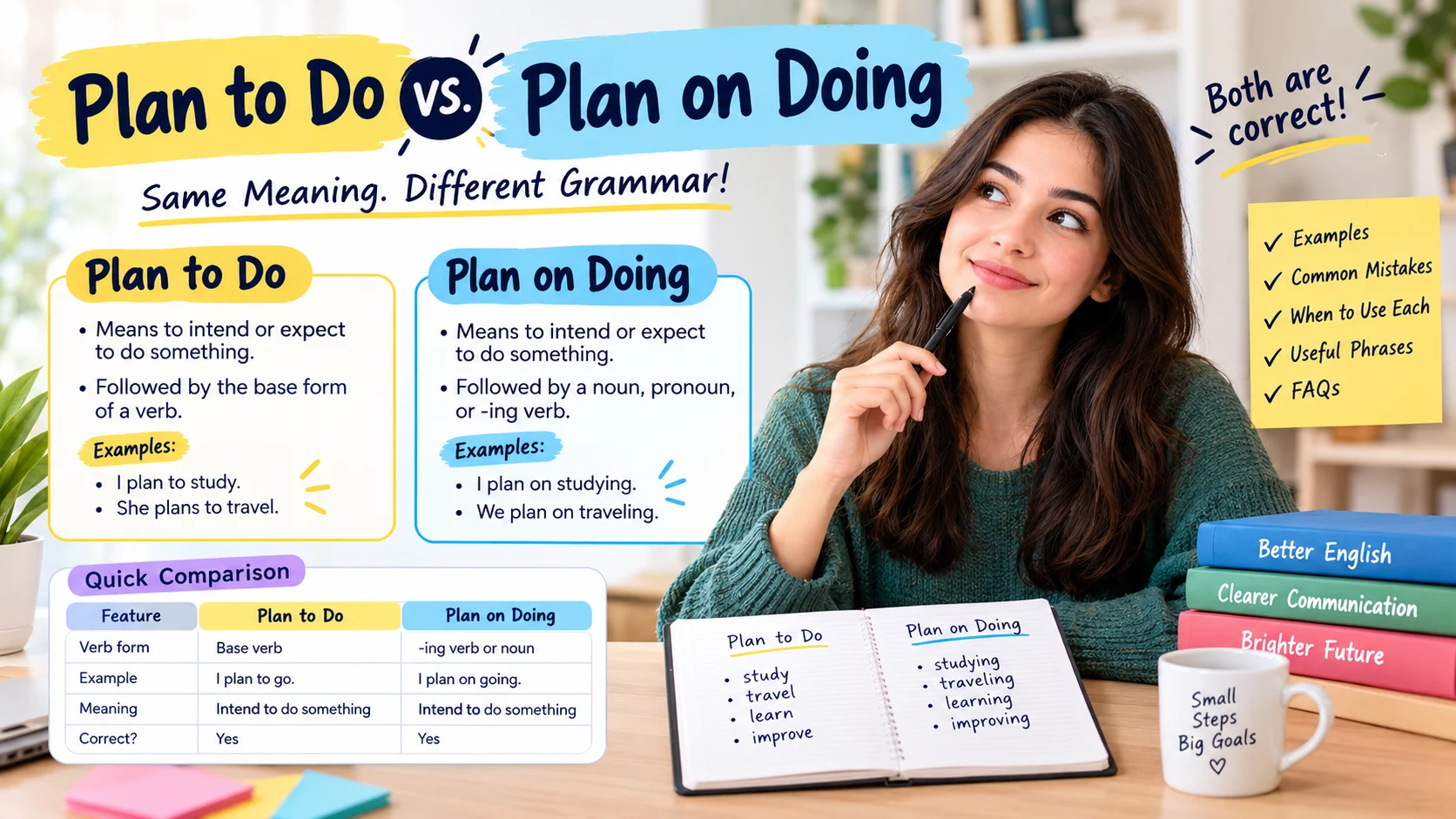
The good news is that both “plan to do” and “plan on doing” are grammatically correct and usually have the same meaning. They express an intention or an expectation about something you want to do in the future. The main difference is their grammatical structure: “plan to” is followed by the base form of a verb, while “plan on” is followed by a noun, pronoun, or verb ending in -ing. For example, you can say, “I plan to visit my grandparents” or “I plan on visiting my grandparents.” Both sentences communicate the same basic idea. However, understanding when and how to use each construction will help you avoid common mistakes.
Quick Answer: Plan to Do vs. Plan on Doing
“Plan to do” and “plan on doing” both mean to intend to do something. Use “plan to” followed by the base form of a verb, as in “I plan to study.” Use “plan on” followed by a noun or an -ing verb, as in “I plan on studying.” Both are natural English expressions.
Why Do People Confuse Plan to Do and Plan on Doing?
People often confuse these expressions because they communicate almost the same idea.
For example:
- I plan to travel next summer.
- I plan on traveling next summer.
Both sentences express an intention to travel. The difference is not primarily about meaning but about the grammatical structure that follows each expression.
The confusion often comes from three things:
- Similar meanings: Both phrases describe intentions, arrangements, or future activities.
- Different verb forms: “Plan to” takes the base form of a verb, while “plan on” takes an -ing form when followed by an action.
- Flexible usage: English speakers commonly use both expressions in everyday conversations.
Understanding the patterns makes choosing the correct expression much easier.
1. What Does Plan to Do Mean?
The expression “plan to do” means to intend or expect to do something in the future.
It is commonly used when talking about personal goals, decisions, arrangements, and future activities.
Grammar Structure
Subject + plan/plans/planned + to + base verb
Examples:
- I plan to learn Spanish.
- She plans to buy a new laptop.
- We planned to visit the museum.
- They plan to move next year.
Notice that the verb after to remains in its base form.
Correct: I plan to study tonight.
Incorrect: I plan to studying tonight.
When Is Plan to Do Commonly Used?
Use “plan to do” when discussing:
- Future intentions
- Personal goals
- Professional decisions
- Travel arrangements
- Education and career plans
- Activities you expect to complete
Example: “I plan to finish my assignment before dinner.”
This sentence clearly communicates the speaker’s intention.
2. What Does Plan on Doing Mean?
The expression “plan on doing” also means to intend or expect to do something.
It is particularly common in everyday conversation, although it is also appropriate in many informal and formal contexts.
Grammar Structure
Subject + plan/plans/planned + on + noun, pronoun, or verb ending in -ing
Examples:
- I plan on learning Spanish.
- She plans on buying a new laptop.
- We planned on visiting the museum.
- They plan on moving next year.
The word on is a preposition, so when it introduces an action, the following verb takes the -ing form.
Correct: I plan on studying tonight.
Incorrect: I plan on study tonight.
When Is Plan on Doing Commonly Used?
Use “plan on doing” when discussing:
- Future intentions
- Expected activities
- Personal decisions
- Everyday arrangements
- Social plans
- Actions you anticipate taking
Example: “I plan on finishing my assignment before dinner.”
This sentence communicates essentially the same intention as “I plan to finish my assignment before dinner.”
Plan to Do vs. Plan on Doing: Comparison Table
| Feature | Plan to Do | Plan on Doing |
|---|---|---|
| Meaning | Intend to do something | Intend to do something |
| Grammar | Plan + to + base verb | Plan + on + noun or -ing verb |
| Correct example | I plan to exercise. | I plan on exercising. |
| Incorrect example | I plan to exercising. | I plan on exercise. |
| Everyday conversation | Common | Common |
| Formal writing | Generally suitable | Generally suitable, depending on context |
| Future intentions | Yes | Yes |
| Personal goals | Yes | Yes |
| Natural usage | Very natural | Very natural |
| Main difference | Uses an infinitive | Uses a prepositional phrase |
Key takeaway: Both constructions are correct. Choose the one that fits your sentence, and make sure the verb form is correct.
When to Use Plan to Do vs. Plan on Doing
Although the two expressions often mean the same thing, certain situations may make one sound more natural than the other.
Use Plan to Do for Direct Statements of Intention
“Plan to” is a straightforward choice when expressing a goal or decision.
Examples:
- I plan to improve my English.
- He plans to apply for the job.
- We plan to save money this year.
This construction is especially useful in essays, professional communication, and statements about goals.
Use Plan on Doing in Everyday Conversation
“Plan on doing” is also natural when discussing anticipated activities or everyday arrangements.
Examples:
- I plan on staying home tonight.
- Are you planning on coming to the party?
- We plan on ordering pizza.
These sentences sound natural in casual conversation.
Can You Use Either Expression in Formal Writing?
Yes. Both expressions are grammatically correct and can be used in formal writing.
For example:
- The company plans to expand its operations.
- The company plans on expanding its operations.
The first sentence may sound more direct and concise in a business report, but the second is not inherently incorrect or unprofessional.
Choose the expression that best suits the surrounding sentence and the tone of your writing.
12 Examples of Plan to Do vs. Plan on Doing
The following examples show how both constructions work in everyday English.
1. Studying for an Exam
- Plan to: I plan to study for my English exam tonight.
- Plan on: I plan on studying for my English exam tonight.
Both sentences express the same intention.
2. Traveling Abroad
- Plan to: We plan to visit Canada next summer.
- Plan on: We plan on visiting Canada next summer.
Both communicate a future travel intention.
3. Learning a Language
- Plan to: She plans to learn French.
- Plan on: She plans on learning French.
The meaning remains essentially the same.
4. Buying a Car
- Plan to: He plans to buy a used car.
- Plan on: He plans on buying a used car.
Both sentences describe his intention to purchase a car.
5. Changing Jobs
- Plan to: I plan to look for a better job.
- Plan on: I plan on looking for a better job.
Both express a possible career decision.
6. Exercising Regularly
- Plan to: They plan to exercise every morning.
- Plan on: They plan on exercising every morning.
Both describe a future routine.
7. Attending a Party
- Plan to: Are you planning to attend the party?
- Plan on: Are you planning on attending the party?
Both questions ask about someone’s intentions.
8. Moving to Another City
- Plan to: We plan to move to London next year.
- Plan on: We plan on moving to London next year.
Both describe an intended relocation.
9. Cooking Dinner
- Plan to: I plan to cook dinner at home.
- Plan on: I plan on cooking dinner at home.
Both communicate the same basic idea.
10. Starting a Business
- Plan to: She plans to start her own business.
- Plan on: She plans on starting her own business.
Both sentences express a business ambition.
11. Reading a Book
- Plan to: I plan to read this book over the weekend.
- Plan on: I plan on reading this book over the weekend.
Both describe a reading intention.
12. Taking a Break
- Plan to: He plans to take a short break after lunch.
- Plan on: He plans on taking a short break after lunch.
Both are correct and natural.
Common Mistakes When Using Plan to Do and Plan on Doing
Even though both expressions are easy to learn, some grammatical mistakes are common.
Mistake 1: Using an -ing Verb After Plan to
Incorrect: I plan to going shopping.
Correct: I plan to go shopping.
Why? The expression “plan to” is followed by the base form of the verb.
Mistake 2: Using the Base Verb After Plan on
Incorrect: She plans on buy a new phone.
Correct: She plans on buying a new phone.
Why? When “plan on” is followed by an action, use the -ing form.
Mistake 3: Mixing Both Structures
Incorrect: We plan on to visit our cousins.
Correct: We plan to visit our cousins.
Also correct: We plan on visiting our cousins.
Why? Each expression follows its own grammatical pattern.
Mistake 4: Forgetting Subject-Verb Agreement
Incorrect: She plan to study tonight.
Correct: She plans to study tonight.
Also correct: She plans on studying tonight.
Why? In the simple present tense, use plans with third-person singular subjects such as he, she, and it.
Mistake 5: Assuming One Expression Is Always More Correct
Incorrect assumption: “Plan on doing” is always wrong in formal English.
Correct understanding: Both constructions are grammatically acceptable. The best choice depends on sentence structure, context, and style.
An Easy Memory Trick
Remember these two patterns:
PLAN TO + BASE VERB
- Plan to eat
- Plan to work
- Plan to travel
- Plan to learn
PLAN ON + VERB-ING
- Plan on eating
- Plan on working
- Plan on traveling
- Plan on learning
Think of the word on as a reminder to use the -ing form when the phrase introduces an action.
For example:
- I plan to swim.
- I plan on swimming.
Once you memorize these patterns, you can use both expressions confidently.
Plan to Do vs. Plan on Doing in American and British English
Both constructions are used in American and British English.
However, the frequency and naturalness of particular expressions can vary depending on the speaker, region, and context.
American English
Both expressions are common in American English.
Examples:
- I plan to visit my family.
- I plan on visiting my family.
The second version is especially natural in everyday conversation, but the first is equally correct.
British English
Both expressions are also understood and used in British English.
Examples:
- We plan to travel next month.
- We plan on travelling next month.
Notice the spelling difference in traveling and travelling. American English generally uses traveling, while British English commonly uses travelling.
This spelling variation does not change the grammatical difference between the two expressions.
Important: Neither “plan to do” nor “plan on doing” belongs exclusively to one variety of English.
Similar Expressions You Should Know
Several other English expressions communicate intentions or future plans.
1. Intend to Do
“Intend to do” means to have a clear purpose or intention.
Example: I intend to complete the course this year.
2. Aim to Do
“Aim to do” emphasizes a goal or desired result.
Example: We aim to improve customer service.
3. Hope to Do
“Hope to do” expresses a desired outcome, which may be less certain than a definite plan.
Example: I hope to visit Japan someday.
4. Expect to Do
“Expect to do” expresses an anticipated action or event.
Example: She expects to finish work by six.
5. Be Planning to Do
“Be planning to do” describes an intention or arrangement that someone is considering or developing.
Example: I am planning to start a new course.
6. Be Thinking of Doing
“Be thinking of doing” often suggests that an idea is under consideration rather than firmly decided.
Example: He is thinking of moving abroad.
7. Look Forward to Doing
“Look forward to doing” expresses excitement or positive anticipation, rather than simply making a plan.
Example: I look forward to meeting you.
These expressions are related, but they are not always interchangeable. Choose the one that communicates your intended meaning.
Final Verdict: Which Expression Should You Use?
Both “plan to do” and “plan on doing” are correct English expressions that communicate intentions or future activities.
Use “plan to do” when you want a direct, concise statement of intention.
Example: I plan to finish my homework tonight.
Use “plan on doing” when you prefer that grammatical construction in conversation or writing.
Example: I plan on finishing my homework tonight.
The meanings are essentially the same in these examples. The important distinction is grammatical: “plan to” takes the base verb, while “plan on” takes a noun or an -ing form when referring to an action.
If you remember that difference, you can confidently use either expression in everyday conversation, academic writing, and professional communication.
Frequently Asked Questions
1. Is It Plan to Do or Plan on Doing?
Both are correct. “Plan to do” is followed by a base verb, while “plan on doing” is followed by a noun or an -ing verb when referring to an action.
Examples: “I plan to travel” and “I plan on traveling.”
2. Is Plan on Doing Grammatically Correct?
Yes. “Plan on doing” is a standard English construction.
Example: “We plan on visiting our friends this weekend.”
The phrase is suitable for everyday conversation and many forms of writing.
3. Is Plan to Do More Formal Than Plan on Doing?
“Plan to do” often sounds more direct and concise, which can make it a convenient choice in formal or professional writing. However, “plan on doing” is also grammatically correct and can be appropriate in formal contexts.
The best choice depends on the sentence and the intended tone.
4. Can I Say I Plan on Going?
Yes. “I plan on going” is grammatically correct.
Example: “I plan on going to the library after work.”
You can also say, “I plan to go to the library after work.”
Both sentences express the same intention.
5. What Verb Form Comes After Plan to?
Use the base form of the verb after “plan to.”
Correct examples:
- I plan to work.
- She plans to study.
- They plan to travel.
Avoid using an -ing form directly after “plan to” in this construction.
6. What Verb Form Comes After Plan on?
When “plan on” is followed by an action, use the -ing form of the verb.
Correct examples:
- I plan on working.
- She plans on studying.
- They plan on traveling.
You can also use a noun after on, as in “We plan on a short break.”
7. Do Plan to and Plan on Mean Exactly the Same Thing?
They often have the same meaning when expressing an intention.
For example, “I plan to move next year” and “I plan on moving next year” both communicate an intention to move.
However, context and emphasis can affect how a sentence is understood, so the expressions are not necessarily interchangeable in every possible construction.
Remember This
Keep these three rules in mind:
- Plan to + base verb: I plan to study.
- Plan on + verb-ing: I plan on studying.
- Meaning: Both usually express an intention to do something.
You do not need to memorize complicated grammar rules to use these expressions correctly. Focus on the verb form that follows each phrase, and practice with examples from your daily life.
Conclusion
The difference between “plan to do” and “plan on doing” is mainly grammatical, not a major difference in meaning. Both expressions communicate an intention, a decision, or an expected future activity. “Plan to” takes the base form of a verb, while “plan on” takes a noun or an -ing verb when describing an action.
To improve your English, practice creating sentences with both constructions. For example, write “I plan to learn a new skill” and “I plan on learning a new skill.” Recognizing these patterns will help you speak more naturally, write more accurately, and feel more confident when expressing your future plans.

I am Martin Joseph, a passionate writer who enjoys creating helpful, thoughtful, and engaging replies. I aim to make conversations easier by sharing practical responses for every situation.