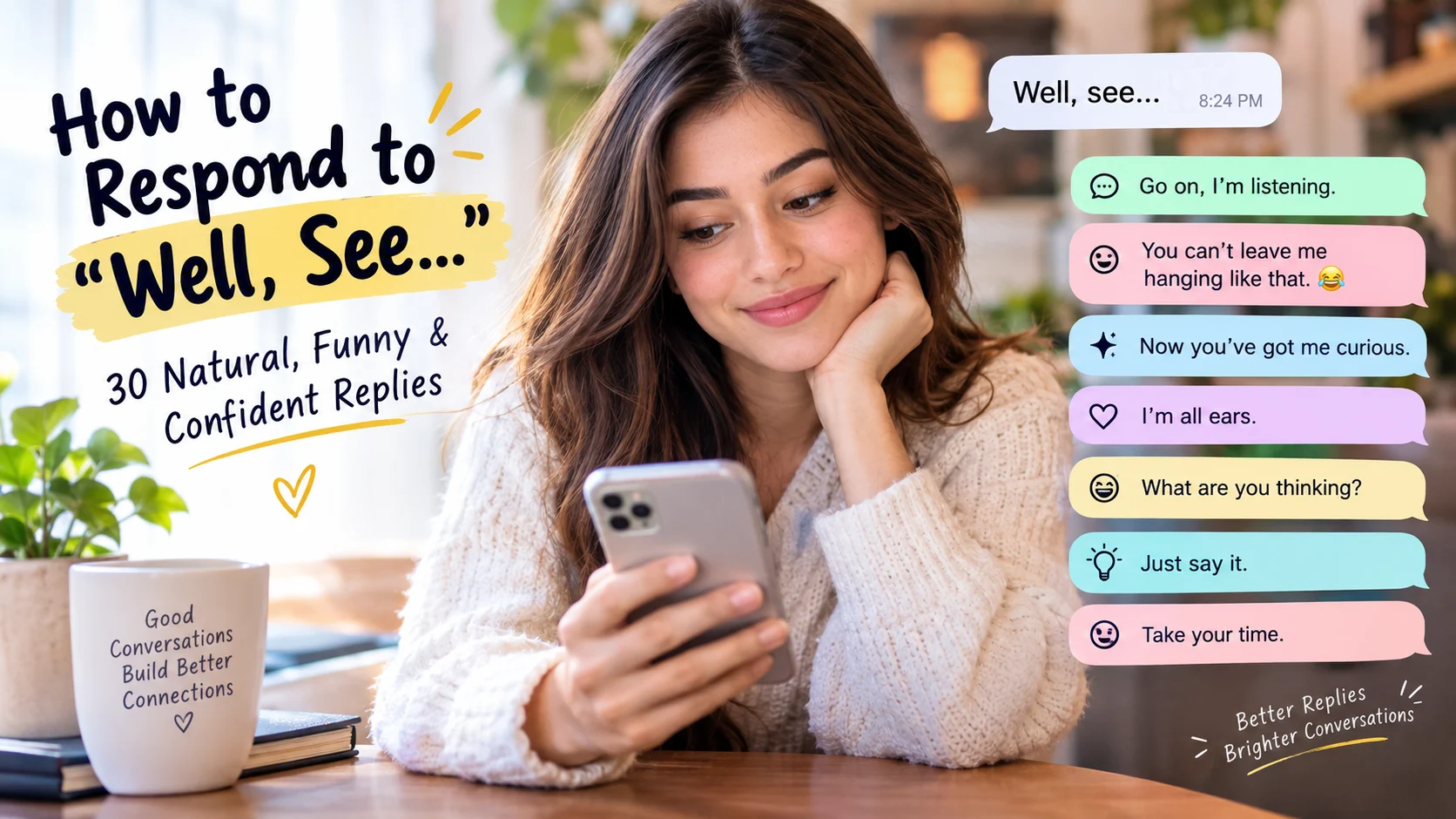
When someone says “Well, see…”, they may be hesitating, changing the subject, explaining something, or leaving their sentence unfinished. The best response depends on the tone and situation. Sometimes they simply need encouragement to continue, while other times a playful reply can keep the conversation interesting.
If you’re wondering how to respond to “well, see…”, you don’t need an overly complicated answer. A simple, natural response can show curiosity, confidence, humor, or warmth. Below are practical replies for texting, casual conversations, dating, friendships, and everyday situations.
1. “Go on, I’m listening.”
Best for: When someone seems hesitant but wants to explain something.
Alternative: “I’m listening—what were you going to say?”
Examples:
“Go on, I’m listening.”
“Okay, I’m listening. Finish your thought.”
This is one of the safest responses because it encourages the person to continue without putting pressure on them.
2. “Well, see what?”
Best for: Casual conversations where you want clarification.
Alternative: “What do you mean?”
Examples:
“Well, see what? 😂”
“Okay, well see what exactly?”
It keeps the conversation moving and gently asks them to finish their thought.
3. “Now you’ve got me curious.”
Best for: Texting when their unfinished statement catches your attention.
Alternative: “Okay, now I want to know.”
Examples:
“Now you’ve got me curious.”
“Great, now I need to hear the rest.”
This reply works especially well when you want to sound interested without being too serious.
4. “I’m waiting for the rest of that sentence.”
Best for: Playful conversations.
Alternative: “You can’t just stop there.”
Examples:
“I’m waiting for the rest of that sentence. 😂”
“You can’t leave me hanging like that.”
It adds humor while encouraging them to continue.
5. “Take your time.”
Best for: When someone seems nervous or unsure about what to say.
Alternative: “No rush.”
Examples:
“Take your time. I’m here.”
“No rush, say what you’re thinking.”
This response feels patient and supportive rather than demanding.
6. “I’m all ears.”
Best for: Friendly and attentive conversations.
Alternative: “Tell me everything.”
Examples:
“I’m all ears.”
“Okay, I’m all ears. What happened?”
It signals genuine interest and makes the other person feel comfortable continuing.
7. “That sounds like there’s a story behind it.”
Best for: When their words suggest something interesting happened.
Alternative: “That sounds interesting.”
Examples:
“That sounds like there’s a story behind it.”
“Okay, I feel like there’s more to this.”
This is a natural way to invite more details.
8. “You can tell me.”
Best for: Conversations where someone seems reluctant to share.
Alternative: “You can be honest with me.”
Examples:
“You can tell me. I won’t judge.”
“Whatever it is, you can tell me.”
Use this when you want to create a comfortable and trusting atmosphere.
9. “Are you trying to tell me something?”
Best for: When their hesitation seems meaningful.
Alternative: “Is there something you’re trying to say?”
Examples:
“Are you trying to tell me something? 👀”
“Okay… are you hinting at something?”
The wording can make this playful or serious depending on your tone.
10. “Well… I’m listening.”
Best for: Calm, straightforward conversations.
Alternative: “I’m paying attention.”
Examples:
“Well… I’m listening.”
“Okay, I’m listening. Go ahead.”
This keeps your reply simple while showing that you care about what they have to say.
11. “You can’t just say ‘well, see’ and stop.”
Best for: Playful texting.
Alternative: “You can’t leave me hanging like that.”
Examples:
“You can’t just say that and disappear. 😂”
“You can’t stop there—I need the rest.”
This is particularly effective when someone deliberately creates suspense.
12. “Interesting… continue.”
Best for: A confident, slightly teasing tone.
Alternative: “Interesting. Go on.”
Examples:
“Interesting… continue.”
“Okay, this has my attention. Continue.”
It sounds composed and gives the other person room to explain.
13. “What are you thinking?”
Best for: Personal conversations.
Alternative: “What’s on your mind?”
Examples:
“What are you thinking?”
“Okay, what’s going through your mind?”
This response works when you sense they are trying to express something deeper.
14. “You have my attention.”
Best for: Confident or slightly flirty conversations.
Alternative: “Okay, I’m intrigued.”
Examples:
“You have my attention. 👀”
“Okay, you definitely have my attention now.”
It shows interest without making the conversation overly serious.
15. “Should I be concerned?”
Best for: Playful situations where their hesitation sounds suspicious.
Alternative: “Uh-oh, should I be worried?”
Examples:
“Well, see… should I be concerned? 😂”
“That pause sounds suspicious. Should I worry?”
Keep this lighthearted so it doesn’t sound genuinely alarmed.
16. “I feel like there’s a ‘but’ coming.”
Best for: When someone appears to be adding a qualification.
Alternative: “I sense a plot twist.”
Examples:
“I feel like there’s a ‘but’ coming.”
“Okay, I’m sensing a plot twist here.”
This adds personality to an otherwise ordinary conversation.
17. “Just say it.”
Best for: Close friends or casual conversations.
Alternative: “Come on, say what you mean.”
Examples:
“Just say it. 😂”
“Okay, just say what you’re thinking.”
Because it is direct, use it with people who are comfortable with your communication style.
18. “No judgment here.”
Best for: When someone seems worried about your reaction.
Alternative: “You can be honest with me.”
Examples:
“No judgment here. Go ahead.”
“You can say it—I’m not judging.”
This can make difficult conversations feel safer and more open.
19. “Now I really want to know.”
Best for: Curious texting conversations.
Alternative: “Okay, I’m officially curious.”
Examples:
“Now I really want to know.”
“Okay, you’ve officially made me curious.”
It communicates interest without sounding demanding.
20. “Is that good or bad?”
Best for: When the phrase sounds ambiguous.
Alternative: “Should I take that as good news?”
Examples:
“Wait, is that good or bad?”
“Okay… should I be excited or worried?”
This is useful when you genuinely cannot tell what the person means.
21. “Well, see… what?”
Best for: Short text exchanges.
Alternative: “See what?”
Examples:
“Well, see… what? 😄”
“See what? You have to finish that.”
A short response can sometimes be more natural than a long explanation.
22. “I’m sensing hesitation.”
Best for: Playful conversations.
Alternative: “You sound unsure.”
Examples:
“I’m sensing some hesitation here.”
“Hmm, I’m detecting hesitation. 😂”
It acknowledges their uncertainty while keeping things relaxed.
23. “Do you need help saying it?”
Best for: When someone is clearly struggling to express themselves.
Alternative: “Want help finding the words?”
Examples:
“Do you need help saying it?”
“Having trouble finding the words?”
This can be supportive when used sincerely.
24. “You’re making this mysterious.”
Best for: Lighthearted texting.
Alternative: “Why are you being so mysterious?”
Examples:
“You’re making this very mysterious. 😂”
“Okay, why all the suspense?”
It turns an awkward pause into a fun moment.
25. “Okay, I’m intrigued.”
Best for: When you genuinely want to hear more.
Alternative: “You’ve got me interested.”
Examples:
“Okay, I’m intrigued.”
“Now I’m definitely interested in hearing more.”
This is especially natural in casual conversations and messaging.
26. “Tell me what you mean.”
Best for: When you want a clear explanation.
Alternative: “Can you explain?”
Examples:
“Tell me what you mean.”
“Okay, tell me what you mean by that.”
It is direct without automatically sounding confrontational.
27. “You’re not getting away with that unfinished thought.”
Best for: Close friends and playful texting.
Alternative: “Nice try, but finish the story.”
Examples:
“You’re not getting away with that unfinished thought. 😂”
“Nope, finish what you were saying.”
This adds humor while encouraging the conversation to continue.
28. “I’ll let you finish.”
Best for: Giving someone space to speak.
Alternative: “Go ahead, I won’t interrupt.”
Examples:
“I’ll let you finish.”
“Go ahead, I’m not interrupting.”
This works well when the person is gathering their thoughts.
29. “Okay, now I’m invested.”
Best for: Fun conversations where they have created suspense.
Alternative: “Now I need to hear this.”
Examples:
“Okay, now I’m invested. 😂”
“You’ve made me too curious now.”
It communicates enthusiasm and keeps the conversation energetic.
30. “Whatever you were going to say, I’m ready.”
Best for: Supportive and open conversations.
Alternative: “Whenever you’re ready, I’m listening.”
Examples:
“Whatever you were going to say, I’m ready.”
“Whenever you’re ready, I’m listening.”
This is a warm option when you want the person to feel comfortable speaking honestly.
FAQs About How to Respond to “Well, See…”
1. What does “well, see…” usually mean?
“Well, see…” is often an unfinished conversational phrase. The speaker may be hesitating, explaining something, changing direction, or preparing to give more information. The meaning depends heavily on the context and tone.
2. What is a good response to “well, see…” over text?
Simple responses such as “Go on, I’m listening,” “What do you mean?” or “Now you’ve got me curious” work well because they naturally encourage the person to continue.
3. How can I respond to “well, see…” in a funny way?
Try something playful like “You can’t leave me hanging like that 😂”, “I’m waiting for the rest of that sentence,” or “Okay, I’m sensing a plot twist.”
4. How do I respond if someone seems nervous?
Use a reassuring reply such as “Take your time,” “You can tell me,” or “No judgment here.” These responses create space for an honest conversation.
5. Should I ask what they mean?
Yes, if their statement is unclear. A simple “Well, see what?” or “What are you trying to say?” can clarify the conversation without overthinking it.
Conclusion
Knowing how to respond to “well, see…” is mostly about reading the situation. If the person seems hesitant, be patient and encouraging. If they are being playful, match their energy with a humorous response. And if you genuinely do not understand what they mean, simply ask for clarification.
The most natural replies are often the shortest: “Go on,” “I’m listening,” “What do you mean?” or “Now you’ve got me curious.” Choose the response that matches your relationship, tone, and the message behind the conversation.

I am Martin Joseph, a passionate writer who enjoys creating helpful, thoughtful, and engaging replies. I aim to make conversations easier by sharing practical responses for every situation.