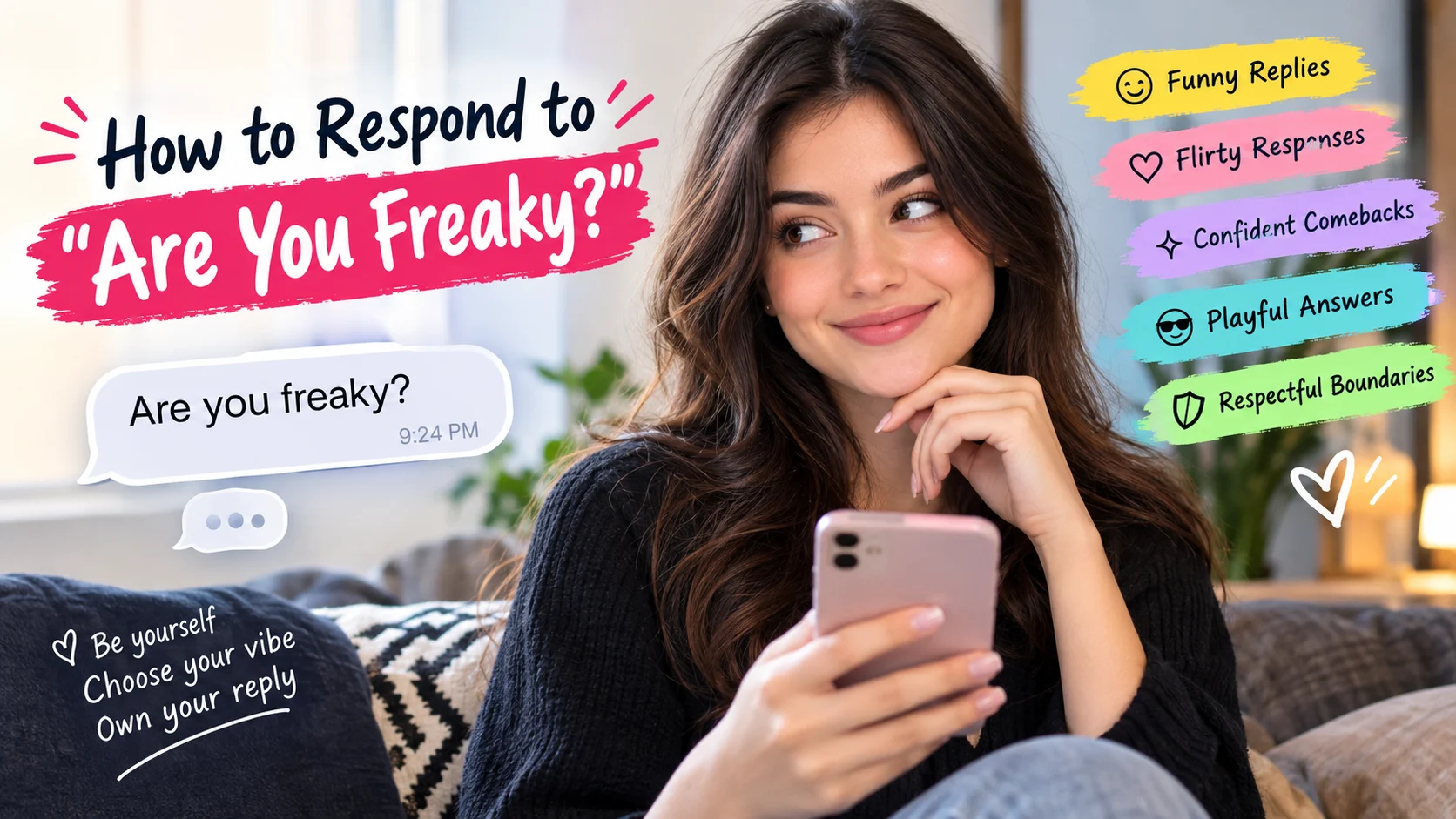
When someone asks, “Are you freaky?”, they’re usually trying to find out how adventurous, playful, or open-minded you are. The question can be innocent, teasing, flirtatious, or more personal depending on the relationship and the tone of the conversation.
Knowing how to respond to “are you freaky?” gives you the freedom to match their energy without saying more than you’re comfortable with. Whether you want a funny comeback, a flirty response, a confident boundary, or a simple answer, the best reply is one that feels natural to you.
1. Give a Playful “Maybe” Response
Best for: Keeping the conversation mysterious and playful.
Alternative: “Maybe you’ll find out someday.”
Examples:
“Maybe… depends who’s asking.”
“You’ll have to keep wondering.”
A playful “maybe” avoids giving away too much while keeping the conversation light.
2. Turn the Question Back on Them
Best for: When you want them to reveal their intentions first.
Alternative: “Why do you ask?”
Examples:
“What makes you curious?”
“Are you asking for yourself?”
Turning the question around can make the conversation more interesting without committing to a particular answer.
3. Give a Confident Answer
Best for: When you are comfortable being direct.
Alternative: “I’d say I’m pretty adventurous.”
Examples:
“I’m definitely not boring.”
“I have a playful side.”
Confidence works well when you want to sound relaxed rather than nervous or defensive.
4. Use a Funny Comeback
Best for: Casual conversations where humor fits.
Alternative: “That information is classified.”
Examples:
“Nice try, detective.”
“That’s above your clearance level.”
Humor can take the pressure off while keeping the exchange entertaining.
5. Keep It Mysterious
Best for: Flirty conversations where you don’t want to overshare.
Alternative: “Some things are better discovered naturally.”
Examples:
“I’m full of surprises.”
“You’ll have to get to know me first.”
A little mystery can keep the conversation engaging without becoming too personal.
6. Say You’re Playful, Not “Freaky”
Best for: When you want to describe yourself more comfortably.
Alternative: “I’m more playful than freaky.”
Examples:
“I’d call myself adventurous.”
“I like keeping things fun.”
This gives you control over the label while still answering the question.
7. Give a Simple “No”
Best for: When you aren’t interested in that kind of conversation.
Alternative: “Not really.”
Examples:
“No, that’s not really me.”
“I’m pretty low-key.”
A short answer is completely enough. You don’t owe anyone a detailed explanation.
8. Set a Clear Boundary
Best for: When the question feels too personal.
Alternative: “I’d rather not discuss that.”
Examples:
“That’s a little personal for me.”
“I keep that part of my life private.”
A respectful boundary can end the topic without creating unnecessary tension.
9. Ask What They Mean
Best for: When the question is vague.
Alternative: “What do you mean by freaky?”
Examples:
“That’s a pretty broad question—what exactly do you mean?”
“Define ‘freaky’ first.”
The word can mean different things to different people, so clarification can prevent misunderstandings.
10. Respond With Light Teasing
Best for: Friendly or flirtatious banter.
Alternative: “You seem very curious about me.”
Examples:
“Someone has questions today.”
“Wow, straight to the interesting questions.”
Teasing keeps the exchange fun without requiring a serious answer.
11. Say “Depends on the Person”
Best for: A confident but non-specific response.
Alternative: “It depends on the situation.”
Examples:
“Depends on who I’m comfortable with.”
“Trust and chemistry make a difference.”
This response acknowledges that personal boundaries and comfort levels matter.
12. Keep It Cute
Best for: Light flirting without getting too serious.
Alternative: “I’m sweet with a mischievous side.”
Examples:
“Maybe just a tiny bit.”
“I can be surprisingly playful.”
A cute response works especially well when the conversation is already warm and casual.
13. Use a Sarcastic Reply
Best for: Someone who asks unexpectedly.
Alternative: “What gave you that impression?”
Examples:
“Is this an interview?”
“Should I prepare a résumé for this question?”
Sarcasm can redirect an awkward question into harmless humor.
14. Be Honest About Your Personality
Best for: Someone you genuinely want to get to know better.
Alternative: “I’m adventurous in some ways, but I have boundaries.”
Examples:
“I like trying new things, but I’m selective.”
“I’m playful when I’m comfortable with someone.”
Honesty helps create clearer expectations than pretending to be someone you’re not.
15. Say “You’ll Have to Get to Know Me”
Best for: Building curiosity.
Alternative: “That’s something you discover over time.”
Examples:
“Get to know me first.”
“You might be surprised.”
This keeps the response confident while moving the conversation toward genuine connection.
16. Give a One-Word Answer
Best for: Quick texting conversations.
Alternative: “Maybe.”
Examples:
“Sometimes.”
“Possibly.”
Short answers can be surprisingly effective when you don’t want to overthink your response.
17. Say You’re Adventurous
Best for: When “freaky” feels like the wrong word.
Alternative: “I’m definitely adventurous.”
Examples:
“I enjoy trying new experiences.”
“I’m open-minded when I’m comfortable.”
This lets you answer honestly using language that better reflects your personality.
18. Use “Why, Are You?”
Best for: Turning the flirtation back toward them.
Alternative: “What about you?”
Examples:
“Why, are you testing the waters?”
“Are you trying to tell me something?”
It creates an opportunity for the other person to explain why they asked.
19. Respond With Confidence and Boundaries
Best for: When you want to flirt without oversharing.
Alternative: “I’m playful, but I know my boundaries.”
Examples:
“I like fun conversations, but I move at my own pace.”
“I’m open-minded, but comfort comes first.”
Confidence doesn’t require revealing personal details.
20. Say You’re Not Into Labels
Best for: When you dislike the word “freaky.”
Alternative: “I don’t really label myself that way.”
Examples:
“I’d rather describe myself as open-minded.”
“I don’t think one word defines me.”
This is a thoughtful response when the question feels too simplistic.
21. Give a Flirty but Respectful Reply
Best for: Mutual flirting between adults.
Alternative: “Maybe you’re asking the wrong person the right question.”
Examples:
“That depends on the chemistry.”
“You’re definitely curious, aren’t you?”
Keep the tone suggestive but respectful rather than making the conversation unnecessarily explicit.
22. Use “That’s for Me to Know”
Best for: Maintaining privacy with confidence.
Alternative: “I like keeping some things mysterious.”
Examples:
“That’s personal information.”
“I’ll let you keep guessing.”
This response works when you want to maintain some mystery.
23. Change the Subject Smoothly
Best for: When you don’t want to discuss the topic.
Alternative: “Anyway, how was your day?”
Examples:
“Let’s talk about something more interesting.”
“Speaking of random questions, what are you up to?”
Changing the subject is a simple way to move away from an uncomfortable conversation.
24. Tell Them You’re Private
Best for: New acquaintances or online conversations.
Alternative: “I don’t share personal stuff like that quickly.”
Examples:
“I’m pretty private about those things.”
“That’s something I only discuss with people I trust.”
Privacy is a perfectly reasonable reason not to answer.
25. Respond With “You Tell Me”
Best for: Playful banter.
Alternative: “What’s your guess?”
Examples:
“What do you think?”
“You seem to have an opinion already.”
This puts the conversational spotlight back on them.
26. Be Direct About Comfort
Best for: When you want to establish expectations.
Alternative: “I’m comfortable talking about some things, but not everything.”
Examples:
“I prefer getting to know someone first.”
“I don’t rush personal conversations.”
Direct communication can prevent the conversation from moving somewhere you don’t want it to go.
27. Use a Clever One-Liner
Best for: Social media, texting, or casual banter.
Alternative: “That question came out of nowhere.”
Examples:
“Bold question.”
“You really skipped the small talk, huh?”
A clever one-liner acknowledges the question without giving a personal answer.
28. Say “Maybe, Maybe Not”
Best for: Keeping things ambiguous.
Alternative: “That depends.”
Examples:
“Maybe. I’m unpredictable.”
“Maybe not—you’ll have to guess.”
This is useful when you want to keep the conversation playful without becoming too revealing.
29. Give a Mature Response
Best for: Meaningful conversations with someone you trust.
Alternative: “I think comfort, trust, and mutual respect matter more than labels.”
Examples:
“I don’t define myself by that word.”
“For me, boundaries and mutual comfort are important.”
A mature answer shifts attention from labels to communication and mutual respect.
30. Choose Your Own Level of Response
Best for: Any situation where you want complete control over the conversation.
Alternative: “I’ll answer what I’m comfortable answering.”
Examples:
“That’s something I decide when I know someone better.”
“I’m happy to talk, but I have boundaries.”
The best response to “Are you freaky?” is ultimately the one that matches your personality, comfort level, and relationship with the person asking.
FAQs About How to Respond to “Are You Freaky?”
1. What does “Are you freaky?” usually mean?
It can be a playful, flirtatious, or personal question asking whether someone is adventurous or open-minded. The exact meaning depends on the context and relationship.
2. What is a good funny response to “Are you freaky?”
Try something like, “That information is classified,” or “Nice try, detective.” Humor lets you keep the conversation light without sharing personal details.
3. How do I respond if I don’t want to answer?
You can simply say, “That’s a little personal,” or “I’d rather not answer that.” A clear, polite boundary is enough.
4. How can I respond flirtatiously without oversharing?
Keep your answer playful and vague. For example, “Maybe you’ll find out,” or “You seem very curious about me.”
5. Should I answer honestly?
If you feel comfortable, honesty is usually the clearest approach. However, you can also keep personal information private and choose how much you want to share.
Conclusion
Knowing how to respond to “Are you freaky?” is less about finding one perfect comeback and more about choosing a response that fits the moment. You can be funny, mysterious, confident, playful, direct, or simply set a boundary.
Whether you’re texting a new person, talking with someone you’re dating, or handling an unexpected question, remember that you control how much you reveal. A natural response that respects your comfort level will always feel better than forcing yourself to match someone else’s energy.

I’m Victor Daniel, a passionate writer at ReplyLop. I enjoy creating helpful, friendly, funny, and thoughtful replies that make conversations easier, clearer, and more engaging.